
What Helps Young Soccer Players Improve Most?
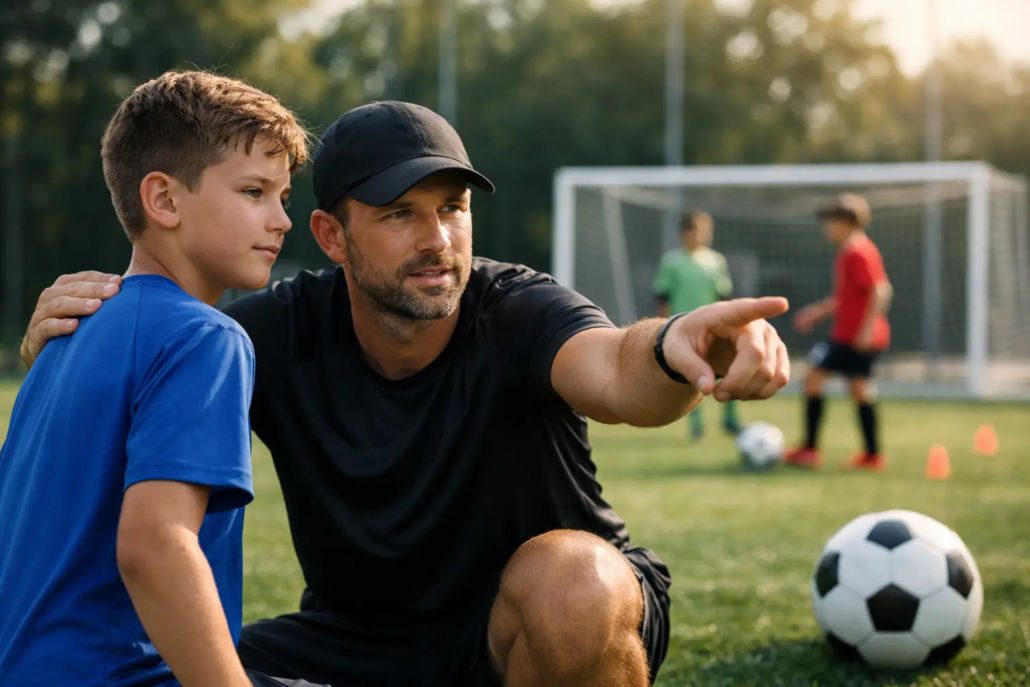
A young player can look outstanding in a warm-up and still struggle when the game gets fast, crowded, and unpredictable. That gap is where real development happens. Parents often ask what helps young soccer players improve, and the answer is not simply more games, more drills, or more expensive equipment. Improvement comes from a consistent system that develops technical skill, decision-making, movement, confidence, and discipline at the right pace for the player.
For a beginner, progress may mean learning to control the ball without looking down. For a competitive player, it may mean receiving under pressure, scanning before the ball arrives, and making the next action faster. Both players need a plan. The difference is the starting point, not the standard.
What Helps Young Soccer Players Improve Over Time
The strongest young players are rarely built by one great session. They are built through quality repetitions over months and years. A player needs coaching that identifies what to work on, enough meaningful touches to make the skill reliable, and game situations that force them to use that skill under pressure.
This is why random training can create activity without creating progress. A player may sweat, shoot, and enjoy the session, but without a clear objective, the same weak habits can remain. Development should have a purpose: improve first touch on the back foot, build confidence using the weaker foot, sharpen change-of-direction mechanics, or teach the player how to recognize a passing lane before it opens.
Parents should look for visible progress in the details. Is the player more balanced when turning? Do they protect the ball better? Are they looking around before receiving? Can they recover after a mistake rather than disappearing from the game? Those changes are more valuable than a highlight clip from one weekend.
Technical Training Must Be Deliberate
Ball mastery is the player’s foundation. Without comfort on the ball, tactical instruction has limited value because the player is still spending too much attention trying to control the next touch. Young players need frequent, intentional work on dribbling, receiving, passing, striking, turning, and using both feet.
The word intentional matters. Repeating a move at half speed with no defender has a place, especially for beginners learning coordination. But players eventually need to perform the same action with time pressure, limited space, and a consequence for losing the ball. That is how a skill moves from practice to competition.
A quality session should progress from clean technique to decision-making. A player may first rehearse a receiving pattern, then receive with a defender closing down, then use that same receiving skill in a small-sided game. The progression teaches more than mechanics. It teaches timing, awareness, and composure.
The Weaker Foot Cannot Be Optional
Young players naturally favor one foot. That is normal. Allowing the weaker foot to remain ignored, however, limits the player’s future options. A one-footed player needs extra touches to turn, sees fewer passing angles, and becomes easier to defend.
The goal is not to make every player perfectly two-footed overnight. The goal is to make the weaker foot trusted enough to receive, pass, dribble away from pressure, and finish simple chances. Consistent small doses of weaker-foot work are more effective than occasional marathon sessions.
Better Decisions Make Skills Matter
Soccer is not a drill sport. A player does not get several seconds to admire a clean first touch or choose the ideal pass. The best decision may be a simple pass, a quick turn, a shield, or even a reset backward. Young players improve when they learn to read the picture before the ball reaches them.
Coaches can build this habit by asking better questions. What did you see before you received? Where was the pressure? Why was the far-side pass available? This approach develops independent thinkers instead of players who wait to be told every move.
Small-sided games are especially valuable because they increase touches and decisions. In a 3v3 or 4v4 environment, every player is involved in attacking, defending, transition, and problem-solving. There is no place to hide. For younger players, this format often teaches more than standing in a large-sided game and touching the ball only a few times.
Video feedback and technology can also help when used correctly. Tools that measure reaction time, passing accuracy, foot speed, or movement patterns give players evidence of where they stand. Data should guide the next training focus, not become a substitute for coaching. A number matters only when the player understands how to improve it.
Athletic Development Supports the Soccer Player
Technical quality must be paired with movement quality. Speed is valuable, but speed without balance, deceleration, coordination, and body control can lead to inefficient movement and unnecessary injury risk. Young athletes need to learn how to accelerate, stop, land, change direction, and compete physically in age-appropriate ways.
For preteen players, athletic development often looks like coordination, agility, body awareness, and confidence moving in different directions. As players mature, strength, power, and speed training can become more structured. The right progression depends on age, physical maturity, training history, and the player’s individual needs.
This is one area where more is not always better. A player already carrying a heavy club schedule may not need additional high-intensity sessions every day. They may need recovery, mobility, technical work at a lower load, or a better balance between field training and strength development. Serious progress requires smart workload management, not constant exhaustion.
Consistency Beats the Occasional Big Week
A player who trains with focus two or three times each week for a full season will usually outgrow the player who trains intensely for one week before tryouts and then disappears. Development rewards consistency because soccer skills are physical and cognitive habits. Habits fade when they are not reinforced.
At home, short training blocks can make a real difference. Ten focused minutes of juggling, wall passing, ball manipulation, or weaker-foot touches adds up over time. The key is quality. Players should set a specific target, track it, and stop before sloppy repetition becomes the standard.
Parents can support this without turning the driveway into a pressure chamber. Encourage the work, provide the routine, and let the player own the responsibility. Ask what they improved rather than asking only whether they scored. The player who learns to value preparation develops a stronger long-term relationship with the sport.
The Right Coach Creates a Clear Pathway
Young players need more than encouragement. They need correction, standards, and a coach who can distinguish between a temporary mistake and a pattern that needs attention. A qualified coach sees whether a player’s first touch is poor because of body shape, scanning, timing, confidence, or a lack of technical repetition. Each cause requires a different solution.
The best training environment also groups players thoughtfully. A player needs enough challenge to stretch beyond current ability, but not so much that every session becomes survival. Beginners benefit from patient instruction and confidence-building touches. Advanced players need tighter pressure, faster decisions, and accountability in the details.
At Soccer Field Academy, that pathway can move from early coordination and ball familiarity to structured technical training, private coaching, performance work, and elite preparation. The value is not simply having more programs. It is having a progression model that gives each player the next right challenge.
Confidence Comes From Evidence
Real confidence is not loudness or praise after every rep. It is the belief that a player can handle a difficult moment because they have prepared for it. When a player has practiced receiving under pressure hundreds of times, they are more likely to demand the ball in a match. When they have improved their speed or reaction time through measurable work, they carry that proof into competition.
Mistakes are part of that process. A young player who loses the ball should learn to react, recover, and try again. Coaches and parents should avoid treating every mistake as a crisis. High-level players make mistakes too. The difference is that they respond quickly and keep making purposeful decisions.
The next improvement is usually not hidden in a dramatic new trick. It is in one honest assessment, one focused training goal, and one more quality repetition than yesterday. Give young players the coaching, structure, and patience to build those habits, and their confidence will have something real to stand on.

