
How to Develop Weak Foot Soccer Skills Fast
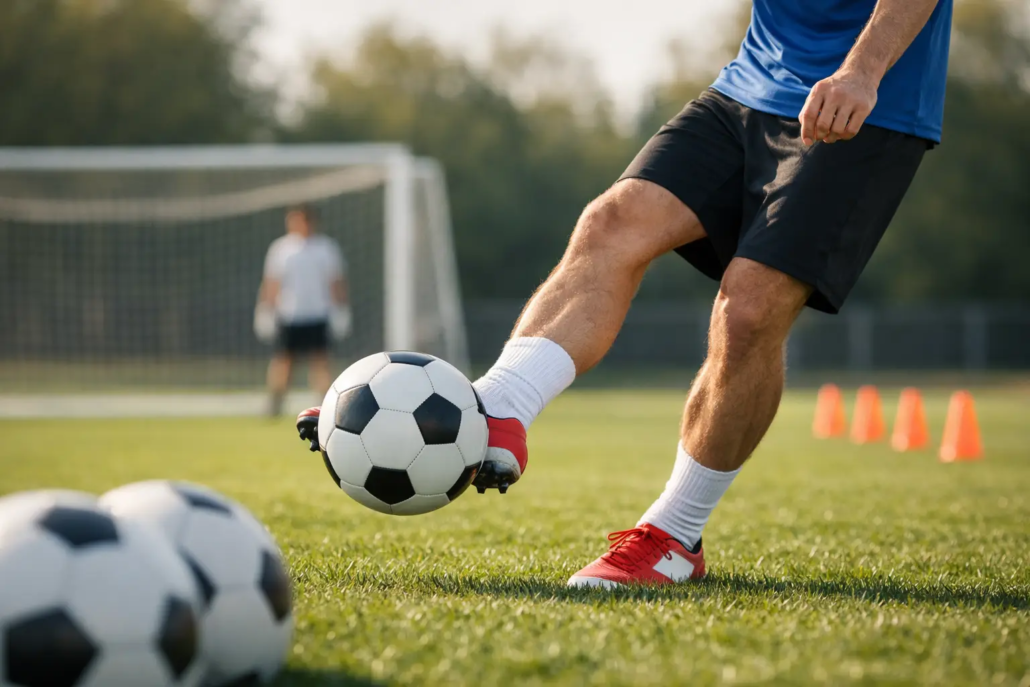
A player who can only pass, receive, or finish on one side becomes predictable quickly. Defenders read the body shape, close the preferred lane, and force rushed decisions. Learning how to develop weak foot soccer ability is not about making both feet identical. It is about building enough technical confidence that a player can keep the ball, attack space, and make the right decision under pressure.
For young players, the weak foot is often avoided because it feels slower and less accurate. That avoidance becomes a habit. The answer is not random repetition or kicking a ball with the non-dominant foot for five minutes after practice. Real progress comes from a disciplined plan that moves from clean technique to speed, pressure, and game application.
Why a Strong Weak Foot Changes the Game
Two-footed players have more solutions. They can receive away from pressure, pass through either lane, finish from tighter angles, and change direction without telegraphing the next action. At higher levels, that extra half-second matters. A defender who expects a right-footed player to cut inside can be beaten when the player drives, passes, or shoots with the left instead.
For parents, this is a long-term development issue rather than a quick technical fix. A young player with a developing weak foot may look uncomfortable at first. That is normal. The priority is building coordination and confidence early, before the player becomes reliant on one predictable pattern.
The goal also depends on the player. A beginner may need to use the weak foot comfortably for simple passes and dribbling. A competitive midfielder needs to receive and play forward with either foot under pressure. A forward needs the ability to finish first time on both sides. The standard rises with the player’s age, position, and ambition.
How to Develop Weak Foot Soccer Technique First
Before adding speed, start with the details that create clean contact. Most weak-foot mistakes are not caused by a lack of effort. They come from poor balance, a locked ankle, an inconsistent plant foot, or a player trying to strike too hard before they can strike accurately.
For passing, the support foot should be beside the ball, with the chest controlled and eyes scanning between the ball and the target. The striking ankle needs to be firm. Players should begin with the inside of the foot because it provides the largest, most reliable passing surface. A crisp five-yard pass with the weak foot is more valuable than a wild 25-yard ball.
For shooting, teach the player to approach with balance and strike through the center of the ball before chasing power. A weak-foot finish should not look like panic. The player should arrive under control, place the shot into a target area, and recover quickly for a rebound or next action.
Receiving deserves equal attention. Many players can force a weak-foot pass in a drill but immediately shift the ball back to their dominant foot after receiving. Train the first touch with the non-dominant foot across the body, into space, and away from pressure. That first touch is often what creates the next pass, dribble, or shot.
Build Repetition Into Every Ball Contact
The weak foot improves when it is part of daily training, not a separate skill reserved for one session per week. Short, focused blocks work well for youth players because they create high-quality repetitions without sacrificing technique through fatigue.
A player can complete this 20-minute technical block four to six days per week:
- Spend five minutes using only the weak foot for ball mastery: toe taps, sole rolls, inside touches, outside touches, and pull-push movements.
- Pass against a wall for five minutes, beginning at close range and aiming for a specific target with the inside of the weak foot.
- Receive and play for five minutes: take the return pass with the weak foot, move the ball across the body, then pass again with that same foot.
- Finish with five minutes of weak-foot striking, using small targets before increasing distance or adding movement.
Quality matters more than inflated numbers. If a player completes 100 weak-foot passes with poor posture and rushed contact, they are repeating the wrong movement. Start with a manageable target, such as 30 accurate passes in a row from a set distance, then increase the challenge when the standard is met.
Parents can help by tracking simple benchmarks: weak-foot passing accuracy, successful first touches, and shots hit on target. Visible data gives players proof that the work is producing progress. It also keeps training focused on execution instead of vague effort.
Move From Isolated Drills to Game Pressure
Technical drills build the foundation, but games expose the real problem: players often abandon the weak foot when defenders, teammates, and time pressure enter the picture. Training must eventually force the decision.
Start with constrained small-sided games. In a 3v3 or 4v4 environment, a coach can award an extra point for a goal scored with the weak foot or require a weak-foot first touch in a designated zone. The purpose is not to punish the dominant foot. It is to create enough repetition that players recognize weak-foot opportunities naturally.
Directional receiving drills are equally effective. Set up a player with a defender behind them and a target on either side. The player must scan, receive with the foot farthest from pressure, and play toward the open target. Sometimes that will be the weak foot. Sometimes it will not. This is a critical distinction: elite development is not about forcing the weak foot in every situation. It is about giving the player the ability to choose the best option.
As confidence grows, add time limits, moving passes, and live defenders. A player who can pass with their weak foot while standing still has started the process. A player who can use it after scanning, receiving at speed, and absorbing pressure is becoming harder to defend.
Train Dribbling and Finishing on Both Sides
Weak-foot development is often reduced to passing, yet dribbling and finishing are where players become truly unpredictable. A winger who can drive outside and cross with either foot creates better service. A central player who can escape pressure on either side protects possession. A striker who can finish across goal with either foot doubles the threat inside the box.
For dribbling, use gates and changes of direction. Have the player enter a gate with the weak foot, take two or three controlled touches, then exit at speed using the outside of that foot. The outside touch is especially valuable because it helps players accelerate without always shifting the ball back to their preferred side.
For finishing, begin with passes rolled from different angles. A player should practice first-time and two-touch finishes with the weak foot, then progress to receiving on the move. Keep the target specific. Rather than simply telling a player to shoot, give them a corner, a small gate, or a zone to hit. Precision builds belief.
Do not overlook crosses and longer passes for advanced players. Those actions require more strength and timing, so they should come after the player owns the basics. Trying to hit long diagonal balls too early can reinforce bad mechanics. Build the striking pattern from short distance outward.
Common Mistakes That Slow Development
The biggest mistake is allowing a player to avoid the weak foot whenever the drill becomes difficult. If every mistake leads to an immediate switch back to the dominant foot, the player never develops trust in the other side.
Another mistake is training only without movement. Soccer is not played from a stationary position. Players need to practice weak-foot actions after a sprint, while changing direction, and with a defender nearby. The technique may be less clean at first, but that is where game-ready improvement happens.
Finally, do not confuse more power with better technique. Young players often swing harder when the weak foot feels unreliable. Slow the action down. Improve balance, body shape, and contact. Speed and power can be added once accuracy becomes consistent.
Make Weak-Foot Work Measurable
Serious players need a standard. Set a baseline at the beginning of a training cycle: accuracy over 25 passes, successful weak-foot first touches through a gate, shots on target from a specific distance, and weak-foot actions used during small-sided games. Re-test every few weeks under the same conditions.
Technology-driven training can make this process more objective. Ball-touch systems such as SoccerBot360 can challenge both feet through timed passing, scanning, and reaction work, while speed and agility training improves the body control needed to use either foot after movement. At Soccer Field Academy, the strongest results come when technical repetition is paired with coaching feedback and clear performance targets.
The weak foot will not become reliable through occasional effort. Give it intentional repetitions, demand it in realistic game situations, and measure the improvement. Over time, the player who once avoided one side of the field becomes the player defenders cannot easily predict.

