
Why Do Soccer Players Need Strength to Excel?
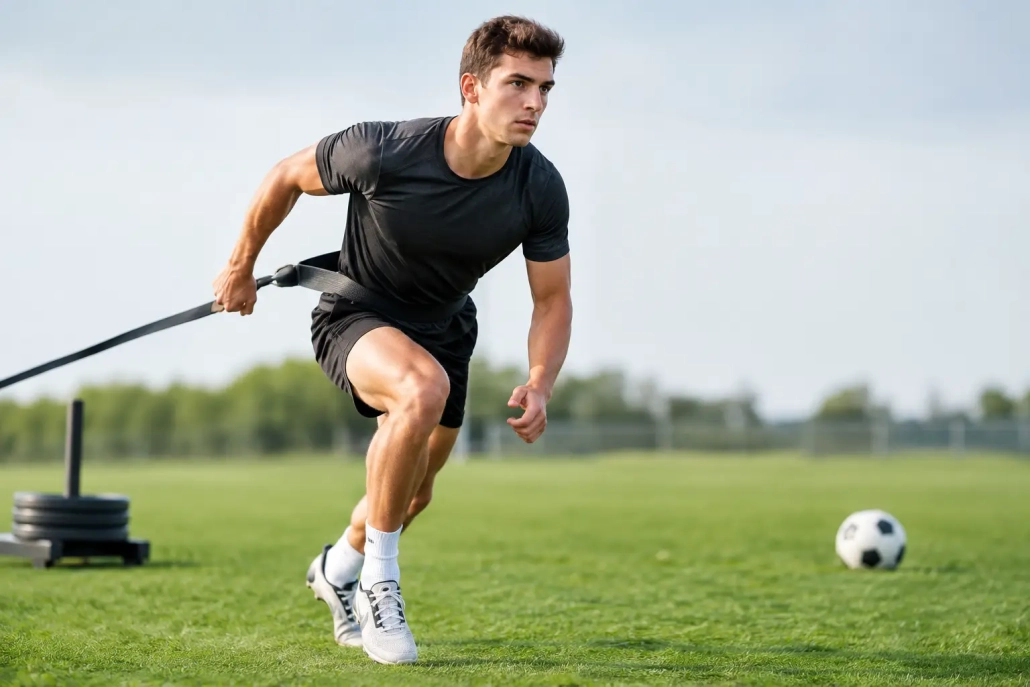
The strongest player on the field is not always the biggest. Often, it is the player who stays balanced through contact, wins the second ball, accelerates after a cut, and still has control of the ball late in the match. That is why do soccer players need strength is a question every serious player and parent should understand. Strength is not about building a bodybuilder’s physique. It is about building a more capable soccer athlete.
For youth players, the right strength work supports the skills coaches want to see every weekend: cleaner changes of direction, stronger first steps, better body positioning, and confidence in competitive moments. Technical ability remains essential, but technique is far more effective when a player has the physical foundation to execute it under pressure.
Why Do Soccer Players Need Strength?
Soccer is a repeated sprint sport. Players accelerate, decelerate, jump, land, turn, shield, tackle, strike, and recover hundreds of times during a game. Each action places demands on the legs, hips, core, and upper body. A player who cannot control those demands may still have excellent footwork in an unopposed drill, but struggle when the game gets faster and more physical.
Strength gives players more control over their own bodies. It helps them hold their position while receiving with pressure from behind, stay upright after a shoulder challenge, and plant safely before changing direction. It also improves how efficiently force moves from the ground through the body and into a sprint, pass, or shot.
This does not mean every young player needs a barbell program. A 7-year-old needs movement literacy, coordination, and body control. A high school athlete preparing for varsity, club showcases, or college soccer may benefit from a more structured progressive resistance program. The goal changes with age, maturity, training history, and competitive demands.
Strength Improves the Actions That Decide Matches
A soccer player rarely needs strength in isolation. They need it in the moments where a fraction of a second or a few inches of position changes the outcome.
Better acceleration and change of direction
Speed starts with force. When a player pushes into the ground, the ground pushes back. Stronger legs and hips can help a player produce more force during the first few steps of a sprint, which matters when chasing a through ball or recovering defensively.
Strength also matters when slowing down. Deceleration is one of the most overlooked athletic skills in youth soccer. A player who can brake under control can cut more sharply, react to a defender’s movement, and avoid losing balance before the next action. Training the glutes, hamstrings, quads, calves, and core helps athletes absorb force before they redirect it.
More stability in contact
Soccer is a contact sport, even when the contact is not dramatic. Players lean into opponents, protect the ball near the sideline, battle for headers, and compete for loose balls in crowded spaces. A stronger athlete is not automatically more aggressive, but they are harder to move off the ball.
Core strength is especially valuable here. The core transfers force between the lower and upper body and helps the player maintain posture while turning, shooting, or absorbing contact. For a midfielder receiving in traffic or a forward posting up with their back to goal, this stability can turn a turnover into a successful next pass.
More powerful soccer-specific skills
A powerful shot is not created only by swinging the leg harder. It begins with a stable plant foot, hip control, trunk rotation, and a coordinated transfer of force. The same principle applies to long passes, goal kicks, jumping for headers, and explosive takeoffs.
Strength training will not replace technical repetition. Players still need thousands of quality touches, passing patterns, finishing reps, and game-like decisions. But strength gives those technical actions a stronger platform. When fatigue rises or pressure arrives, the player has a better chance of maintaining mechanics.
Strength Training Helps Reduce Injury Risk
No program can guarantee an injury-free season. Soccer involves unpredictable movement, contact, playing surfaces, growth spurts, and accumulated fatigue. Still, a well-designed strength program can help players become more resilient.
Many youth soccer injuries occur when an athlete cannot control a landing, knee position, or change of direction. Teaching players to squat, hinge, lunge, brace, jump, and land with good mechanics creates habits that carry onto the field. Strong hamstrings and hips are particularly important for sprinting and knee control, while calf and ankle strength can support stability during cutting and landing.
For growing athletes, consistency matters more than intensity. Two focused sessions per week can be more valuable than an occasional exhausting workout. Players need enough challenge to adapt, but not so much volume that it takes away from technical training, recovery, sleep, or enjoyment of the game.
Youth Strength Training Is Not About Lifting Heavy Too Soon
Parents sometimes hear “strength training” and picture young athletes attempting adult lifting routines. That is not the standard. Quality youth performance training begins with coaching, technique, and progression.
For younger players, effective strength work may look like crawling patterns, single-leg balance, controlled jumping, bodyweight squats, lunges, carries, and age-appropriate games that develop coordination. These movements teach athletes how to own their space and control their bodies.
As players develop, resistance can be added through bands, medicine balls, dumbbells, sleds, and eventually barbells when the athlete has demonstrated consistent movement quality. The load is only one variable. Tempo, range of motion, posture, balance, and intent all matter.
A strong program also avoids treating every athlete the same. A player returning from an injury, entering a rapid growth phase, or training four nights per week with a club needs a different plan than a player beginning performance work for the first time. The best training meets the athlete where they are and progresses with purpose.
The Mental Advantage of Getting Stronger
Physical preparation changes more than physical performance. It can change how a player sees the game.
A player who trusts their balance is more willing to receive under pressure. A player who feels explosive is more likely to attack space. A defender who knows they can recover after being beaten is less likely to panic. That confidence does not come from empty motivation. It comes from repeated proof in training that the body can handle the demands of competition.
This is especially meaningful for youth athletes navigating growth, new levels of competition, and the physical differences that can show up between players of the same age. Strength training gives them controllable progress markers. They may not control their height, opponents, or playing time, but they can improve their movement quality, sprint mechanics, jumping ability, and resilience through disciplined work.
How to Build Strength Without Losing the Soccer Focus
Strength training should support soccer, not compete with it. The highest-priority work for a developing player remains quality coaching, ball mastery, decision-making, and game understanding. Performance work is the multiplier that helps those skills show up more consistently.
Start with two age-appropriate sessions per week, particularly during the season. Each session should include a movement preparation phase, lower-body strength, core control, upper-body pulling and pushing, and landing or acceleration mechanics. Keep the work focused. A player does not need to be exhausted to have trained effectively.
In the offseason, athletes may be able to build more strength because match demands are lower. In a heavy tournament period, the emphasis may shift toward maintenance, mobility, and recovery. That is why a generic workout pulled from social media is rarely the answer. Context matters.
At Soccer Field Academy, performance training can give Columbus players a structured environment to develop movement quality and athletic confidence alongside their technical game. The purpose is not simply to work harder. It is to make each training hour produce measurable progress.
The player who commits to getting stronger is not choosing strength instead of soccer. They are building the physical base that allows their soccer ability to show up when the match gets fast, physical, and demanding. Grind now, shine later.