Soccer Coaching That Builds Complete Players
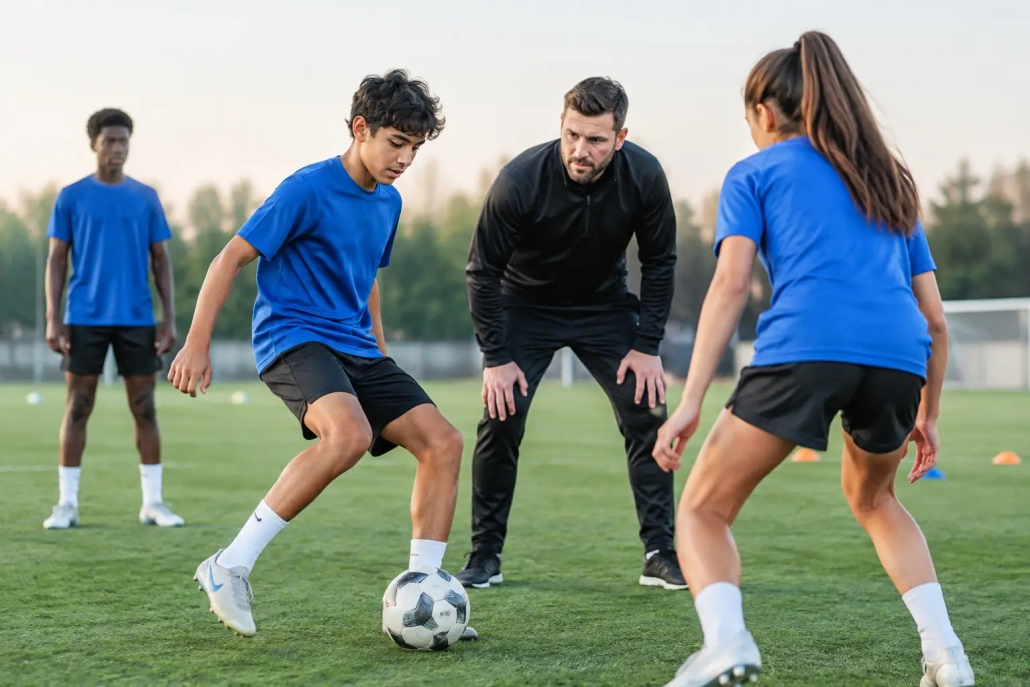
A player receives the ball with a defender closing quickly. The next touch, scan, and decision happen in seconds. That moment is where effective soccer coaching shows up. It is not measured by how many cones a player dribbles through alone. It is measured by whether they can control the ball, recognize pressure, and make a confident choice when the game speeds up.
For youth players, the right training environment builds far more than foot skills. It creates habits: arriving ready to work, responding to coaching, competing with purpose, and understanding that improvement comes from repeated, focused effort. Parents should expect that development to be visible over time, not promised after one session.
What Great Soccer Coaching Actually Develops
Strong soccer coaching gives players a complete development plan. Technical ability matters, but a player who can perform a move in isolation and cannot use it under pressure is not yet prepared for competitive matches. The goal is to connect technique to decision-making, movement, athleticism, and confidence.
At younger ages, coaching should make players comfortable with the ball. They need thousands of touches, coordination work, balance, and games that make movement enjoyable. A 4-year-old does not need a tactical lecture. They need a coach who can teach listening, movement, sharing space, and basic ball control through age-appropriate activities.
As players grow, the demands change. Around the developmental years, they need sharper first touches, stronger weak-foot ability, cleaner passing, and the courage to take on defenders. Older competitive players need more: speed of play, tactical awareness, positional discipline, physical preparation, and the ability to perform after mistakes.
The best programs do not treat every player the same. A beginner may need confidence to use their right foot. A high-level winger may need to improve receiving under pressure, changing pace, and delivering a final ball. Both need coaching. Their roadmaps should not look identical.
Soccer Coaching Must Connect Training to the Game
A common mistake in youth development is confusing activity with progress. Players can be busy for an hour without being challenged in the areas that will change their game. Training needs a purpose, a standard, and a progression.
A quality session often begins by establishing a technical theme, such as receiving, dribbling, finishing, or passing. But it should not end there. Players must then apply that theme in increasingly difficult situations. Can they receive with the correct body shape? Can they recognize the defender’s position? Can they execute when tired, rushed, or competing for a result?
This is why game-based training matters. Small-sided games create more touches, more decisions, and more moments of pressure than players often experience in a full-sided match. They reveal whether a player scans before receiving, protects the ball, recognizes an overload, or forces a low-percentage play.
Repetition is still essential. Players need time to refine mechanics. The trade-off is that repetition without context can produce players who look polished in drills but hesitate in games. On the other hand, game play without technical correction can reinforce poor habits. The strongest coaching blends both: deliberate technical work followed by realistic decisions.
Train the First Touch Before the Highlight
Parents and players often focus on flashy skills, and creativity has value. But the first touch is usually more important than the trick that follows it. A positive first touch can take a player away from pressure, open the field, or create the next pass. A poor first touch turns a promising moment into a turnover.
Coaches should teach players to check their shoulder, prepare their body before the ball arrives, and choose where the ball should go next. That requires patience. It also requires an environment where players are allowed to make mistakes, receive clear feedback, and try again at a higher standard.
Build Players Who Can Think at Speed
Soccer is a cognitive game. Before the ball arrives, players need to gather information. Where is the pressure? Which teammate is free? Is there space to turn? What happens if the first option disappears?
Training that includes visual cues, timed decisions, directional play, and competitive constraints helps players process faster. Technology can support that work when it has a clear purpose. Tools such as SoccerBot360 and Speed Court can challenge reaction time, coordination, touch quality, and movement patterns while giving players measurable benchmarks. Technology is not a replacement for a coach. It is a way to make effort more visible and training more accountable.
The Coaching Standard Matters as Much as the Curriculum
A session plan is only as effective as the coach leading it. Youth players need instructors who understand the game, but knowledge alone is not enough. Great coaches can observe details, communicate them simply, and adjust a session when the group needs a different challenge.
Look for coaches who correct with clarity. “Work harder” is not a complete instruction. “Open your body before receiving so you can play forward on your second touch” gives a player something specific to apply. The same standard applies to encouragement. Empty praise may feel good for a moment, but earned confidence comes from players seeing that they can solve a difficult problem through preparation and repetition.
Credentials and playing experience can be useful indicators, particularly when paired with a proven developmental methodology. A licensed coach should understand age-appropriate training, match demands, physical development, and how to create a learning environment that is competitive without becoming destructive.
For parents, the key question is simple: does the coach know what your child needs next? A strong coach can explain the current focus, identify strengths and gaps, and outline a realistic path forward. That clarity is especially valuable for families navigating club soccer, supplemental training, tryouts, or college-prep goals.
Development Is Not a Straight Line
Players do not improve at the same pace. One athlete may make a rapid technical jump, then plateau while learning to handle pressure. Another may be physically behind peers for a season but develop exceptional awareness and become more influential later. Good coaching accounts for these changes instead of labeling players too early.
That is why a long-term pathway matters. Young children need an introduction to movement and the ball. Recreational players need foundational confidence and enjoyment. Competitive athletes need higher intensity, advanced technical demands, and feedback tied directly to performance. Elite players may need individual work that targets a specific position, weakness, or recruiting goal.
Soccer Field Academy is built around that progression, giving players ages 2 through 18 ways to move from foundational training into more demanding academy, private, and performance-focused environments. The value is not simply having more sessions available. It is having the right challenge at the right stage.
Year-round indoor training also changes the consistency of development, especially in Columbus. Weather should not determine whether a player gets quality touches, speed work, or coached repetition during key months of the year. Consistency does not mean training hard every day without recovery. It means maintaining a purposeful rhythm that supports growth across a full season.
How Parents Can Judge Whether Training Is Working
The scoreboard is not the only evidence of progress. Goals and wins matter, but youth players can influence games in ways that do not show up immediately in statistics. Watch for better first touches, more willingness to receive the ball, faster recovery after losing possession, improved use of both feet, and smarter choices in pressure moments.
Ask your player what they are working on. If they can explain a recent coaching point, they are starting to own their development. Ask the coach what success looks like for the next training cycle. The answer should be specific enough to observe: cleaner receiving, faster change of direction, stronger 1v1 defending, more accurate finishing, or improved conditioning.
Avoid chasing a new program every time progress feels slow. Consistent, high-quality soccer coaching needs time to take hold. At the same time, do not stay in an environment that offers no feedback, no progression, and no standard beyond keeping players occupied.
The right coach will challenge your player, support their confidence, and make the work meaningful. Give young athletes a clear standard, the tools to reach it, and enough time to build real habits. When they step into the next pressure moment, they will be ready to show what their training has earned.