How to Prevent Soccer Injuries in Young Players
A player who can train consistently has an advantage over the player who only trains hard in short bursts. To prevent soccer injuries, youth players need more than a warm-up before kickoff. They need a development plan that builds strong movement patterns, manages workload, and gives growing bodies enough time to recover.
For parents, the goal is not to eliminate every scrape, rolled ankle, or collision. Soccer is a fast, physical sport. The goal is to reduce avoidable injuries while helping players develop the strength, awareness, and confidence to compete at a higher level.
Prevent Soccer Injuries by Building Movement First
Many youth soccer injuries are not caused by one dramatic tackle. They develop when a player repeatedly cuts, lands, accelerates, or decelerates with poor control. A player may have excellent touch on the ball but still lack the single-leg stability, hip strength, or body positioning needed to handle the demands of the game.
This is why quality movement belongs in every player-development pathway. Young players should learn how to land softly with knees aligned over their feet, stop under control, change direction without collapsing inward, and absorb contact without losing balance. These skills support performance as much as safety. Cleaner deceleration can mean a faster change of direction. Better balance can mean a stronger first touch under pressure.
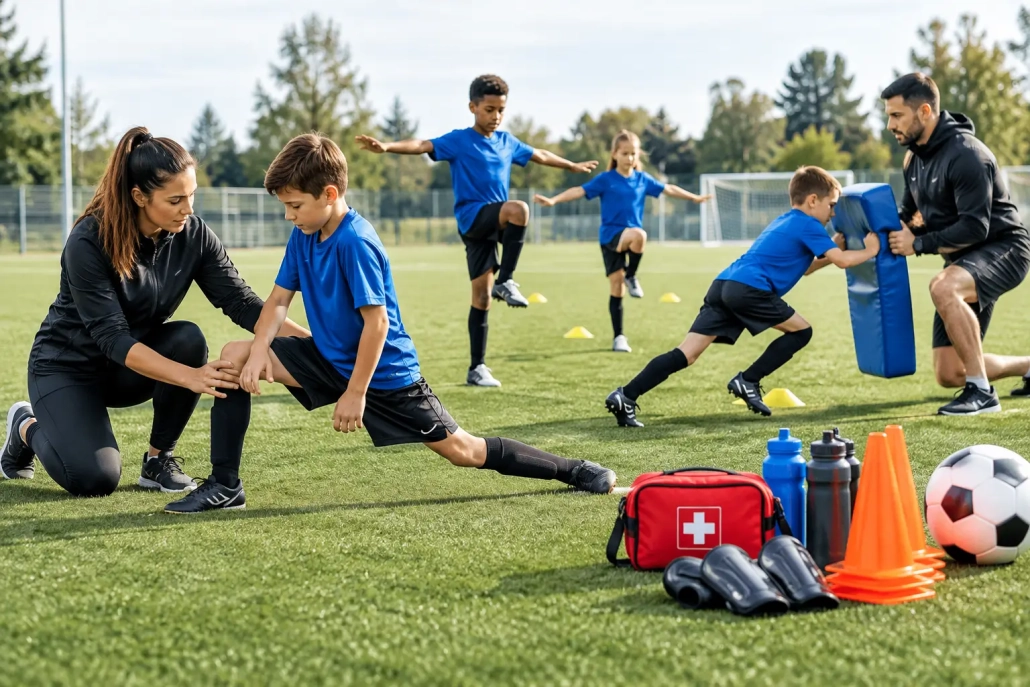
For younger athletes, movement training should feel athletic and engaging: hopping, skipping, balancing, racing, and reacting. As players mature, training can become more structured with sprint mechanics, strength work, agility patterns, and single-leg exercises. The progression matters. Asking an athlete to perform advanced plyometrics before they can control a basic landing is not elite development. It is unnecessary risk.
A Good Warm-Up Is Preparation, Not a Ritual
Static stretching alone does not prepare a player for sprinting, cutting, and striking the ball. Before training or matches, players need a dynamic warm-up that raises body temperature and rehearses game-ready movement.
A productive warm-up includes light running, mobility through the hips and ankles, controlled lunges, skips, activation exercises, and gradual accelerations. It should also include balance and change-of-direction work. The point is to prepare the nervous system for the speed of soccer, not simply fill ten minutes before practice begins.
The best warm-up is one players perform with focus. Coaches should correct poor technique rather than treating the warm-up as unstructured social time. A player who learns to move well at low speed is more likely to maintain better positions when the game becomes chaotic.
Manage Workload Before Fatigue Takes Over
Hard work drives progress. Too much hard work without enough recovery can drive overuse injuries, burnout, and declining performance. This balance is especially important for competitive youth players who may stack club practices, school soccer, private training, games, camps, and strength sessions into the same week.
Parents and players should look beyond the calendar. A 90-minute technical session is not the same physical demand as a tournament match with multiple high-intensity games. A player may be able to attend both, but the total load must make sense for their age, training history, sleep, and current condition.
Watch for patterns that signal a player needs adjustment: persistent soreness, unusual fatigue, a drop in speed or enthusiasm, recurring pain in the same area, or changes in running mechanics. Pushing through mild discomfort can sometimes turn a manageable issue into weeks away from the field.
Rest is not lost development. It is where the body adapts to training. A serious player needs at least one lighter day each week, and often more during demanding tournament periods. Off-seasons should include active recovery and a change of emphasis rather than year-round competition at maximum intensity.
Avoid the Weekend Tournament Trap
Tournament weekends can create a sharp spike in workload. Players may compete in several matches, spend long hours sitting between games, sleep poorly, and return to full training immediately afterward. That combination is hard on developing bodies.
Plan the days around a tournament with purpose. Keep the session before the event lighter, prioritize hydration and sleep, and use the next day for recovery or low-intensity technical work when possible. Not every post-tournament session needs to be another fitness test.
Strength Training Helps Players Stay Available
Properly coached strength training is one of the most valuable investments a youth player can make. It does not mean chasing heavy weights or training like an adult professional. It means developing control, coordination, and age-appropriate strength that supports the demands of the sport.
A well-designed program strengthens the glutes, hamstrings, calves, core, and upper body while teaching players to squat, hinge, push, pull, brace, and stabilize. These patterns help athletes sprint more efficiently, protect joints during cutting movements, and hold their position in challenges.
The details depend on the player. A growing 12-year-old with knee pain may need a different approach than a 17-year-old preparing for college soccer. Training history also matters. The right program meets the athlete where they are, measures progress, and increases difficulty only when movement quality earns it.
At Soccer Field Academy, performance training can complement technical development by giving players a structured environment to improve speed, reaction, coordination, and movement control. For players who train year-round indoors, that consistency can be a major advantage when it is paired with intelligent recovery.
Footwear, Fields, and Equipment Matter
The wrong cleat does not guarantee an injury, but poor footwear can affect traction, comfort, and confidence. Players should wear shoes that fit securely, match the playing surface, and are replaced when they are worn down or causing discomfort. Cleats that are too aggressive for a hard surface can create excessive grip during cutting, while worn-out footwear may reduce stability.
Shin guards should fit properly and be worn for every practice and game, not only for match day. Goalkeepers need equipment appropriate for their surface and training environment, especially during repetitive diving drills. For younger players, properly sized balls also matter. A ball that is too large or heavy changes striking mechanics and can encourage poor technique.
Parents should also pay attention to field conditions. Uneven grass, wet surfaces, hard ground, and slick indoor turf can all change how players move. Coaches can adjust activities, footwear recommendations, and intensity when conditions make high-speed drills less appropriate.
Recovery Is a Skill Young Players Can Learn
Elite habits are built away from the ball as well as on it. Sleep, nutrition, hydration, and honest communication all affect a player’s ability to train safely.
Young athletes need consistent sleep, particularly during growth spurts and heavy training blocks. A tired player reacts later, makes poorer decisions, and is more likely to lose control in a tackle or landing. Hydration should begin before practice, not after the player already feels thirsty. Meals should support training with enough carbohydrates for energy and protein for recovery, without turning youth sports nutrition into a complicated science project.
Most importantly, players need permission to speak up. A culture that praises toughness but ignores pain creates problems. There is a difference between normal training discomfort and pain that changes how a player runs, kicks, cuts, or sleeps. Parents and coaches should take recurring pain seriously, especially in the knees, heels, hips, groin, ankles, and lower back.
When a Player Should Stop and Get Evaluated
A player should come off the field after a head impact, suspected concussion, severe swelling, inability to bear weight, joint instability, or sharp pain. They should not return to play based on determination alone. The same is true when pain repeatedly returns during activity or causes compensations such as limping or avoiding one side of the body.
Medical evaluation is also wise when a player has pain that does not improve with rest, symptoms that interfere with daily activity, or a noticeable decline in movement. Qualified medical professionals should guide diagnosis and return-to-play decisions. Coaches can support the process, but they should not replace it.
The strongest youth players are not the ones who ignore every warning sign. They are the ones who build disciplined habits, train with purpose, and stay available long enough for their talent to compound. Protect the body, respect the process, and give every training session a reason.