Is One on One Soccer Coaching Worth It?
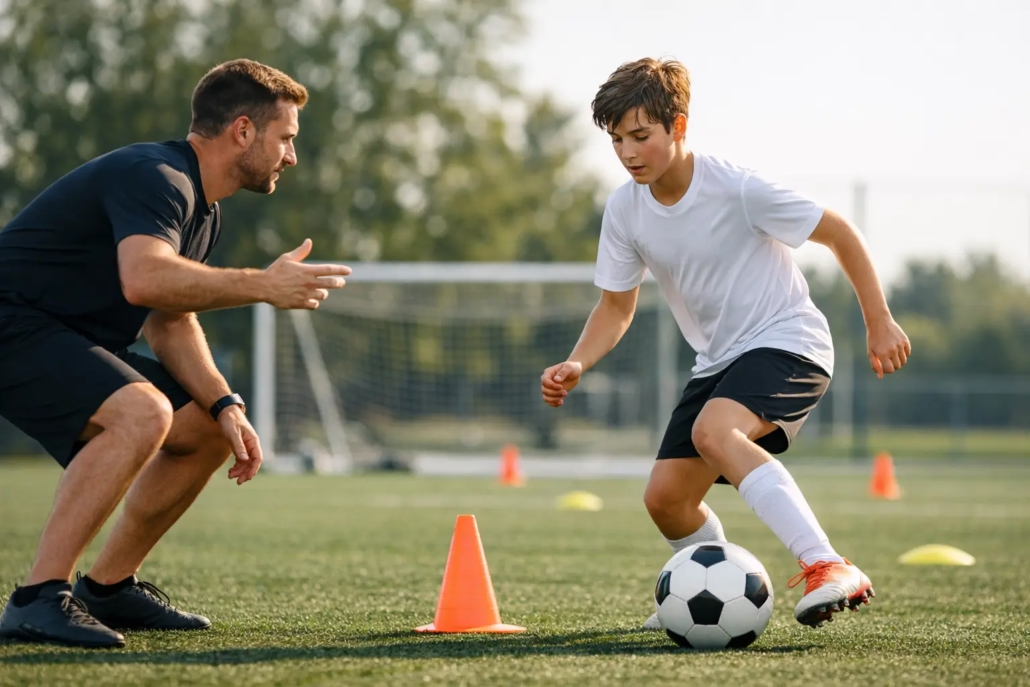
A player who touches the ball 300 times in a session will almost always develop faster than a player who waits through lines, traffic, and group pacing. That is the core value of one on one soccer coaching. It removes wasted reps, exposes weaknesses faster, and gives serious players a training environment built around their actual needs instead of the average pace of a team session.
For parents, the question is rarely whether personalized training can help. It can. The real question is when it makes sense, what it should focus on, and how to tell whether the investment is producing measurable progress. For players, especially those who want more than recreational improvement, private coaching can become the difference between staying stuck and making a real jump in confidence, execution, and decision-making.
What one on one soccer coaching actually does
Team training matters. Players need to learn spacing, timing, communication, and the rhythm of the game. But team environments are not designed to solve every individual issue. A coach with 14 to 18 players on the field cannot stop every repetition, correct every body shape, or tailor every drill to one athlete’s technical ceiling.
One on one soccer coaching changes that equation. The session can be built around first touch, striking mechanics, weak-foot development, scanning habits, change of direction, finishing under pressure, or position-specific work. Instead of splitting attention across a roster, the coach can watch details that usually go unchecked – ankle lock on contact, first-step explosiveness, receiving angles, hips before turning, timing of release, and recovery between actions.
That level of specificity matters because development is usually limited by small errors repeated hundreds of times. A player may be highly motivated and still plateau because those errors are never isolated and corrected with enough repetition.
Why some players improve much faster in private sessions
The biggest advantage is training density. In a strong private session, the player is engaged almost continuously. There is less standing, less waiting, and less hiding. Every technical action is visible. Every mistake has a consequence. Every correction can be applied immediately on the next rep.
There is also a psychological benefit. Many young players know they are struggling with something but cannot name it. Maybe their first touch pops up under pressure. Maybe they rush their finish. Maybe they look down too long when dribbling. In a private setting, those issues stop being vague frustrations and become trainable problems. That shift builds confidence because progress becomes visible.
For advanced players, the benefit is often even greater. Strong players do not need random volume. They need precise training. If a winger needs to sharpen end product after beating the first defender, or a center midfielder needs to receive on the half-turn more cleanly, private coaching can target that gap with far more efficiency than a generic team practice.
When one on one soccer coaching makes the most sense
It is not only for elite prospects. It can help beginners, developing players, and high-level athletes for different reasons.
A younger player may need one on one work to build comfort on the ball, improve coordination, and gain confidence before stepping into a more competitive environment. In that case, the goal is not pressure for pressure’s sake. It is technical foundation and a positive sense of mastery.
A mid-level player often benefits when progress has stalled. This is common around the ages when team play gets faster and technical flaws become more exposed. The player is working hard, but game speed starts to punish weak touch, poor mechanics, or limited awareness. Private coaching can address those bottlenecks before they become habits.
For serious competitive players, the need is usually about refinement. They may already train several times a week, but they need extra work that is intentional, measurable, and aligned with larger goals such as making a top team, earning more minutes, preparing for showcases, or building toward college-level expectations.
The right time depends on the player. If motivation is low and the athlete does not want more training, adding sessions may create resistance instead of growth. But if the player wants improvement and needs structure, private coaching can provide the missing edge.
What to expect from high-level one on one soccer coaching
Not all private training is equal. A quality session should look organized, demanding, and purposeful. It should not feel like random drills stitched together to make the hour look busy.
The best coaches begin with evaluation. They identify what the player does well, where the technical leaks are, and which corrections will create the biggest return. From there, the session should move through a progression. Mechanics first, then repetition, then increased speed, then pressure, then transfer into realistic actions.
For example, if finishing is the focus, a serious session should not stop at shooting from a cone. It should address approach angle, plant foot placement, body control, choice of surface, finishing after movement, and execution under fatigue or time pressure. If first touch is the focus, training should involve different service types, directional control, speed of setup, and decision-making after the touch.
This is also where technology can add value when used correctly. Tools that measure reaction time, foot speed, passing accuracy, or cognitive response can make progress easier to track. Data does not replace coaching, but it can sharpen it. When a player sees measurable gains, motivation usually rises with it.
One on one soccer coaching vs team training
This is not an either-or decision. The strongest development model usually combines both.
Team training teaches players how to function inside the game. Private coaching helps them upgrade the tools they bring into that game. One teaches collective execution. The other sharpens individual performance.
If a player only does private training, they may improve technically but miss game-context learning. If they only do team training, they may stay exposed in the same weak areas for months because no one has time to isolate them. The balance matters.
For many families, one targeted private session per week alongside regular team training is enough to create noticeable progress. During certain periods, such as offseason blocks, recovery from a poor season, or preparation for tryouts, players may benefit from a more concentrated phase.
How parents can tell if it is working
Visible effort during the session is not enough. Good training should produce observable changes over time.
The first sign is cleaner execution. The player’s touch settles sooner. Passes arrive with better pace and accuracy. Finishing becomes less rushed. Movements look more controlled. These are not dramatic overnight transformations, but they are real markers.
The second sign is game transfer. Confidence under pressure improves. The player asks for the ball more. Decisions come faster. Instead of avoiding difficult actions, they begin to handle them. This is where training proves its value.
The third sign is clarity. A strong coach can explain what is being trained, why it matters, and what progress looks like. Families should not feel like they are guessing. Development should be intentional.
Choosing the right coach and environment
Credentials matter, but so does the ability to teach. A high-level playing background or license is valuable only if the coach can communicate clearly, correct efficiently, and hold standards without draining confidence.
Look for an environment that supports repetition and concentration. Indoor training can be especially valuable in a market like Columbus, Ohio, where weather can interrupt consistency. Players improve faster when their schedule is not constantly derailed by field conditions or seasonal downtime.
It also helps to choose a program with a broader developmental model, not just isolated sessions. When private coaching exists inside a serious training ecosystem, the work can align with age, stage, and performance goals. That is where personalized sessions become more than extra touches. They become part of a long-term plan.
At Soccer Field Academy, that standard is built around licensed coaching, structured progression, and measurable development tools that give players and parents a clearer picture of growth.
Is one on one soccer coaching worth it?
If the player is motivated, the coaching is high quality, and the sessions are built around real developmental needs, yes. It can accelerate progress in ways group training often cannot. But the value is not in the format alone. It is in the precision.
One on one soccer coaching works best when it is disciplined, demanding, and connected to a bigger purpose. For some players, that purpose is confidence. For others, it is technical correction, more playing time, or preparation for higher levels of competition. The path is not identical for every athlete, and it should not be.
The right private session does more than make a player sweat. It gives them a better standard to train toward, a better understanding of their game, and a better chance to turn effort into real progress.