
How to Improve Weak Foot for Better Soccer
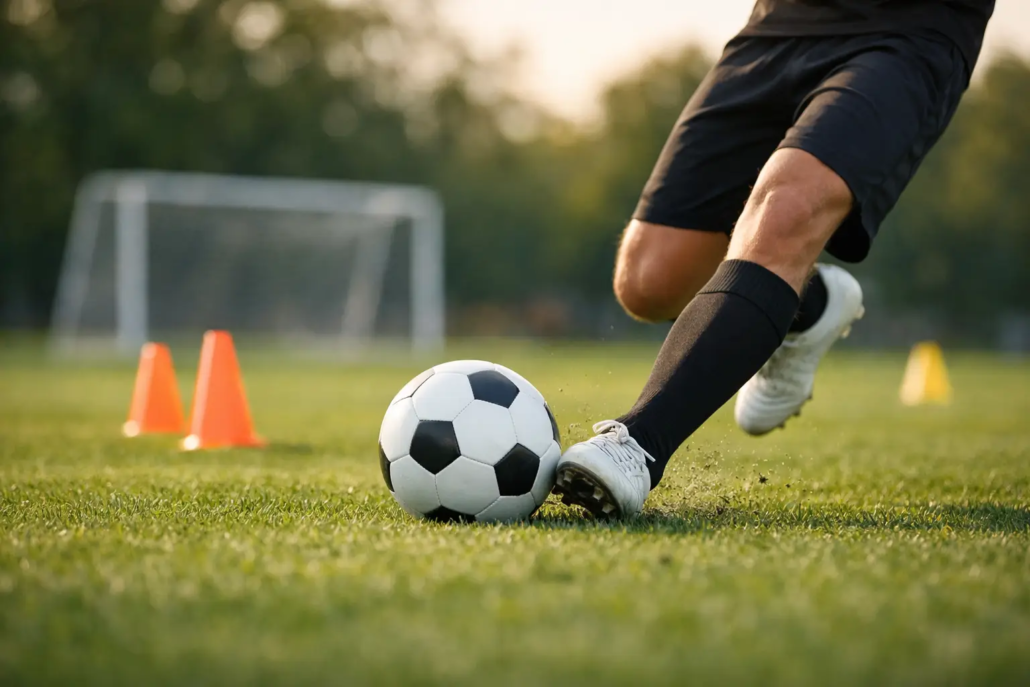
A defender has closed the passing lane to your strong foot. The ball arrives on your weaker side, and the next touch determines whether your team keeps possession or loses it. Learning how to improve weak foot ability is not about becoming flashy in training. It is about giving yourself more answers under pressure.
For young players, a weak foot can quietly limit everything: first touches, passing angles, finishing options, turns, and confidence. For competitive players, opponents notice it quickly. They will show you onto the side they know you would rather avoid. The solution is not random repetition. It is disciplined, high-quality work that gradually makes the weaker foot a trusted tool.
Why a Weak Foot Changes Your Game
A player with only one reliable foot is easier to defend. They need extra touches to shift the ball, their passing picture becomes smaller, and they often rush decisions when the game forces them to use the uncomfortable side. Even a technically strong player can look predictable if they always cut back to the same foot.
Developing both feet creates more than technical range. It improves your speed of play. You can receive across your body, play a first-time pass, protect the ball while turning, or finish from a different angle without pausing to reposition. That fraction of a second matters in crowded midfield spaces, around the penalty area, and when pressing defenders are closing fast.
Parents should also understand that a weak foot is normal. It is not a flaw in a young player. Most players have a dominant side. The goal is not identical feet. The goal is a dependable non-dominant foot that works in real soccer moments.
How to Improve Weak Foot Technique First
Before increasing speed, clean up the contact. A player who practices 200 poor touches is simply making the wrong movement more automatic. Start slowly enough that each repetition has a purpose.
Build a Stable Passing Platform
For inside-foot passing, point the toes of the plant foot toward the target and place that foot beside the ball, not behind it. Lock the ankle of the weak foot, open the hip, and strike through the middle of the ball with the inside surface. The follow-through should travel toward the target.
Many young players miss weak-foot passes because their plant foot is too far away, their ankle is loose, or they lean backward. A coach can correct those details quickly, but players can also use a wall and pay attention to the ball’s return. A clean pass comes back predictably. A spinning or bouncing return gives useful feedback.
Train Your First Touch, Not Just Your Strike
Passing is only useful if the first touch sets up the next action. Use the weak foot to cushion a ball from a wall, then move it into space with the same foot before passing again. Begin with the inside of the foot, then progress to outside-foot touches, sole rolls, and receiving across the body.
Keep the ball close enough to play the next pass in one or two touches. If every weak-foot touch travels three yards away, the player is not ready to add speed. Control comes before tempo.
Learn to Dribble With Both Surfaces
Weak-foot dribbling should not mean running in a straight line while tapping the ball with the inside of the foot. Players need inside and outside touches, changes of pace, and the ability to protect the ball. Set up a small cone channel and dribble through it using only the weak foot. Use the inside on one pass, the outside on the return, and finish with a change of direction.
The important detail is body position. Keep knees bent, chest slightly forward, and arms active for balance. Your eyes should come off the ball regularly. In a game, the best weak-foot touch is the one that lets you see the next pass, not the one that looks perfect in isolation.
A 15-Minute Weak-Foot Training Block
Consistency beats occasional marathon sessions. Three focused sessions per week will produce more progress than one long session where concentration disappears. A player can add this 15-minute block before or after team training, provided the quality stays high.
Start with three minutes of ball manipulation: toe taps, sole rolls, inside-outside touches, and pull-pushes using only the weaker foot. Keep the ball within a step of the body and aim for rhythm rather than maximum speed.
Then spend five minutes passing against a wall. Use two touches at first: receive with the weak foot, set the ball, and pass with the weak foot. As accuracy improves, progress to one-touch passes. Pick a small target on the wall instead of simply kicking at a large surface. Accuracy creates accountability.
Use the next four minutes for movement. Dribble through cones or markers, accelerate for five yards, stop the ball with the sole, and turn back. Include both inside and outside cuts. This connects technical control to the body movements that happen in games.
Finish with three minutes of striking. Place the ball at different angles and hit low passes or shots toward a target with the weak foot. Do not chase power immediately. A firm, accurate strike into a corner is more valuable than a hard shot that misses by five yards.
Make the Work Look Like Soccer
A wall is a valuable training partner, but it cannot recreate pressure, scanning, or decision-making. Once basic technique is improving, players need game-like constraints. This is where weak-foot training becomes transferable.
In small-sided games, set a rule that a player must use their weak foot for the first touch or for every pass in a specific zone. The rule should challenge the player without stopping the game every few seconds. For a beginner, weak-foot touches may be enough. For an advanced player, require weak-foot passes in the final third or weak-foot finishes during a shooting competition.
At first, performance may dip. Passes may be slower, and finishing may be less clean. That is a necessary trade-off. If a player never risks using the weaker side in a competitive setting, training progress stays trapped on the practice field. The goal is controlled discomfort, followed by increased confidence.
Four Drills That Build Real Confidence
Use these drills with a clear score. Measurable work gives players a reason to focus and makes improvement visible over time.
- Weak-foot wall target: Make 25 accurate passes to a small wall target from six to eight yards. If the return is controllable, count it. Record how many attempts it takes to reach 25.
- Receive and escape: Pass to a wall, receive with the weak foot, take the next touch around a cone, and pass again. Work both directions so the player learns to open their body instead of always receiving square.
- Cone slalom to finish: Dribble through five cones with the weak foot only, then strike a low shot into a marked corner. Time the drill, but only count attempts that finish on target.
- Two-goal 1v1: Set up two small goals. The attacking player can score only with the weak foot. The defender creates pressure, forcing the attacker to use touches, turns, and body positioning under stress.
For younger players, reduce the distance and use larger targets. For older competitive players, add a time limit, a defender, or a required scan before receiving. The drill should be difficult enough to demand concentration but achievable enough to preserve clean technique.
Common Mistakes That Slow Progress
The biggest mistake is treating the weak foot as a warm-up-only foot. If it appears for five minutes of juggling and disappears when the game starts, development will be slow. Players need planned repetitions and opportunities to use the foot in real decisions.
Another mistake is always striking as hard as possible. Power is attractive, especially for players who want to improve their shot. But weak-foot development begins with balance, clean contact, and target awareness. Add power only when the player can repeatedly strike the ball with accuracy.
Finally, do not confuse equal use with equal ability. A right-footed player may never hit every type of ball with the same force or comfort as their right foot. That is fine. If their left foot can receive, pass, carry, turn, and finish when the moment demands it, they are far harder to defend.
Track Progress and Raise the Standard
Training feels more serious when players can see the results. Test a simple benchmark every two weeks: 20 weak-foot passes to a target, 10 first-touch-and-pass sequences, and 10 shots from a realistic angle. Track accuracy before trying to track speed.
Technology-guided repetition and coach feedback can accelerate this process because players receive immediate information about touch quality, reaction time, and decision-making. At Soccer Field Academy, structured technical work can pair intentional repetition with demanding game-like environments, helping players turn a weaker side into a confident option.
The next time the ball arrives on the uncomfortable side, do not avoid it. Take the touch, trust the work, and make the play your opponent did not expect.

