
8 Best Indoor Soccer Training Tools for Players
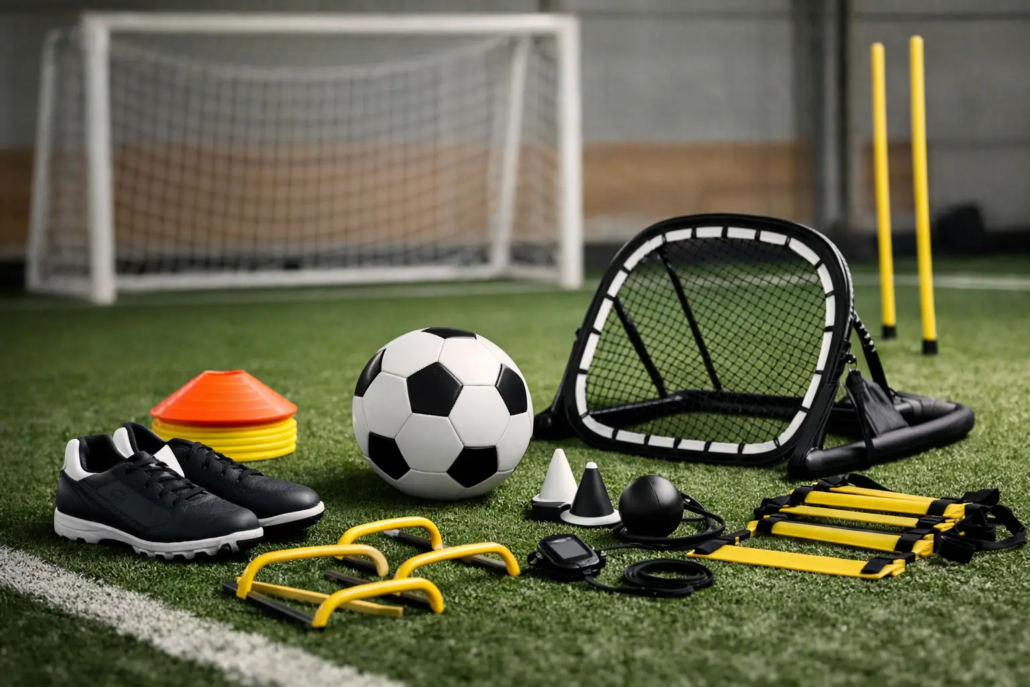
A player can spend an hour juggling in the basement and still struggle to scan before receiving the ball. That is why the best indoor soccer training tools do more than keep a ball moving. They create repeatable touches, faster decisions, stronger movement patterns, and the confidence to perform when the game speeds up.
For parents, the goal is not to fill a garage with equipment. It is to choose tools that match your player’s current stage of development and give them a reason to train with purpose between team sessions. For players, the standard is simple: every rep should transfer to a better first touch, cleaner movement, quicker reaction, or more controlled finish on the field.
What Makes an Indoor Training Tool Worth It?
The best equipment gives players immediate feedback. A rebounder tells them whether their pass was accurate. A reaction-light system exposes whether they can process information under pressure. A small-sided ball reveals whether their touch is truly controlled.
Space matters, too. A young player in a living room needs a different setup than a serious midfielder with access to a basement, garage, or indoor field. Safety matters as well. Hard shots, low ceilings, and fragile furniture can turn a productive session into a short-lived experiment.
Most importantly, equipment cannot replace coaching. A tool is only valuable when the player understands the objective: use the weaker foot, receive across the body, check the shoulder before the ball arrives, or accelerate with correct mechanics. Random repetition can build habits just as easily as it builds skill.
The Best Indoor Soccer Training Tools for Real Development
1. A Quality Soccer Ball and a Futsal Ball
Every player needs a properly sized soccer ball. For young players, the right size helps them develop coordination and confidence rather than forcing them to fight the ball. Older players should train with a ball that matches their game environment whenever possible.
A futsal ball is one of the most useful indoor additions for players ages 8 and up. Its reduced bounce demands a cleaner first touch and encourages the ball to stay close to the feet. It is especially effective for tight-space dribbling, sole-roll work, quick combinations, and receiving under pressure.
The trade-off is that futsal does not perfectly replicate an outdoor match ball. Use it to sharpen technique, then make sure players also get regular reps with the ball they use in games.
2. A Rebounder or Passing Board
A rebounder is one of the strongest investments for a player who needs more touches without needing a training partner. Passing into a target and receiving the return develops the habits that decide midfield and defensive moments: body shape, first touch, passing weight, and preparation before contact.
For a beginner, the work can be simple. Pass with the inside of the foot, receive with the opposite foot, and keep the ball within one step. Advanced players should add constraints: two-touch only, weak foot only, receive on the back foot, or scan a visual cue before the ball returns.
A passing board is more compact and often better suited to a basement or garage. It does not provide every rebound angle a larger net can create, but it is durable, portable, and excellent for focused technical work. A player who trains 10 intentional minutes a day on a board can accumulate thousands of quality contacts over a season.
3. Flat Cones and Floor Markers
Cones look basic because they are basic. That does not make them optional. Flat markers create a clear training area without becoming a tripping hazard, and they can be used for dribbling lanes, receiving boxes, change-of-direction patterns, and small goals.
The mistake is setting up an elaborate cone course and encouraging players to race through it with their heads down. Soccer is not a cone-dribbling contest. Use markers to create decisions. For example, have the player dribble toward a central gate, react to a called color, and exit through the correct side. The player now has to control the ball while processing information.
For ages 2 through 7, cones can turn coordination work into a game. For competitive players, they should support precise movement and technical constraints rather than replace game-like training.
4. A Small Pop-Up Goal
A small goal gives technical work a finish line. Players become more deliberate when a dribble, combination, or first touch ends with a pass or shot into a target. This is valuable indoors because it keeps sessions competitive without requiring full-power striking.
Use a soft ball or low-bounce ball where space is limited. Players can practice opening their body to finish, passing into corners, or taking a first touch away from pressure before shooting. A pair of small goals also allows siblings or teammates to play short, high-touch games that build creativity and composure.
Avoid treating a pop-up goal as permission to blast the ball. In a confined space, accuracy, disguise, and speed of execution matter more than power.
5. A Ball Mastery Mat or Visual Dribbling Grid
A ball mastery mat gives younger players a visual structure for learning moves, while a taped floor grid can provide the same benefit at almost no cost. The point is not memorizing flashy tricks. It is teaching players how to manipulate the ball with different surfaces of both feet.
A well-designed session might include toe taps, foundations, sole rolls, V-pulls, inside-outside touches, and turns. Players should begin slowly enough to execute the movement correctly, then increase speed only when control remains sharp.
This tool is particularly useful during bad-weather weeks, when consistent touches can disappear. Five focused minutes before school or after homework is more valuable than one rushed 45-minute session once a week.
6. Reaction Lights and Cognitive Training Systems
Elite soccer is not only about how fast a player moves. It is about how quickly they see, decide, and execute. Reaction lights and cognitive systems add a decision-making layer to indoor training by giving players a visual cue they must identify and respond to.
A player can dribble in a small area, react to a color, then perform a specific turn or pass. They can sprint to a light, collect a ball, and finish through a target gate. These drills train attention, response speed, and composure under a changing task.
Technology is most effective when it supports a clear soccer action. Flashing lights alone do not create a better player. The value comes from pairing the cue with scanning, footwork, ball control, or acceleration. At Soccer Field Academy, tools such as SoccerBot360 help turn that link between perception and execution into measurable training.
7. An Agility Ladder and Mini Hurdles
An agility ladder can improve rhythm, foot placement, and coordination, especially for developing athletes. Mini hurdles add a useful challenge for knee drive, posture, and controlled landing. But neither tool automatically creates game speed.
Players do not run through ladders during matches. The real benefit comes when footwork is followed by a soccer action: accelerate into a ball, receive and turn, react to a coach’s call, or defend a small gate. Keep ladder patterns brief, clean, and purposeful. If form breaks down, slow the drill down.
For younger athletes, these tools can build body awareness and enjoyment. For older players, pair them with sprint mechanics and change-of-direction coaching so the movement actually transfers to the field.
8. A Training Journal or Simple Progress Tracker
The least expensive tool may be the one that creates the most consistency. A training journal helps players record their weekly sessions, weaker-foot touches, juggling records, passing totals, and personal goals. It gives parents a clear picture of effort without making every session feel like homework.
Keep the tracking simple. A player might write down one technical target, one physical target, and one confidence target each week. Examples include completing 200 weak-foot passes, improving a reaction drill score, or speaking more during small-sided play.
Measurable progress builds belief. When players can see that their touch count, accuracy, or movement quality has improved, training becomes personal instead of something adults tell them to do.
Build an Indoor Setup Around the Player, Not the Product
A strong home setup for a beginner may be a properly sized ball, flat cones, and a small goal. A competitive player preparing for higher-level soccer may benefit from a rebounder, futsal ball, reaction training, and a consistent tracking system. More equipment is not always better.
Parents should also consider how the player responds to independent training. Some athletes thrive with a checklist and a few tools. Others need a coach, training partner, or structured environment to maintain standards and correct details. That is not a weakness. It is simply why serious development combines personal work with expert feedback.
The right tool should make a player want to return tomorrow, but it should also demand better habits today. Choose equipment that rewards clean technique, fast thinking, and disciplined repetition. Those are the qualities that show up when the ball arrives in a crowded moment and the player has one second to make it count.