
Speed Court Soccer Review: Does It Build Speed?
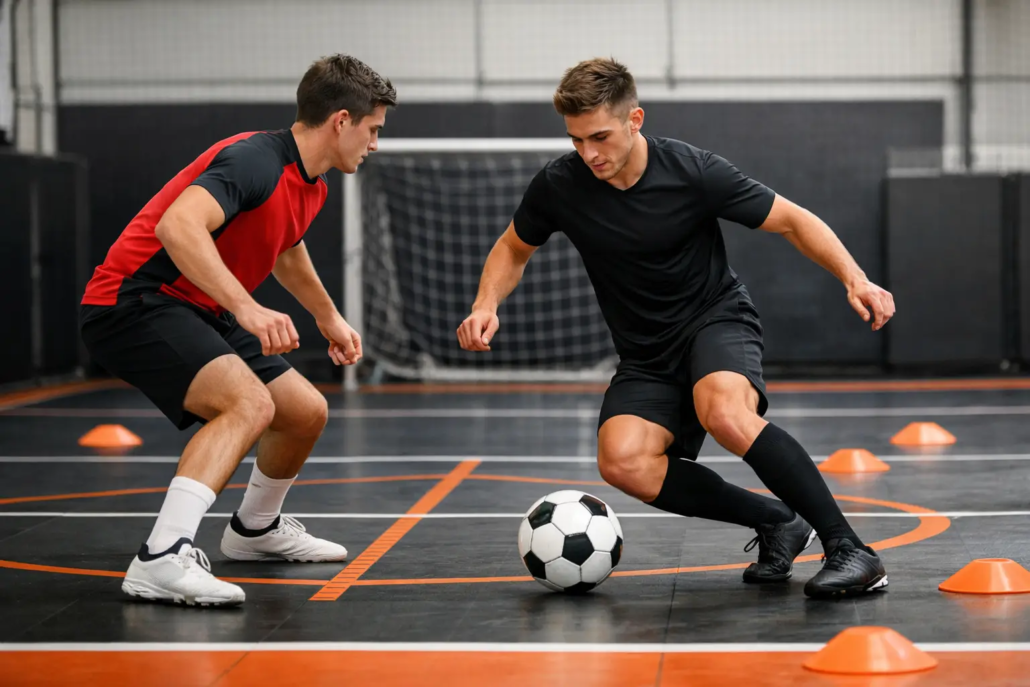
A player can look quick in a straight sprint and still arrive late to the ball. Soccer rarely rewards speed in a clean line. It rewards the player who recognizes a cue, changes direction, controls their body, and accelerates again before the opponent reacts. This Speed Court soccer review looks at whether reactive movement training can improve the type of speed that shows up on the field.
For development-focused families, the value is not in a flashy technology session alone. It is in whether the work transfers to confident defending, sharper pressing, cleaner transitions, and better decisions under pressure. Used with purpose, Speed Court training can be a powerful part of a complete player-development plan.
What Speed Court Trains for Soccer Players
Speed Court is an interactive training surface that uses lights, visual cues, and timed movement patterns to challenge an athlete’s reaction speed, footwork, balance, and change of direction. Rather than simply telling a player where to run, the system requires them to process information and respond immediately.
That distinction matters. In a match, players are not following pre-planned cone patterns. They are reading an opponent’s first touch, a teammate’s run, a loose ball, or an opening that disappears in half a second. The physical action and the decision happen together.
A well-designed Speed Court session can target several qualities soccer players need: acceleration out of a cut, deceleration before a turn, lateral movement, body control, visual reaction, and the ability to re-accelerate after changing direction. The timed format also creates accountability. Players can see whether their movement is becoming more efficient instead of relying only on the feeling that they worked hard.
Speed Court Soccer Review: Where It Delivers
The strongest benefit of Speed Court is its ability to connect athletic movement with cognitive demand. A player may have fast feet in a ladder drill but hesitate when a light changes or when the next direction is unknown. That hesitation is often the gap between being athletic and being game quick.
It develops reactive speed, not just sprint speed
Straight-line speed still matters, especially for wide players, strikers, and defenders recovering into space. But most soccer actions include a reaction before the sprint. A center back must recognize a through ball. A midfielder must turn away from pressure. A winger must react when the defender shifts their hips.
Speed Court training places a decision in front of the movement. The athlete has to identify the cue, organize their body, and move with urgency. Over time, this can help players become more comfortable responding quickly without losing posture or balance.
It exposes inefficient movement habits
Young players often lose valuable time when they stop. Their knees collapse inward, their chest rises too high, their feet cross unnecessarily, or they need extra steps to get moving again. These habits are difficult to spot in a crowded team session, especially when every player is performing the same drill.
The Speed Court gives coaches a controlled setting to observe how an individual player plants, turns, and re-accelerates. The clock provides useful feedback, but the coaching is what creates the improvement. Faster times achieved through poor mechanics are not the goal. Efficient, repeatable movement is.
It creates measurable progress
Parents should be careful with any training promise that cannot be evaluated. Athletic development is not always linear, particularly during growth spurts, but players still need a way to see progress.
Timed Speed Court sessions establish a baseline and provide repeatable tests. A player can track improvements in reaction-based movement, directional change, and overall completion time. That data should not define the athlete, but it can reinforce discipline. When a player sees that focused work produces a better score, confidence becomes more than motivation. It becomes evidence.
It can build confidence for players who hesitate
Not every developing player lacks effort. Some lack trust in their ability to move quickly when the situation changes. They second-guess the first step, worry about making a mistake, or become passive against faster opponents.
A progressive training environment lets those players rehearse quick decisions without the fear of a match result. Repetition builds familiarity. Familiarity helps the player attack a movement rather than wait for certainty. That is especially valuable for younger athletes building coordination and for competitive players returning after time away from high-intensity training.
What Speed Court Cannot Replace
A credible Speed Court soccer review also needs to be clear about the limitations. The system is a development tool, not a substitute for soccer training.
It does not teach a player how to receive on the half-turn, scan before the ball arrives, disguise a pass, or recognize a tactical overload. It cannot replace ball mastery, small-sided games, strength development, sprint mechanics, or high-level coaching. A player who only trains movement patterns may become more agile without becoming a better soccer player.
The best results come when reactive athletic work supports technical and tactical training. For example, a player might complete Speed Court work before a session focused on pressing cues, transition defending, or first-touch decisions. The physical work prepares the body and brain to apply those actions with a ball and against real opponents.
It also depends on the athlete’s age and needs. A six-year-old may benefit most from coordination, balance, listening skills, and movement confidence. A 14-year-old competing at a high level may need sharper deceleration, reactive change of direction, and repeated high-quality efforts. The platform can serve both athletes, but the program should not look the same.
Who Benefits Most From Speed Court Training?
Speed Court is valuable for recreational players who need better body control and confidence, but it can be especially effective for players entering more competitive environments. As the pace of play rises, technical ability alone is not enough. Players must process information and move efficiently under pressure.
Defenders can benefit from better recovery movement and lateral reactions. Midfielders can improve their ability to shift, turn, and accelerate into new spaces. Forwards can sharpen the first steps that create separation. Goalkeepers may use reactive footwork training as one component of their movement development, though goalkeeper-specific technical training remains essential.
The player who often arrives a step late is a strong candidate. So is the technically skilled athlete who struggles to translate talent into game impact because their body cannot keep up with their ideas. In both cases, the goal is not simply to move more. It is to make quicker, cleaner movement decisions.
How to Get Real Value From a Speed Court Session
A strong session begins with an assessment, not a generic workout. Coaches should identify whether a player needs help with posture, first-step acceleration, braking, lateral movement, reaction time, or confidence. That diagnosis determines which patterns and coaching cues deserve attention.
Quality matters more than exhausting volume. If a player is fatigued to the point that their mechanics fall apart, they may rehearse poor habits. Short, intense efforts with proper rest often make more sense for speed and reaction development than long conditioning-style circuits.
Progression matters, too. A player can begin with simple visual cues and clear movement patterns, then advance toward more unpredictable reactions and soccer-specific decision demands. Once movement quality improves, the next step is transferring it to the ball: receiving after a directional cue, defending a 1v1 action, or exploding into a finishing movement.
At Soccer Field Academy, Speed Court work is most effective when it sits inside a broader development roadmap that includes skilled coaching, technical repetition, and competitive game application. Technology provides the feedback. The coach provides the standard, correction, and progression.
The Bottom Line for Serious Players and Parents
Speed Court is worth considering when it is used as a coached, measurable part of complete soccer development. It can improve the connection between reaction, movement, and confidence – three qualities that matter when the game becomes faster and less predictable.
It is not a shortcut to elite performance. The players who gain the most are the ones willing to repeat the details: lower their center of gravity, brake under control, react without panic, and carry those habits into technical training and matches. Start with an honest assessment of where the player loses time, then build a plan that turns that weakness into a competitive advantage.

