10 Best Drills for Soccer Coordination
Clean first touches break down when coordination breaks down.
That is why the best drills for soccer coordination are not just about moving faster through cones or looking sharp on a ladder. They train a player to organize feet, eyes, balance, timing, and decision-making under pressure. For youth players, that creates confidence on the ball. For advanced players, it sharpens the small movement details that separate average execution from elite play.
Coordination in soccer is often misunderstood. Parents sometimes think it means agility alone. Players often think it means fancy footwork. In reality, coordination is the ability to control the body efficiently while processing the game. A coordinated player can adjust stride length before receiving, shift weight to protect the ball, react to a deflection, and stay composed while changing direction at speed.
That is also why the right drill depends on age and training level. A six-year-old needs rhythm, balance, and basic body control. A fourteen-year-old academy player needs those same qualities, but with more speed, more reactivity, and more ball demands. Good training respects that progression.
What makes the best drills for soccer coordination work?
The strongest coordination drills challenge more than one system at once. They usually combine movement quality with either ball contact, visual processing, or reaction demands. If a drill only teaches a memorized pattern with no variation, it can still help early on, but its transfer to real match play is limited.
For that reason, high-value coordination work usually includes three elements. First, it teaches body control – posture, balance, foot placement, and deceleration. Second, it adds timing – the player has to execute at the right moment, not just eventually. Third, it progresses into perception – seeing a cue, reacting to a call, or adjusting to a changing environment.
This is where many well-meaning sessions fall short. Players spend ten minutes flying through ladders, but their hips rise, arms stop working, and touches disappear as soon as a ball is added. That is activity, not development. The goal is measurable improvement in movement efficiency that carries into the game.
1. Ladder patterns with ball exit
Ladder work still has value when it is used correctly. The mistake is treating the ladder as the end goal. It should be a tool for rhythm, foot speed, and body organization, followed immediately by a soccer action.
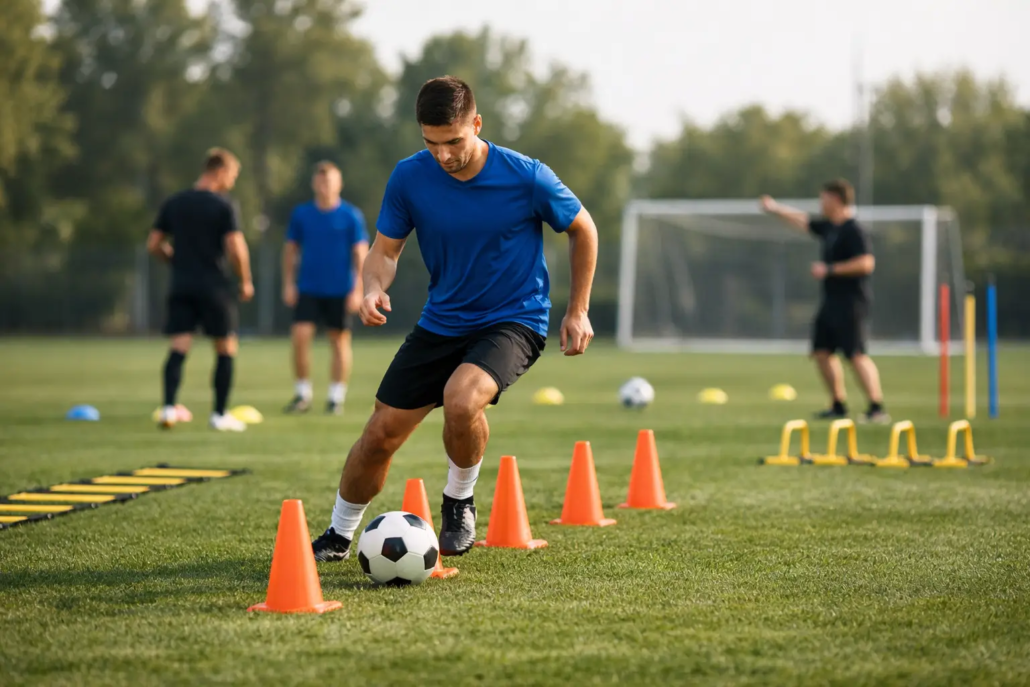
Start with simple patterns such as one foot in each box, two feet in each box, or lateral in-and-out steps. As soon as the player exits the ladder, they take a first touch into space and pass, dribble, or shoot. That final action matters because it connects coordination to technique.
For younger players, keep the speed controlled and reward clean feet. For older players, add a visual cue at the end so they must exit left or right based on a coach’s call. That turns a predictable pattern into a reactive one.
2. Cone square footwork and receiving
Set four cones in a square, about five to seven yards apart depending on age. The player moves around the square using different footwork patterns – forward shuffle, backpedal, side shuffle, crossover – and then checks to receive a pass.
This drill is excellent because it teaches body orientation. In matches, players rarely receive while standing still and facing perfectly forward. They open up, adjust hips, scan, and arrive into the ball. The cone square creates those movement demands in a controlled way.
If you want more challenge, vary the service. A bouncing pass, a firmer driven pass, or a pass to the back foot all increase the coordination demand. The body has to solve a more realistic problem.
3. Single-leg balance to first touch
Elite coordination is not always fast. Sometimes it is about stability before action.
Have the player stand on one leg for a few seconds while the coach serves a ball. The player must receive and return it without losing posture, or step out of the balance hold and take a controlled first touch into space. This looks simple, but it exposes weak ankles, poor core control, and rushed touches immediately.
For younger athletes, use hands first with catches and tosses before progressing to feet. For older athletes, add volley returns or require the first touch across the body. This is one of the best ways to build control that actually supports technical quality.
4. Mirror movement drills
Pair two players or use a coach and player. One leads with short explosive movements in a marked area while the other mirrors. Forward, backward, lateral, stop, reaccelerate. After five to eight seconds, add a ball for the reacting player to win or control.
Mirror work develops reaction speed, spatial awareness, and body adjustment. It is especially useful for defenders and midfielders who constantly respond to an opponent’s movement. It also teaches athletes not to cross feet carelessly or lose posture during quick directional changes.
The trade-off is fatigue. If the work period is too long, movement quality drops fast. Short, intense sets usually produce better results than long sloppy ones.
5. Hurdle hops into dribble acceleration
Low hurdles are useful for developing elastic coordination – quick ground contacts, knee drive, and landing control. After a sequence of hops, the player immediately collects a ball and accelerates through a short dribbling lane.
The key here is clean landings. If a player collapses inward at the knee or lands heavily, the drill is too advanced or the hurdle spacing is wrong. Good coordination training is not about making a player survive the drill. It is about teaching efficient movement patterns under increasing difficulty.
For advanced players, finish with a change of direction or a quick shot. For beginners, keep the hops simple and focus on balance after each contact.
6. Numbered cone reaction drill
Set out cones in different colors or numbers. The player starts in the middle with a ball. On the coach’s command, they move to the called cone, perform a specified action, and return under control.
This is one of the best drills for soccer coordination because it blends movement, cognition, and ball control. The player is not just running a preset route. They must hear or see the cue, process it, move efficiently, then execute with the ball.
That cognitive layer matters. Soccer is filled with chaotic information. Players who can organize their feet while processing cues tend to play faster because they waste less time recovering balance or correcting body position.
7. Juggle to movement transition
Have the player juggle two or three touches, then move into a cone gate, turn, and continue juggling or bring the ball down into a dribble. This teaches adjustment and touch control while the body is in motion.
A lot of players can juggle in place. Fewer can control the ball after shifting direction or changing speed. That difference shows up in games when a pass pops up awkwardly or a player has to settle under pressure.
This drill should match the player’s level. For a newer player, one controlled lift and catch may be enough. For an advanced player, require alternating feet, thigh-foot combinations, or movement into a weak-foot finish.
8. Speed ladder with defensive turn
Start with a quick ladder sequence, then sprint to a cone, open hips, execute a defensive turn, and recover to a second marker. This pattern is valuable for players who need cleaner transitions between front-facing movement and recovery runs.
Outside backs, center backs, and defensive midfielders benefit a lot from this because they are constantly changing from pressing shapes to recovery movement. Coordination here is less about fancy feet and more about efficient turning mechanics.
Done properly, this drill improves foot placement, hip mobility, and reacceleration. Done poorly, it becomes rushed and upright. Coaching detail matters.
9. Ball-wall coordination circuits
A wall or rebound surface is one of the most efficient training tools available. Players can combine quick feet around markers with one-touch and two-touch passing against the wall, then reset and repeat from a new angle.
The value is repetition with consequence. If the feet are disorganized, the pass quality suffers. If the pass is off line, the next touch becomes harder. That feedback loop helps players connect lower-body coordination with technical precision.
At higher levels, this type of work can become very advanced, especially when using weak foot patterns, one-touch sequences, or timed rounds. At younger ages, keep it simple enough that players can maintain quality.
10. Small-area chaos dribbling
Mark a tight grid with several players dribbling at once. On command, they perform a turn, accelerate, stop on the ball, or find a new space. You can also add passive pressure or gates to increase the decision load.
This is where coordination starts to look like soccer. Players have to keep the head up, adjust stride length, avoid collisions, manipulate the ball, and react quickly. It trains more than cones ever can because the environment is constantly changing.
The challenge is density. Too crowded, and the drill becomes random. Too open, and the coordination demand drops. Good coaching means adjusting space so players are forced to solve movement problems without losing technical control.
How to choose the right coordination drills
Not every player needs the same menu. A younger beginner may need broad athletic coordination first – balance, hopping, rhythm, stopping, and starting. An older competitive player may need more reactive training tied directly to receiving, turning, and changing speed with the ball.
Parents should also know that more complex does not always mean better. If a player cannot hold posture, control the landing, or keep eyes up during a basic pattern, adding more cones and commands only hides the weakness. Strong development is built on progression, not confusion.
In a serious training environment, coordination work should be coached, measured, and progressed over time. That is where tools like reaction-based training surfaces and structured technical stations can make a difference, because they expose whether the athlete is truly improving or just repeating familiar patterns.
The best coordination drills are the ones that make a player more efficient when the game speeds up. When feet are organized, the mind is calmer, touches are cleaner, and confidence rises. Train that consistently, and the results stop looking like drills. They start showing up on match day.