
Indoor Versus Outdoor Soccer Training
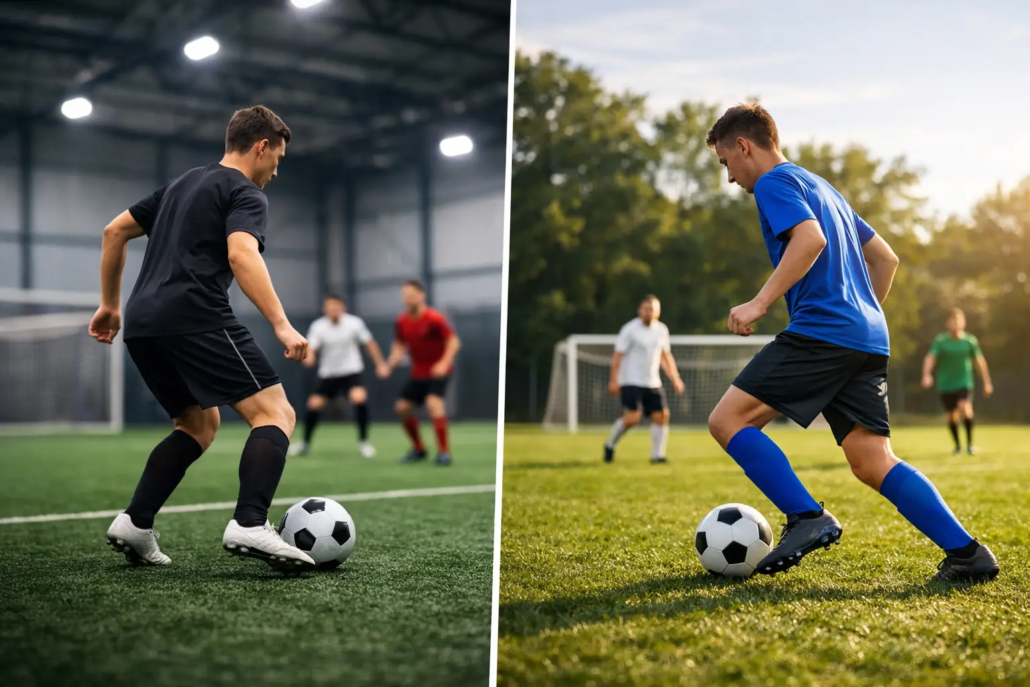
A player who looks sharp on a perfect spring field can struggle the moment the ball moves faster, space tightens, or weather turns ugly. That is why indoor versus outdoor soccer training matters more than most families realize. The environment changes the speed of play, the number of repetitions, the physical demands, and even the confidence a player carries into matches.
For serious development, this is not an either-or argument. It is a question of what each setting teaches, when it teaches it best, and how to use both with purpose. Players do not improve just because they spend more time training. They improve when the training environment matches the skill being built.
Indoor versus outdoor soccer training: what really changes
Indoor training compresses the game. Space is tighter, actions happen faster, and players get more touches in less time. That makes indoor work especially effective for first touch, quick passing, scanning, foot speed, and composure under pressure. A technical mistake is exposed immediately because the game does not slow down to hide it.
Outdoor training expands the game. Players must deal with larger spaces, longer passing distances, changing surfaces, weather, and more realistic match patterns. That matters for tactical understanding, movement off the ball, recovery runs, crossing, finishing from wider angles, and reading the full rhythm of the game.
Neither environment is automatically better. Each creates a different set of demands. A disciplined development plan uses those demands instead of fighting them.
What indoor training does best
Indoor training is often where technical habits are built fastest. The ball stays involved, repetitions come quickly, and players cannot disappear. In a crowded training environment, every touch has a consequence. That intensity is valuable for younger players learning control and for advanced players refining execution speed.
The biggest advantage is repetition quality. When sessions are organized well, players receive more meaningful actions per minute than they often get outdoors. There is less time spent chasing loose balls across large distances and more time receiving, turning, combining, and solving problems. For parents, that usually means visible progress in confidence and cleanliness on the ball.
Indoor work is also excellent for cognitive development. Quick walls, reduced space, and constant pressure force players to scan before receiving. They learn to recognize angles, anticipate defenders, and move the ball before pressure closes. That is not just technical polish. It is game intelligence being trained at speed.
There is also the consistency factor. In a year-round development model, missed weeks matter. Rain, frozen fields, heat advisories, and poor surface conditions can interrupt outdoor progress. A professional indoor environment protects training continuity, which is one of the biggest drivers of long-term improvement.
That said, indoor training has limits. If players spend too much time only in tight spaces, they can become excellent in short actions without fully learning the larger tactical picture. Some players get comfortable playing fast in small windows but struggle with timing longer runs, hitting driven balls over distance, or organizing themselves in full-field transition moments.
Where outdoor soccer training has the edge
Outdoor soccer training teaches players how the game breathes. There is more space, more time in some moments, and more complexity in others. Positioning matters differently. Players must judge distance, shape, and timing across bigger areas. That has major value once players move into competitive match environments.
Passing range is one clear example. Indoors, combinations are usually shorter and sharper. Outdoors, a player has to strike and receive over greater distances with consistency. The weight of pass changes. The body shape changes. The decision changes. Those are not small details. They are match-level demands.
Outdoor sessions also develop tactical discipline in a more realistic context. Team shape, pressing lines, switching the point of attack, defending wide spaces, and attacking in transition all become clearer when players train in full dimensions. For older athletes, especially those preparing for high-level club, high school, or college soccer, this matters a lot.
Then there is the reality of the game itself. Most players compete outdoors for much of the year. They need experience managing sun, wind, wet grass, uneven bounces, and changing field speed. Technical quality is only part of performance. Adaptability is another.
Still, outdoor training can become inefficient if it is not coached with structure. On a full field, weaker players can hide. Touch counts can drop. Long lines and too much passive instruction can waste valuable time. Space alone does not create development. Coaching design does.
How age and level should shape the choice
For younger players, especially beginners, indoor training often gives faster returns. More touches, less dead time, and simpler visual cues help build coordination, balance, and confidence. A young player does not need massive space to learn how to receive, dribble, and strike the ball correctly. In many cases, smaller environments are better because they keep children engaged and involved.
As players mature, the balance starts to shift. Technical speed still matters, but now the player also needs tactical range. An advanced 13-year-old or 16-year-old must be able to process both tight-space pressure and full-field decisions. That is where the strongest development plans start blending environments rather than choosing one side.
Level matters too. A recreational player may benefit most from the consistency and repetition of indoor sessions, especially if confidence on the ball is still growing. A highly competitive player may need indoor work for speed of execution and outdoor work for tactical application. The stronger the ambition, the more precise the training mix should become.
Indoor versus outdoor soccer training for specific goals
If the goal is ball mastery, first touch, quick combination play, and faster feet, indoor training usually offers the cleaner path. The environment rewards precision and punishes hesitation. Players learn to operate under pressure, which transfers well to match intensity.
If the goal is game understanding across bigger spaces, positional awareness, crossing, long passing, and realistic team movement, outdoor training becomes essential. The player needs room to read the field and execute over distance.
For speed and athletic development, it depends on how the work is structured. Indoor settings can be excellent for acceleration, reaction time, and short explosive actions, especially when paired with performance tools that measure output. Outdoor work often adds more sprint distance, deceleration demands, and repeated running patterns linked to match play.
For return on investment, parents should think beyond simple convenience. The best environment is the one that produces measurable progress in the area a player actually needs. More sessions are not always better. Better-targeted sessions are.
The best players learn to transfer between both
A technically strong player should be able to dominate a tight indoor sequence and then carry that same composure into an outdoor match. A tactically smart player should be able to understand space outdoors and still execute quickly when time is reduced indoors. Real development is transfer.
That is why elite academies do not treat training environments as separate identities. They use them as tools. Indoor sessions can sharpen technique, reaction speed, and decision-making density. Outdoor sessions can stretch those gains into larger tactical problems. One builds the engine. The other tests it under match conditions.
At Soccer Field Academy, that kind of structured progression matters because serious players need more than random reps. They need coaching that knows what to train, when to train it, and how to measure whether it is actually improving.
So which one should your player choose?
If your child needs more touches, more confidence, and more technical repetition, indoor training is often the smartest next step. If your player already has technical stability and now needs broader tactical experience, outdoor work should carry more weight. If the goal is long-term performance, the strongest answer is usually both – used intentionally, not equally.
The real mistake is picking a training environment based on habit instead of development. Players change. Their needs change. Training should change with them.
The best path is not indoor or outdoor. It is knowing what the player in front of you needs right now, then putting them in the environment that demands growth.