
Indoor Training vs Outdoor Practice in Soccer
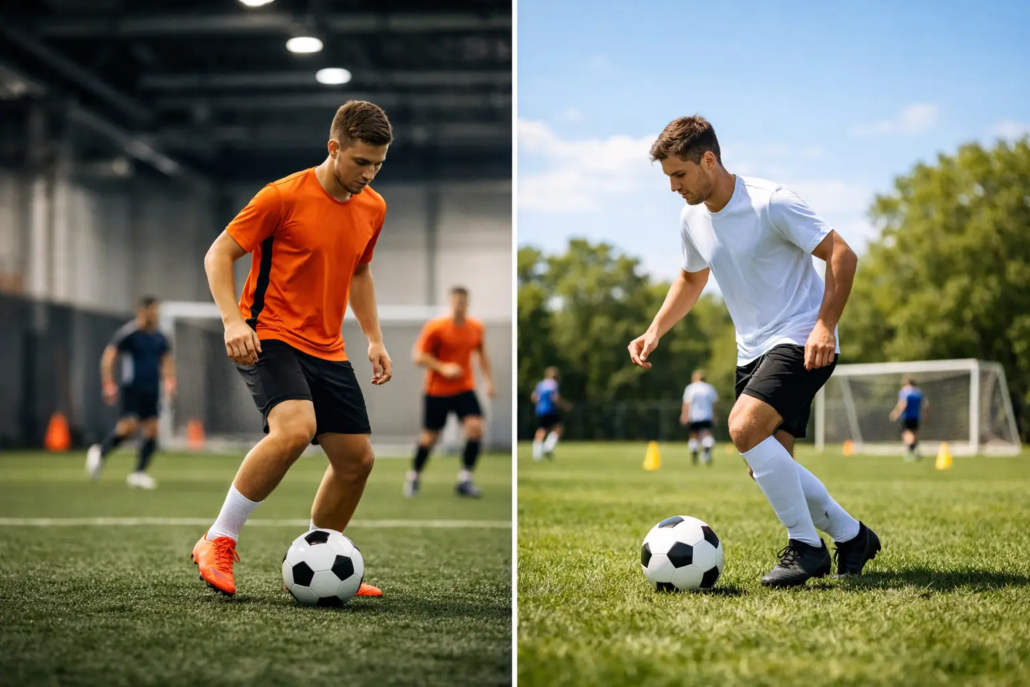
A player who looks sharp on Tuesday in a controlled session can look rushed on Saturday in wind, rain, and game pressure. That is why indoor training vs outdoor practice is not a simple either-or decision for serious soccer development. Each environment builds different parts of the player, and families who understand that make better training choices over the long term.
For youth athletes, the real question is not which setting is better in the abstract. The better question is what the player needs right now. A young beginner may need repetition and confidence. A high-level winger may need cleaner first touches at speed. A center midfielder may need more scanning, quicker decisions, and better execution under pressure. The environment should match the developmental objective.
Indoor training vs outdoor practice: what each really develops
Indoor training gives coaches control. The surface is consistent, the ball moves predictably, and weather stops being a factor. That matters more than many parents realize. When the environment is stable, coaches can isolate technique, increase repetition, and demand a higher standard on details like body shape, first touch, passing weight, and finishing mechanics.
For younger players, that consistency accelerates learning. If a six-year-old is still figuring out balance, coordination, and how to strike the ball cleanly, random weather and poor field conditions can slow progress. Indoors, the player gets more usable repetitions and more immediate correction. That is how habits start to become skills.
For advanced players, indoor sessions can be even more valuable when the work is precise. Tight-space technical training, speed of play, quick combination work, and cognitive drills all benefit from a controlled environment. If the goal is measurable improvement, controlled training conditions make it easier to track progress instead of guessing at it.
Outdoor practice develops a different set of qualities. Soccer is ultimately played outside for most players, and outdoor sessions teach adaptation. The ball skips differently on grass. Wind changes decision-making. Space is larger. Visual cues are different. Players must judge distance, timing, and pressure in a more variable setting.
That variability is not a flaw. It is part of the game. Outdoor practice builds tactical realism, field awareness, longer passing range, recovery running, and the ability to perform when conditions are imperfect. It also exposes players to transitions and spacing that are harder to replicate in a smaller indoor setting.
If indoor work sharpens the blade, outdoor work tests whether the blade holds up in real match conditions.
Why serious players usually need both
Families sometimes treat indoor training as offseason work and outdoor practice as the “real” soccer. That thinking leaves development on the table. High-level players improve fastest when they use both settings intentionally.
Indoor training is often where technical flaws get corrected. A coach can stop the action, demand a better receiving angle, repeat the pattern, and raise the execution standard. Outdoor practice is where those corrections have to survive chaos. Can the player still receive on the back foot when a defender is closing? Can they still scan early when the field is stretched and the tempo rises?
The strongest development model is progressive. Build the skill in control. Stress the skill under pressure. Then apply the skill in realistic space and game speed. That sequence respects how players actually learn.
This matters for parents evaluating training options. If a player only trains outdoors, weaknesses can hide behind the flow of team play. If a player only trains indoors, they may look polished but struggle with adaptation. Development is strongest when technical work, physical work, and tactical application connect.
Indoor training is often better for precision
There are moments in development when precision matters more than realism. If a player’s first touch is inconsistent, more game-like chaos does not solve the problem. It usually exposes it. That player needs repetition with coaching detail.
The same is true for striking mechanics, weak-foot development, receiving under controlled pressure, and footwork speed. Structured indoor sessions can increase quality touches and reduce wasted time. In a high-performance environment, that matters. Serious work produces serious results when the work is specific.
Technology can also make indoor sessions more effective when it is used with purpose. Tools that measure reaction speed, passing accuracy, or movement efficiency help turn training into feedback, not just activity. For ambitious players, measurable growth builds confidence because progress is visible.
Outdoor practice is often better for transfer
Transfer is the key word. A skill is only valuable if it shows up in competition. Outdoor practice tests transfer because the player has to solve bigger problems in a less predictable space.
Full-width patterns, longer runs, aerial balls, environmental distractions, and larger tactical demands all shape player development. A defender must read space differently outdoors. A striker must time runs over greater distances. A goalkeeper must judge flight and surface conditions. These are game truths, not small details.
That is why players preparing for league play, showcases, or tryouts cannot rely on indoor work alone. They need outdoor repetitions that challenge timing, endurance, and tactical discipline.
What parents should look at before choosing one over the other
The biggest mistake is choosing the environment based on convenience alone. Scheduling matters, but development should lead the decision.
Start with the player’s age and training age. Younger athletes usually benefit from a strong indoor foundation because repetition and confidence are essential early. As players mature, the balance shifts depending on position, competition level, and seasonal demands.
Then look at the player’s current limitation. If your child struggles with clean touches, ball mastery, speed of execution, or confidence in tight areas, indoor training may be the better immediate investment. If your child reads the game slowly outdoors, loses shape, struggles with spacing, or fades physically over a full field, outdoor work may need more attention.
Finally, consider the season. Winter is an obvious time for quality indoor development, especially in places like Columbus where weather can interrupt consistency. But indoor work should not be viewed only as a weather backup. It can be the highest-value environment for targeted technical and cognitive improvement at any point in the year.
The wrong way to compare indoor and outdoor soccer work
The comparison breaks down when people assume one environment should do everything. Indoor sessions are not supposed to replace every tactical and physical demand of the outdoor game. Outdoor team training is not always designed to fix every technical issue at an individual level.
That is where many players plateau. Team practice may offer good competition and tactical structure, but not enough touches or individualized correction. On the other side, private or small-group indoor work may sharpen technique but not fully test game transfer. One builds components. The other tests integration.
Elite development requires both correction and application.
For highly motivated players, this is where a structured training ecosystem matters. A player should know why they are in a session, what skill is being trained, how progress is measured, and where that progress should appear next. Random training creates random results.
How to balance indoor training vs outdoor practice through the year
There is no universal split that fits every player. A recreational eight-year-old and a college-bound sixteen-year-old should not train the same way.
For younger players, more indoor technical work can be a strong investment because early development is about coordination, comfort on the ball, and confidence. For middle-school players entering more competitive environments, the balance often shifts toward combining technical indoor work with increasingly demanding outdoor tactical and physical sessions. For older, advanced players, the best plan usually changes by season. During heavy match periods, indoor sessions may focus on refinement and recovery of sharpness. In the offseason, they may become the primary setting for technical rebuilding.
The key is intent. If a player is indoors, the work should be focused and demanding, not just active. If a player is outdoors, the session should push game understanding and execution, not simply fill time.
A serious academy environment understands that development is layered. Technical mastery, decision-making, athletic movement, and confidence do not improve in the same way or in the same setting. They need the right training dose in the right environment at the right time.
Parents do not need to choose sides in the indoor versus outdoor debate. They need to identify what their player needs next. Some weeks that means high-repetition technical work in a controlled facility. Other weeks it means getting outside, solving bigger tactical problems, and learning to perform when conditions are not perfect.
The best players are not built by one environment. They are built by using each environment with purpose, discipline, and a clear development plan.

