
How to Train First Touch Indoors Right
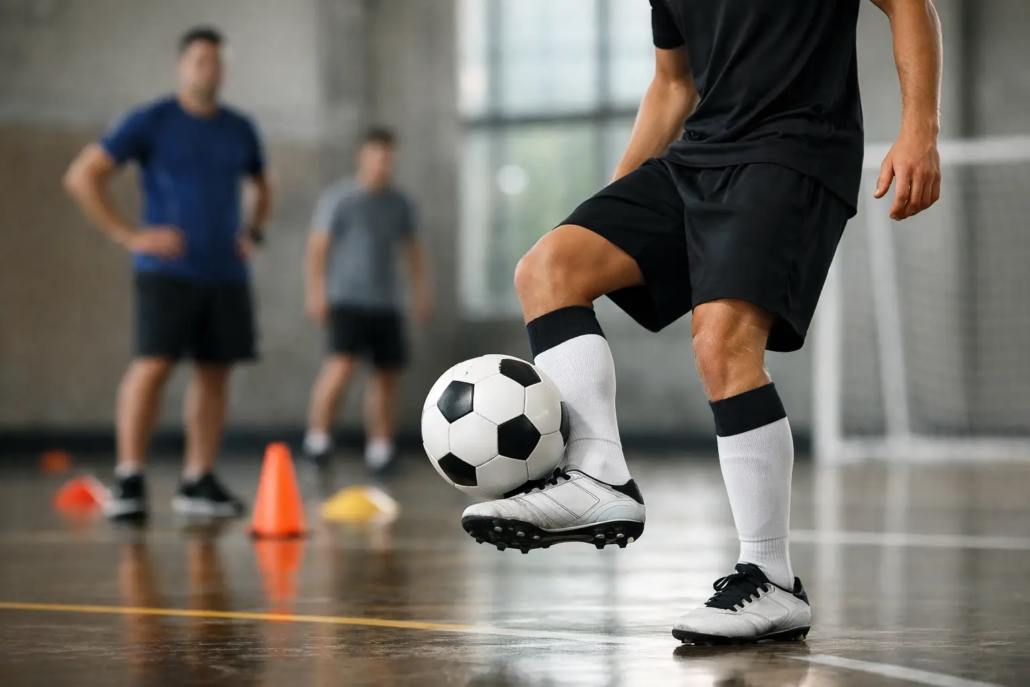
The fastest way to expose a weak player is simple – put them in a tight space and speed up the ball. First touch shows up immediately. It shows in how quickly a player can settle the ball, escape pressure, and play the next action with control. If you want to know how to train first touch indoors, start by accepting one truth: indoors does not limit technical growth. Done correctly, it sharpens it.
Indoor training strips away excuses. The space is tighter, the surfaces are cleaner, and the number of quality repetitions can be much higher than in a full outdoor session. For youth players, that matters. For parents, it means development does not have to stall because of weather, field conditions, or seasonal breaks. For serious players, it means every rep can be more intentional.
Why indoor first touch training works
A great first touch is not just about cushioning the ball. It is about solving the next problem before pressure arrives. Indoors, players get more touches in less time, and that changes the learning environment. The ball comes back faster off walls, passes travel cleanly, and mistakes are obvious. That feedback loop is valuable.
There is also less room to hide. In big outdoor spaces, a poor touch can sometimes be recovered with speed. Indoors, a heavy touch usually becomes a turnover. That is why indoor work can accelerate technical discipline. Players begin to understand that the first touch must have purpose, not just contact.
The trade-off is that indoor sessions can become too predictable if all the work is stationary. If a player only traps balls against a wall with no scanning, no body shape changes, and no pressure cues, the improvement will be limited. Good indoor training builds control, but it also builds awareness, timing, and decision-making.
How to train first touch indoors with purpose
The biggest mistake players make is chasing volume without quality. One hundred careless reps do less than thirty focused ones. The goal is to train the first touch the way it appears in real matches – receiving with different surfaces, under changing angles, while preparing the next action.
Start with body shape. Before the ball arrives, players should be side-on whenever possible, balanced on the balls of the feet, and ready to receive across the body. That alone changes the quality of the touch. A player who receives flat and square usually kills the next pass option. A player who opens up can receive and play forward faster.
Then work through the main receiving surfaces. Inside of the foot is the foundation because it is reliable and clean. Outside of the foot matters because it allows quicker escapes and changes of direction. The laces can be useful on driven balls, and the sole has value indoors, especially in tight areas, but it should not become a crutch. Overusing the sole can slow play if it replaces cleaner directional touches.
Distance matters too. In a small indoor lane, the first touch should usually move the ball just far enough to create the next action. Not three yards. Not a dramatic drag into empty space. Just enough. That level of precision is what separates technical players from players who are only comfortable in easy patterns.
The best indoor first touch setup at home or in a facility
You do not need a full field to improve first touch. You need a ball, a wall or rebound surface, and enough room to adjust your body and take two or three steps. If you have cones, shoes, or markers, use them to create targets and receiving gates. The setup should force direction, not just contact.
A wall is still one of the best tools in the game because it gives immediate repetition. Pass firmly, receive with one touch into space, and play back with control. The key is not standing still. Change the angle after each pass. Open the hips. Receive right foot, then left. Move across the body. Receive on the back foot. If every rep looks the same, the session is too easy.
If you are training in a professional indoor environment, the advantage is even greater. Clean surfaces, consistent rebounds, and structured coaching create a more demanding standard. At Soccer Field Academy, this is where players make faster gains – not because the ball magically behaves better, but because the environment demands concentration and repeatable execution.
Drills that actually improve first touch indoors
The simplest effective drill is wall pass and exit. Play the ball into the wall, receive with one touch out of the feet at an angle, then reset and repeat from the other side. This teaches players to avoid dead touches. The ball should not stop under the body unless that is the specific goal.
Next, add a two-cone gate. After the wall pass, the first touch must take the ball through the gate before the next pass. This creates a directional standard. Now the touch has a target, which is much closer to the demands of a match.
A stronger progression is to number the gates or call colors. If a coach or parent calls “left” or “blue” as the ball travels, the player has to process the cue before receiving. That turns a simple technical drill into perception training. Elite first touch is not just soft feet. It is fast recognition.
Another strong indoor pattern is receive-turn-play. Pass into the wall, receive on the back foot, pivot around a cone or marker, then play the next pass. This is excellent for midfielders and defenders who need to receive while opening out of pressure. Wingers and attackers can use the same pattern but accelerate after the touch to simulate driving into space.
For younger players, keep the challenge level realistic. They still need repetition and confidence. A six-year-old does not need complex scanning cues every second. They need a clean setup, encouragement to use both feet, and a standard for controlling the ball within reach. For older competitive players, the demands should rise quickly. Less time on the ball, more unpredictable service, and stronger emphasis on receiving into the next action.
How to progress indoor first touch training
If you are serious about development, do not keep repeating the same comfortable drill for months. Progression is what drives improvement. Start with static service, then move to angled service. Start with one-touch control into a set area, then reduce the space. Start with no pressure, then add passive pressure from a coach, sibling, or training partner.
Tempo should progress too. Early reps can be deliberate, especially when introducing a new receiving surface. But once the movement pattern is understood, the pace needs to increase. Match play is not patient. If training never challenges reaction speed, the touch may look good in practice and disappear in games.
One useful benchmark is whether the player can keep posture, balance, and directional control as the speed rises. Many players look technical at low tempo. Fewer can maintain quality when the ball is fired in harder and the decision must happen earlier. That is the standard worth chasing.
Common mistakes when learning how to train first touch indoors
The first mistake is trapping the ball instead of directing it. A first touch that stops the ball completely often slows the entire sequence. Sometimes you do need to secure possession, especially under heavy pressure, but most of the time the touch should prepare the next pass, dribble, or turn.
The second mistake is training only the dominant foot. This becomes obvious in games. Players get closed down onto the weak side and suddenly lose all rhythm. Indoors is the perfect place to fix that because the number of repetitions is high and the environment is controlled.
The third mistake is poor intensity. Technical work should not feel rushed, but it should feel alive. Lazy passes create lazy receptions. If the service lacks quality, the touch never gets tested.
The fourth mistake is ignoring vision. Players who stare at the ball through the entire reception usually struggle under pressure. Even indoors, build the habit of checking space early, then receiving with a picture of what comes next.
What parents and players should look for in quality first touch training
Not all technical training is equal. If a session is built on long lines, low repetitions, and generic praise, progress will be slow. Quality first touch training should be measurable. Are touches getting cleaner? Is the player receiving on both feet? Can they handle faster service? Are they turning out of pressure more often instead of playing safe backward every time?
That is where structured coaching matters. Good coaches do not just say “soft touch.” They correct body angle, timing, surface selection, and the purpose of the touch. They know when a player needs more repetition and when they need more complexity. That balance is how confidence gets built the right way – through evidence, not guesswork.
If your player trains indoors consistently, expect improvement to show up in small but meaningful ways first. They will settle difficult passes sooner. They will need fewer corrective touches. They will play faster in tight areas. Those are the signs that the work is transferring.
First touch is one of the clearest indicators of a player’s ceiling, but it is also one of the most trainable skills in the game. Indoors gives you the chance to rehearse it with discipline, detail, and enough repetition to make the improvement stick. Train it with intent, demand quality from every rep, and the ball will start feeling slower even when the game gets faster.