
Speed and Agility Training for Soccer
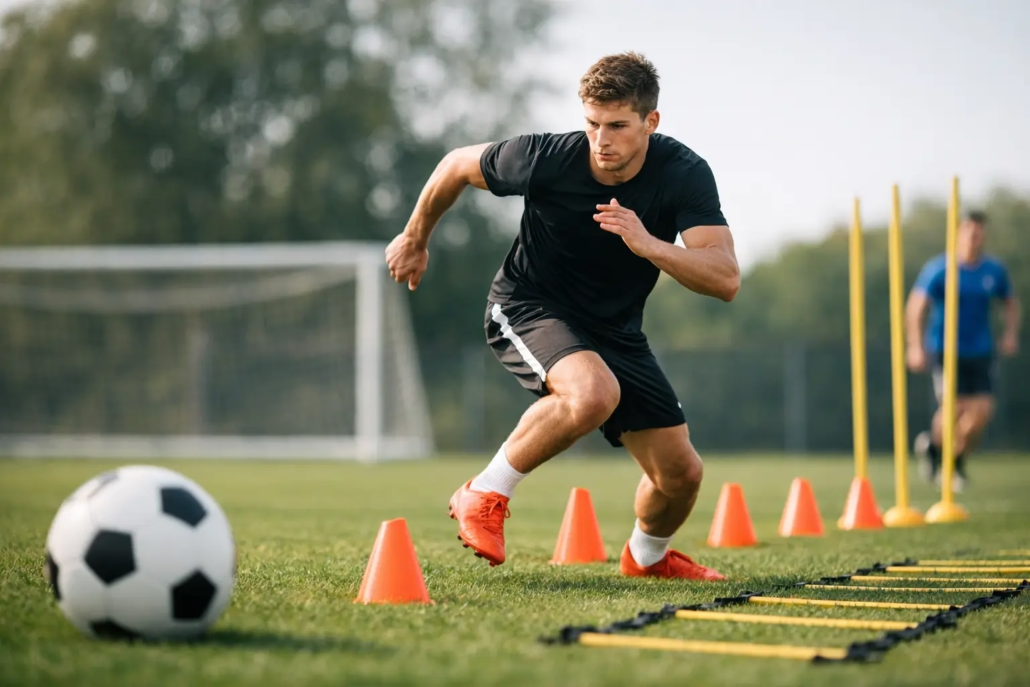
The gap between getting to the ball first and arriving half a step late usually is not effort. It is movement quality. Speed and agility training for soccer is not just about running fast in a straight line. It is about how quickly a player can start, stop, re-accelerate, adjust body position, and make the right decision while the game is moving around them.
That matters at every level. A young player needs it to build coordination and confidence. A serious club player needs it to press, recover, and separate in tight spaces. And for parents, it is one of the clearest areas where smart training produces visible results when the work is structured correctly.
What speed and agility training for soccer actually means
Too many players hear the word speed and think sprinting. They hear agility and think ladder drills. Both ideas are incomplete.
In soccer, speed includes acceleration over the first few yards, stride efficiency, balance during directional changes, and the ability to repeat explosive actions throughout a session or match. Agility goes even further. It includes deceleration, body control, reaction time, foot placement, and decision-making under pressure. A player who can turn quickly but loses the ball under pressure is not truly agile in a soccer context.
That is why quality training has to connect physical mechanics with soccer-specific movement. The game asks players to explode into space, shut down space, shift laterally, recover backward, and react to unpredictable cues. Training should reflect that reality.
Why straight-line speed is only part of the picture
Straight-line speed still matters. If two players read the same moment and one accelerates better, that player usually wins the action. But soccer rarely gives you a clean 40-yard runway.
Most decisive movements happen in short distances. Five yards. Eight yards. A quick angle change. A recovery run after a missed tackle. A first step to receive between lines. That means the first two or three steps often matter more than top-end sprint speed.
There is also a trade-off that coaches need to manage. Players can get better at moving fast in drills that look clean and predictable, yet still struggle in real match situations. Why? Because games are chaotic. The best speed and agility training for soccer teaches players how to produce force efficiently while reading cues, staying balanced, and executing with the ball or immediately after contact.
The foundation comes before the flash
For younger players especially, coordination comes before complexity. A player who cannot control posture, knee position, and foot strike does not need advanced reaction drills yet. They need a foundation.
That foundation includes posture, arm action, ankle stiffness, landing mechanics, and deceleration control. When those pieces improve, players become faster almost by default because they stop leaking energy through poor movement. They also reduce the kind of avoidable stress that comes from constantly cutting and stopping with bad mechanics.
This is where many families waste time. They chase advanced drills they see online without building the movement habits that make those drills effective. Serious development is usually less glamorous at the start. It is technical, repetitive, and measured.
How elite soccer speed is developed
The best programs do not treat speed as punishment or conditioning. They coach it like a skill.
Acceleration work teaches players how to project force forward with the right body angle and first-step intent. Deceleration work teaches them how to lower their center of mass, control momentum, and stop without losing balance. Change-of-direction training teaches them how to plant, reposition, and exit efficiently. Reactive work adds decision-making so the movement is connected to what actually happens in a match.
For advanced players, cognitive training becomes a separator. Reading a cue a fraction sooner changes everything. If the eyes, brain, and body are trained together, players do not just move fast. They play fast. That difference matters when pressure rises and space disappears.
Technology can help here when it is used with purpose. Tools such as reaction systems, movement tracking, and directional cue training can expose whether a player is truly improving or simply getting comfortable with a drill pattern. At Soccer Field Academy, that measurable approach is part of why players and parents can see development instead of guessing at it.
The biggest mistakes players make
One of the most common mistakes is doing everything at one speed. Players jog through warmups, rush through ladder patterns, then sprint only when told. Real speed development requires intention. Some reps should be technical and controlled. Others should be explosive and near full output. Mixing that up without a plan usually leads to mediocre results.
Another mistake is treating agility as foot speed only. Fast feet are useful, but they are not the main event. If a player can tap through a ladder quickly but cannot decelerate into a cut or react to pressure, the transfer to soccer is limited.
A third mistake is ignoring strength. Speed and agility are not separate from force production. Players need enough lower-body strength and core control to apply force into the ground, absorb force when stopping, and hold positions under contact. This does not mean every player needs a heavy lifting program. It does mean body control, stability, and age-appropriate strength work belong in the process.
Age matters in speed and agility training for soccer
Not every player should train the same way. That sounds obvious, but it is often ignored.
For early youth players, the priority is coordination, rhythm, balance, and body awareness. Training should feel athletic and engaging while teaching movement discipline. Short efforts, clean patterns, and simple reaction tasks work well.
For middle-school and early teen players, you can increase structure and demand. This is often the ideal window to clean up running mechanics, introduce sharper deceleration work, and build repeatable explosive habits.
For high school players with competitive goals, training needs to become more individualized. Position, maturity, strength levels, previous injury history, and match schedule all affect what the player needs most. A winger may need more repeated acceleration and lateral exit work. A center back may need more recovery speed, crossover mechanics, and braking control. One-size-fits-all training stops making sense as the player gets more serious.
What parents should look for in a training program
Parents do not need to be performance specialists, but they should know how to spot quality. First, look for coaching that actually teaches movement rather than just running kids through cones. If the coach cannot explain why a player is leaning too far back, overstriding, or cutting inefficiently, progress will be slower.
Second, look for progression. Good speed work builds from simple to advanced. Players should not be thrown into random reaction drills before they can control basic movement shapes.
Third, look for measurability. Improvement should show up in movement quality, confidence, and objective benchmarks when possible. Serious programs track development instead of relying on hype.
Finally, look for an environment that matches the player’s ambition. Some athletes need a fun introduction to movement. Others need a high-performance setting with clear standards and accountability. The right fit depends on the player, but the standard should always be purposeful coaching.
How this training shows up on the field
When speed and agility work is done well, the game starts to look different. Players get off pressure earlier. They recover faster after mistakes. They arrive to duels in stronger body positions. Defenders close space with more control instead of diving in. Attackers create small windows of separation that become real chances.
Confidence changes too. A player who trusts their movement is more willing to press, attack space, and compete in transition moments. That confidence is not motivational fluff. It comes from repetition, technical correction, and proof that the body can handle the demand.
There is no shortcut here. Speed and agility training for soccer works best when it is consistent, coached, and connected to how the game is actually played. Some players improve quickly because they were never taught proper mechanics. Others improve more gradually because they are refining small details at a higher level. Both paths are valid if the training is honest and specific.
The right program does more than make a player look quick in drills. It builds an athlete who can move with control, react under pressure, and perform at speed when the moment matters most. That is the standard serious players should train for.
