
Soccer Strength Training Guide for Youth Players
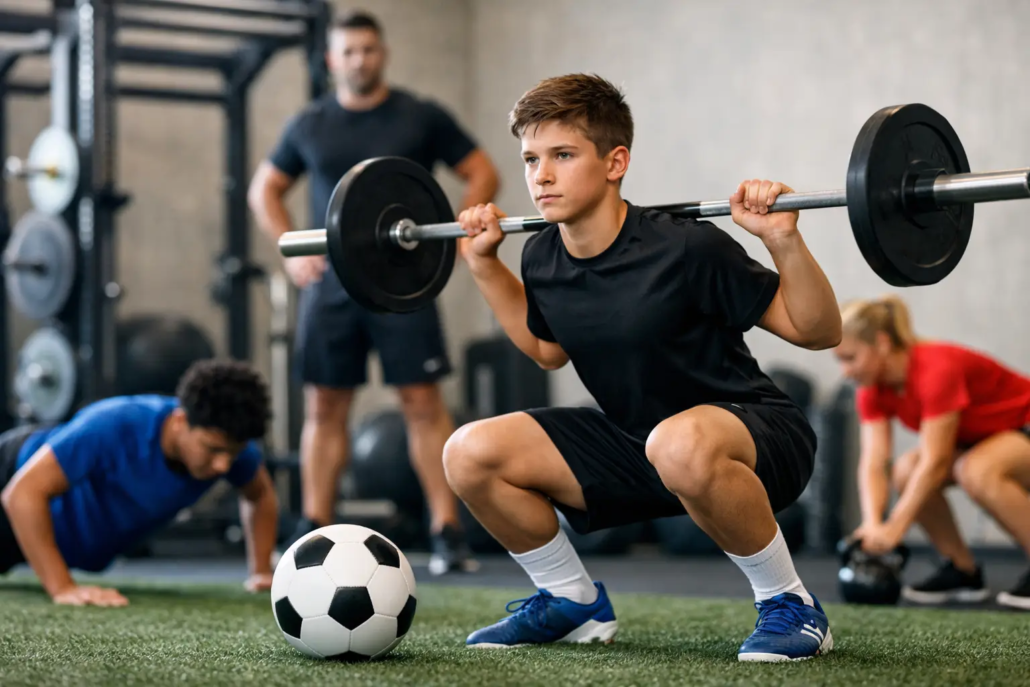
Saturday looks great until the 68th minute. The first touch gets heavy, the recovery run is a step late, and every 50-50 feels harder than it should. For most youth players, that drop-off is not just a conditioning issue. It is a strength issue. A smart soccer strength training guide helps players move better, hold off pressure, decelerate safely, and repeat high-speed actions without breaking down.
Parents often hear the word strength and picture heavy barbells or bodybuilding routines that do not belong in youth soccer. Serious player development works differently. Strength training for soccer is not about adding size for its own sake. It is about building a more efficient athlete – one who can sprint, stop, cut, jump, absorb contact, and stay available across a long season.
What a soccer strength training guide should actually build
The best soccer players are not just strong. They are strong in the patterns the game demands. That starts with lower-body force production, but it also includes trunk control, single-leg stability, posture, landing mechanics, and the ability to transfer power from the ground through the body.
In practical terms, a strong soccer player can accelerate in fewer steps, protect the ball under contact, and change direction without losing balance. Just as important, that player can tolerate the repeated stress of training and matches. Strength is performance, but it is also durability.
For younger players, the first goal is movement quality. Can they squat with control, hinge at the hips, lunge without collapsing inward, and land softly from a jump? For older and more competitive players, the goal expands. Now we want to improve force, rate of force development, asymmetry management, and the physical qualities that support speed and repeatability.
Why soccer strength training matters more than most families realize
Technical quality still leads the sport. A player who cannot scan, receive cleanly, and execute under pressure will not solve that with the weight room. But when two players are technically close, the stronger athlete usually wins more moments.
That edge shows up in obvious ways, such as shielding and tackling, and in less obvious ones, such as posture late in the game, consistency of first-step speed, and the ability to decelerate before a cut. Many non-contact injuries happen during braking, not sprinting. If a player cannot control force, speed becomes harder to use safely.
There is also a confidence effect. Players who feel physically prepared play with more intent. They press harder, commit to duels, and recover mentally after contact because they trust their body. That matters for development, especially in adolescent years when the game gets faster and more demanding.
Age matters in any soccer strength training guide
One mistake parents make is asking whether strength training is good or bad for youth athletes. The real question is what kind, at what age, and under what coaching.
For ages 6 to 9, formal strength work should look like organized movement training. Bodyweight squats, crawling patterns, skipping, landing mechanics, low-level jumps, and basic core control are enough when coached well. The objective is coordination and body awareness, not fatigue.
For ages 10 to 13, players can handle more structure. This is a strong window for teaching technique with goblet squats, split squats, step-ups, hinges, rows, push-up progressions, and controlled medicine ball work. If movement quality is built here, later performance training becomes much more effective.
For ages 14 to 18, training can become more progressive and individualized. Some players are ready for trap bar deadlifts, loaded squats, more advanced unilateral work, and higher-intent power exercises. Others still need to fix basic mechanics. Biological age, training age, and competition level all matter. Two 15-year-olds can need completely different plans.
The foundations: movement before load
A high-level program does not start by asking how much weight a player can lift. It starts by asking how well they move. If knees collapse on a squat, if the trunk folds on a sprint start, or if every landing is loud and uncontrolled, load is not the first answer.
This is where elite coaching separates real development from random workouts. Players need eyes on mechanics. They need coaching that can identify whether a limitation is mobility, stability, coordination, or simple inexperience. Loading bad movement patterns only reinforces inefficiency.
Good early progress often looks simple: cleaner split-squat positions, stronger single-leg balance, better hip control, and smoother deceleration. Those changes may not look dramatic on social media, but they are exactly what transfer to the field.
The key qualities every player should train
Lower-body strength is the backbone. Squat patterns, hinge patterns, and unilateral exercises build the force needed for acceleration, jumping, and contact. Single-leg work matters especially because soccer is played one leg at a time.
Core training should be treated as trunk control, not endless sit-ups. Players need to resist rotation, maintain posture, and connect upper and lower body during sprinting, striking, and defending. Anti-rotation holds, carries, and controlled dynamic patterns usually do more for soccer than high-rep ab circuits.
Power deserves a place too, but only after mechanics are in place. Jumps, bounds, and medicine ball throws teach players to express force quickly. That said, power training is not just about being explosive. It is also about learning to land and absorb force under control.
Upper-body training is often underused in youth soccer. It should not dominate the week, but it matters. Stronger upper backs, shoulders, and arms help posture, balance, shielding, and contact tolerance.
How often should youth players train for strength?
It depends on the season, age, and total workload. In-season players with multiple team sessions and weekend matches may only need one to two quality strength sessions per week. That is often enough to maintain or gradually improve if the work is targeted.
In the off-season, two to three sessions per week usually makes sense. This is the best time to build capacity because match stress is lower and there is more room to progress. For advanced players, the off-season is where meaningful physical gains are made.
More is not always better. If a player is constantly sore, flat in training, or losing sharpness on the ball, the program may be too aggressive or poorly timed. Soccer performance training has to fit the soccer calendar, not compete with it.
Common mistakes that slow development
The biggest mistake is copying adult programs. Youth athletes do not need bodybuilding splits, random max lifts, or conditioning circuits that ruin movement quality. They need coaching, progression, and purpose.
Another mistake is treating speed, strength, and conditioning as separate worlds. They are connected. Stronger mechanics improve sprinting. Better trunk control improves change of direction. Smarter loading supports recovery and availability.
Many players also skip recovery habits. Sleep, hydration, and nutrition are not extras. A player who trains hard but recovers poorly will stall. Growth-phase athletes especially need enough fuel to support both development and performance.
A final mistake is chasing fatigue instead of results. A hard workout is not automatically a productive one. The goal is not to leave the facility exhausted. The goal is to leave better.
What parents should look for in a program
A serious soccer strength training guide should lead families toward coaching that is age-appropriate, progressive, and measurable. Ask how movement is assessed. Ask how sessions are adjusted for beginners versus advanced players. Ask how the program fits around team training and match load.
Look for an environment that values technique and long-term development over ego lifting. The strongest youth programs blend coaching expertise, clear progression, and data where it adds value. Tools that measure speed, reaction, and movement efficiency can sharpen development when they support coaching rather than replace it.
For families in Columbus, Ohio, that matters even more during the winter months when consistent indoor training can keep physical development moving instead of stopping for a season. The best environments do not just keep players active. They build them with intention.
Soccer strength training guide takeaways for serious development
If your player wants to become faster, more resilient, and more confident under pressure, strength training belongs in the plan. Not as a side project. Not as a trend. As part of long-term athlete development.
Done right, strength training gives technical ability a stronger platform. It helps the player who is getting pushed off the ball, the player who fades late, and the player coming back from repeated minor issues that never seem to go away. It also teaches discipline – the kind that serious athletes need when progress is measured over months, not one session.
The right program meets the player where they are, builds what the game demands, and respects that development is a process. Grind now, shine later only works when the work is structured. Start there, and the game starts to look different.