
Soccer Highlight Creation That Gets Coaches Watching
A college coach may give a player’s video less than two minutes before deciding whether to keep watching. That is why soccer highlight creation is not about adding dramatic music or collecting every goal from a season. It is about presenting clear evidence that a player can solve game problems at speed, under pressure, and within a team structure.
For ambitious youth players, a strong highlight reel can support the recruiting process, help coaches evaluate progress, and create a useful record of competitive performance. But video cannot manufacture ability. The best reels are built on the same foundation as player development: consistent training, smart decisions, technical quality, and disciplined match habits.
What Coaches Want From Soccer Highlight Creation
Recruiters do not need a movie trailer. They need to see whether a player’s actions translate to the level they coach. A well-built reel makes that evaluation easier by showing the player in real game contexts instead of isolating only the final pass, shot, or tackle.
For an attacking player, that might mean showing the run before receiving the ball, the first touch away from pressure, and the decision that creates the chance. For a defender, it may mean recognizing danger early, adjusting body position, winning the duel, and making the next pass. Goalkeepers should show communication, starting position, handling, distribution, and recovery after a first save.
The strongest clips answer practical questions: Can this player scan? Do they play with both feet? Can they handle contact? Are they quick enough mentally when the game speeds up? Do they compete after losing the ball? A goal can be impressive, but a smart sequence that reveals awareness and composure may tell a coach more.
This is where parents and players often make a mistake. They build a reel around only the most obvious highlights. A player who scores three long-range goals may look exciting, but a coach also wants to understand how that player contributes when the ball is not arriving perfectly.
Build the Reel Around Position and Level
There is no single ideal highlight video because the right evidence depends on position, age, and competitive target. A 12-year-old seeking a more competitive team does not need the same video as a high school junior contacting college programs. Younger players should use video primarily to review learning and build confidence. Older players can use it as one part of a recruiting package, alongside academic information, game schedules, and full-match film.
Position should guide clip selection. Center backs need clips that show reading the game, defending space, aerial ability, recovery speed, and calm distribution. Outside backs should include moments of 1v1 defending, overlapping runs, crossing, and transition decisions. Midfielders need to show receiving on the half-turn, playing forward, managing pressure, and covering ground on both sides of the ball.
Wingers and forwards should not rely only on finishes. Include movement to separate from defenders, ball retention, combination play, pressing, and chance creation. For goalkeepers, quality matters more than volume. A sequence that shows a save, a quick reset, and a composed outlet can be far more valuable than several isolated highlight saves.
Competitive level matters, too. Video against meaningful opposition carries more weight than a clip from a one-sided match. That does not mean players should wait for a perfect game. It means they should be honest about the context and prioritize clips where the pace and pressure reveal their true level.
Start With Full-Game Film, Not Random Clips
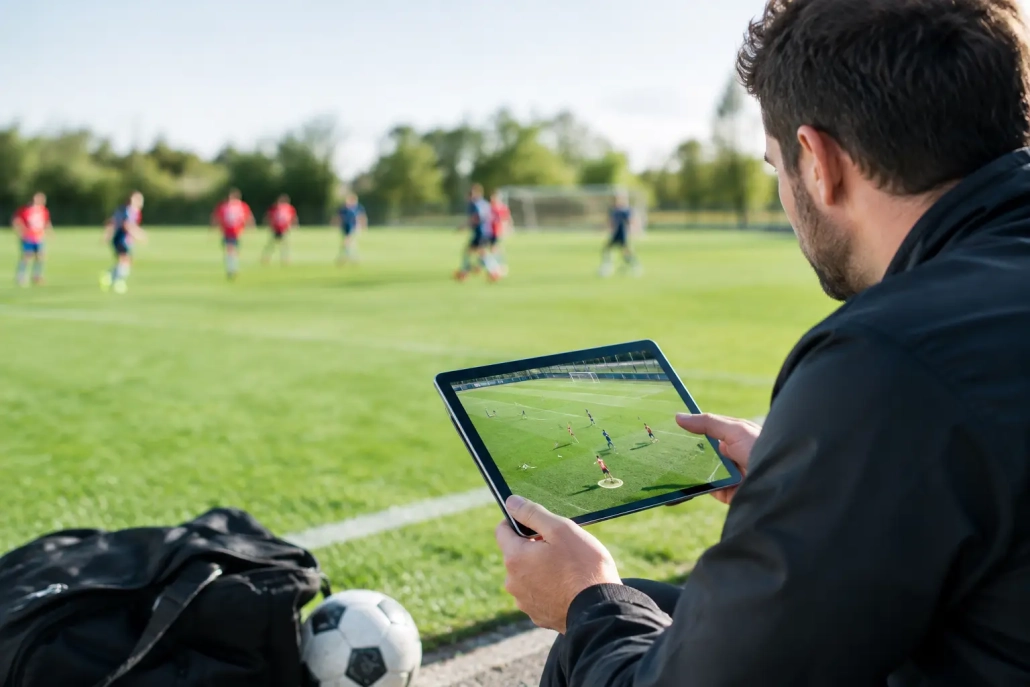
The quality of the final reel depends on the quality of the footage. Record full matches whenever possible, using a stable elevated angle that allows viewers to see the player, teammates, opponents, and developing space. A camera pointed only at the ball may capture the final action but miss the decision-making that led to it.
Before editing, watch each game with a purpose. Do not simply search for goals or assists. Mark moments where the player performed a position-specific action well: a successful press that forces a turnover, a well-timed recovery run, an intelligent switch of play, a clean first touch in traffic, or a defensive communication moment if audio is usable.
This process takes time, which is exactly why it has value. Reviewing full matches trains players to see their own habits. They begin to recognize that their performance is not defined by one spectacular moment. It is defined by repeated actions, especially when tired, frustrated, or under pressure.
At Soccer Field Academy, technology-driven sessions and professional coaching can help players connect film review to specific development targets. If video shows a player struggling to receive with their back to goal, that is not a reason to hide the clip. It is a clear training priority for technical work, scanning habits, strength, and decision-making.
How to Structure a Soccer Highlight Reel
Keep the opening simple. Put the player’s name, graduation year, position, team, jersey number, and contact information on screen briefly. Then begin with the strongest clip. Do not make a coach wait through a long introduction, slow-motion montage, or a collection of logos.
Most youth recruiting reels work best when they stay focused. For many players, three to five minutes is enough to show range without repeating the same action. A younger player making a team video may need even less. If the reel reaches ten minutes, the problem is usually not a lack of talent. It is a lack of editing discipline.
At the start of each clip, identify the player clearly with a circle, arrow, or subtle freeze frame. Remove the marker once the play begins. Coaches need a quick orientation, but they also need to watch the player move naturally without graphics covering the action.
Let each play begin early enough to establish context and end after the result. A through ball is more meaningful when viewers can see the player scan, move, receive, and choose the final pass. A tackle is more meaningful when viewers can see whether the player transitions into the next action.
Music is optional and usually unnecessary. If it distracts from the footage, skip it. Clean editing, accurate information, and strong clips create a more professional impression than effects ever will.
Common Mistakes That Reduce Credibility
The first mistake is making a video that is all goals. Finishing matters, but coaches recruit complete players. The second is using clips that are too short or start too late, leaving no way to assess the player’s decision.
Another common issue is poor identification. If a recruiter cannot quickly find the athlete, they may move on. Keep the player’s jersey number consistent in the opening information and make the first few seconds of every clip easy to follow.
Players should also avoid overstating their role or level. A reel should represent what happened, not what the player wishes happened. Heavy editing, repeated clips, misleading labels, and footage from years earlier can damage trust. Honest film gives coaches a better reason to request a full match.
Finally, do not treat the reel as a substitute for development. A highlight video may open a conversation, but training habits and live performance determine what happens next. Coaches will eventually see full games, attend matches, or ask detailed questions about the player’s role and competitive environment.
Use Video to Drive Better Training
The most valuable use of game footage happens before the reel is published. After every match, choose one or two moments to review with a coach or parent. Ask what the player saw, what options were available, and what technical or physical factor influenced the choice. Keep the discussion specific.
A midfielder who repeatedly receives square may need to improve shoulder checks before the ball arrives. A defender who gets beaten on the dribble may need better distance, angle, and acceleration mechanics. A forward who disappears from games may need sharper movement between lines and a stronger pressing work rate. Film turns vague feedback into visible evidence.
That is the standard serious players should bring to soccer highlight creation. Build a concise reel that makes evaluation easy, but keep using the footage to expose the next area of growth. The clips that matter most next season will be created by the work the player chooses to do now.