
Private Coaching vs Team Training in Soccer
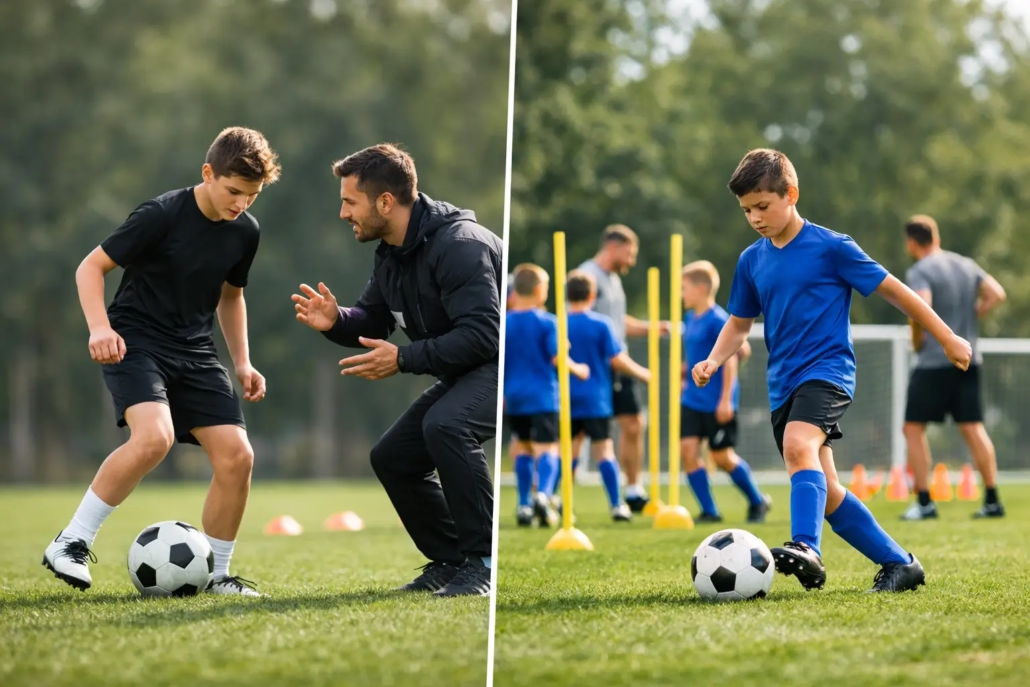
A player can spend four nights a week in team sessions and still struggle with the same first touch, the same weak-foot hesitation, and the same slow decision under pressure. Another player may add one focused private session each week and suddenly look sharper, calmer, and more confident on game day. That is the real conversation behind private coaching vs team training. It is not about which option sounds more serious. It is about which training environment solves the problem in front of the player.
For families trying to make the right investment, that distinction matters. Team training and private coaching are both valuable, but they produce different outcomes because they are built for different jobs. One develops collective play and tactical function. The other targets individual gaps with precision. Serious development usually requires understanding where each one fits.
Private coaching vs team training: what changes on the field?
Team training is designed around the group. Coaches need to organize shape, timing, spacing, transitions, and decision-making within a system. Players learn how to press together, combine in channels, rotate positions, and solve game situations with teammates around them. For match preparation and tactical understanding, that environment is essential.
But team training has limits, even in strong programs. A coach working with 12 to 18 players cannot stop every repetition to rebuild one athlete’s body position, passing mechanics, or scanning habits. The session has to keep moving. That means many players get exposure, but not always correction at the level needed to change a weakness quickly.
Private coaching flips that model. The player becomes the entire session plan. Every rep is tied to a need: receiving across the body, striking cleanly with the weak foot, improving acceleration mechanics, developing tighter turns under pressure, or reading cues earlier. Feedback is immediate. Repetitions are higher. The standard is personal, not general.
This is why private coaching often creates visible technical improvement faster. The player gets concentrated work on details that team environments rarely have time to isolate. That does not make private coaching better in every case. It makes it more effective for specific goals.
When team training is the right tool
If a player needs to understand how the game works, team training cannot be replaced. Soccer is not an individual sport performed next to other people. It is a connected game built on timing, spacing, communication, and decision-making around teammates and opponents.
A winger must learn when to stay wide and when to attack inside. A center back must read pressure, cover angles, and organize the line. A midfielder must scan before receiving and understand the next pass before the ball arrives. These habits develop in game-like environments where the player has to solve live situations with others.
Team training also teaches accountability inside a group. Players learn role discipline, tempo, and the mental demands of competing within a squad. That matters for long-term development, especially as athletes move into higher-level environments where tactical execution is non-negotiable.
For younger players or newer players, team settings can also build confidence through structure and repetition. They get rhythm, social connection, and match-relevant experience. If the player still needs broad exposure to the game, team training is often the foundation.
When private coaching is the right tool
Private coaching becomes valuable when a player has a gap that is holding back performance. Sometimes that gap is technical. Sometimes it is physical. Sometimes it is cognitive. The key is that the issue is specific enough to train directly.
A player who avoids using the left foot is not going to solve that through general possession games alone. A striker who mistimes finishing runs may need repeated, coached patterns. A defender who panics under pressure may need detailed work on first touch, body shape, and scanning before receiving. In those cases, individualized training creates a faster path forward because the session is designed around one athlete’s constraints.
Private coaching is also useful for advanced players whose team sessions are no longer enough to separate them. At higher levels, improvement comes from margins. Cleaner touches. Faster release. Better movement efficiency. Sharper recognition. Players chasing elite outcomes often need targeted work beyond the team calendar.
That is where a high-performance environment matters. Licensed coaching, clear benchmarks, and tools that measure reaction speed, ball mastery, and movement quality can turn private sessions from extra work into directed development. More training is not the goal. Better training is.
The trade-off parents should understand
The biggest mistake is treating private coaching and team training like interchangeable products. They are not. One builds the individual from the inside out. The other tests that individual inside the realities of the game.
If a player does only team training, technical weaknesses can hide for too long. The athlete may compete hard, understand shape, and still lack the clean execution required in high-pressure moments. Progress becomes slower because foundational flaws never get enough focused attention.
If a player does only private coaching, another problem can appear. The athlete may look excellent in isolated work but struggle to transfer those gains into real team play. Soccer intelligence requires context. A polished move means little if the player cannot recognize when to use it, or if they cannot execute it at game speed with pressure, teammates, and tactical consequences.
This is why the right answer is often not either-or. It is sequencing and balance.
How to choose between private coaching vs team training
Start with the player’s actual bottleneck, not the parent’s assumption. Ask a simple question: what is most limiting performance right now?
If the player struggles with confidence on the ball, weak-foot quality, receiving under pressure, striking technique, or speed mechanics, private coaching is often the better short-term investment. These are individual performance issues that improve through precise correction and repetition.
If the player struggles with positioning, reading the game, communication, decision-making within formations, or adapting to teammates, team training may be the priority. Those are collective game problems that need live context.
Age and stage matter too. A 7-year-old still building coordination and comfort on the ball may benefit from a strong developmental group setting with occasional individual support. A 14-year-old chasing top club minutes, high school impact, or future college opportunities often needs both. The standards rise with age, and gaps become more expensive.
Training frequency matters as well. If a player already attends quality team sessions several times a week but is not progressing in one key area, adding private coaching can create breakthrough results. If the player has very little game exposure, extra private sessions alone will not solve the issue.
The strongest model is usually integrated development
The most effective player-development systems do not force a false choice. They build layers. Team training develops tactical awareness, competitive habits, and functional execution in live environments. Private coaching sharpens the tools the player brings into those environments.
That is where real acceleration happens. The player fixes a technical flaw in one-on-one work, then applies it in team sessions. The team environment exposes the next weakness, and individual coaching addresses it. Progress becomes measurable because the two formats feed each other.
For example, a player may use private sessions to improve first touch, scanning, and turning under pressure. In team training, those gains start showing up as cleaner possession, faster combinations, and better decisions in tight spaces. That is development with transfer, not just activity.
In a serious academy setting, this integrated approach can be even stronger when it includes measurable feedback. Technology-based training tools, performance testing, and coach-led progressions give families something better than guesses. They provide evidence. For players with big goals, that level of structure matters.
What serious families should look for
Not all private coaching is high level, and not all team training is developmental. The label alone tells you very little. What matters is the training design.
Look for coaching that identifies the player’s needs clearly, sets a progression, and teaches with detail. Look for sessions that demand concentration, not just effort. Look for an environment that treats confidence as something earned through competence. And look for standards that match the player’s ambition.
In Columbus, Ohio, families who want that kind of structure often look beyond basic extra training and toward a full development model. Soccer Field Academy is built around that idea – combining team-based progression, private coaching, licensed instruction, and measurable tools to help players improve with purpose.
The best choice is not the one that sounds elite. It is the one that moves the player forward in the area that matters most right now. Make that decision honestly, and the results tend to show up where they should: in cleaner habits, stronger confidence, and better performances when the game gets fast.
