
Is Indoor Soccer Good for Development? What It Builds
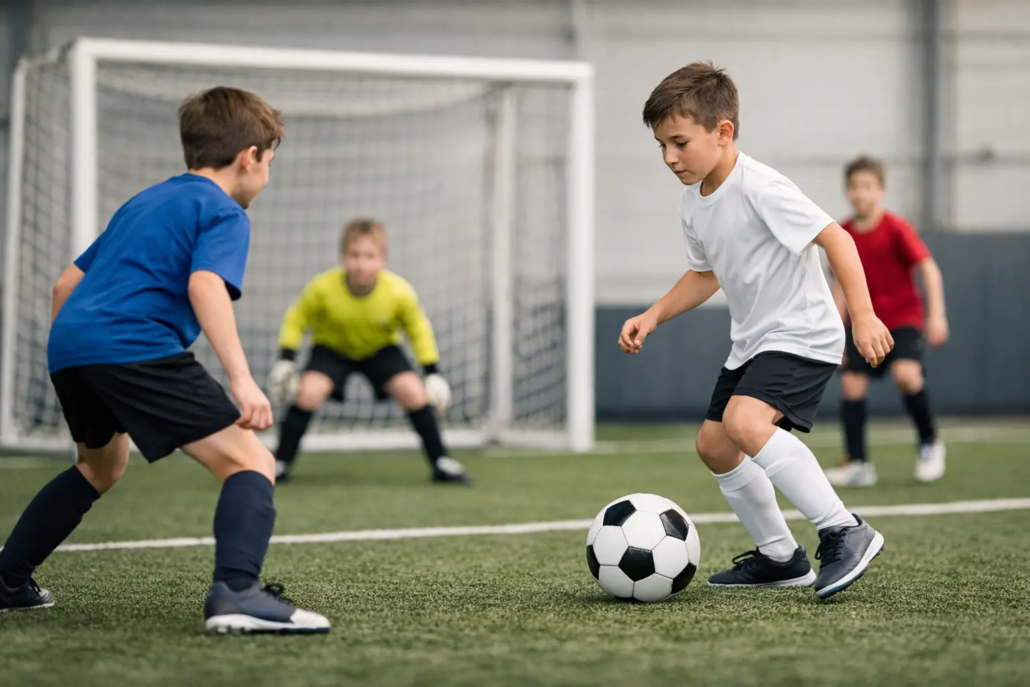
A player receives the ball near the wall, has a defender closing from one side, and has less than a second to decide: turn, protect, pass, or beat the pressure. That repeated demand is why parents ask, is indoor soccer good for development? When the environment is coached with purpose, the answer is yes. Indoor soccer can accelerate technical confidence, speed of thought, and comfort in tight spaces – all qualities that matter when the game moves outdoors.
But indoor training is not a replacement for the full outdoor game. It is a development tool. Used within a structured year-round plan, it can sharpen the individual skills that allow players to perform with greater confidence on larger fields.
Is Indoor Soccer Good for Development? Yes, With Intentional Coaching
Indoor soccer changes the demands on a player. The field is smaller, the action is faster, and there is less room to hide from the ball. Players receive more touches, face more 1v1 moments, and make more decisions under pressure than they often do during a traditional outdoor match.
That matters because development is built through quality repetitions. A young player does not become composed on the ball by standing wide while play happens somewhere else. They improve by receiving, scanning, controlling, protecting, passing, and reacting again and again. Indoor play creates those moments at a high frequency.
The value, however, depends on how the session is run. Unstructured indoor games can be fun and energetic, but they do not automatically produce better players. Elite development requires coaches who can teach body shape, first-touch direction, awareness, defensive positioning, and the decision behind each action. Players need correction, not just activity.
What Indoor Soccer Builds in Young Players
Faster technical execution
The smaller space indoors exposes heavy touches immediately. If a player cannot control the ball cleanly, an opponent is already there. If their passing technique is loose, the ball is intercepted or rolls out of play. That immediate feedback helps players understand why details matter.
Over time, players learn to receive with the proper surface, move the ball away from pressure, and pass with the correct weight. They begin using both feet because the game does not always give them time to shift the ball onto a preferred side. For younger players, this builds coordination and comfort. For competitive players, it develops the precision needed to play at a higher speed.
Better decisions under pressure
Outdoor soccer can give players more time and more space. Indoor soccer removes both. Players must scan before the ball arrives and recognize the next action quickly. They must also understand that the best decision is not always the most exciting one.
A player may need to keep possession instead of forcing a dribble. They may need to use a wall pass, play backward, or protect the ball until support arrives. These are tactical habits that transfer directly to outdoor soccer, where players who think one step ahead often separate themselves.
Confidence in 1v1 situations
Indoor soccer produces frequent duels. Attackers learn how to use changes of direction, body feints, and explosive first steps. Defenders learn to close space, stay balanced, and avoid diving into tackles. Both sides gain confidence because they are repeatedly placed in moments where they must solve a problem independently.
This is especially valuable for players who are technically capable but hesitant in matches. Confidence is not built by telling a player to be brave. It is built when they practice difficult situations, make mistakes in a coached environment, and see that they can handle the next repetition better.
Improved reactions and athletic movement
The pace of indoor play requires quick starts, stops, turns, and changes of direction. Those movements support athletic development when they are taught correctly and balanced with appropriate strength, mobility, and recovery.
A quality program should not treat speed as simply running hard. Players need to learn efficient movement patterns, posture, deceleration, and the ability to react to visual cues. Tools such as Speed Court training can help make those qualities measurable while reinforcing the connection between physical speed and game awareness.
Where Indoor Soccer Has Limits
Parents should be careful of any program that presents indoor soccer as the only answer. The outdoor game still demands skills that cannot be fully replicated on an indoor field: longer passing ranges, aerial service, large-field spacing, transition runs, weather adaptation, and the physical demands of 11v11 competition.
There is also a tactical difference. Indoor players are often close together, while outdoor players must learn when to create width, stretch a back line, and recognize space behind defenders. A player who excels in tight indoor spaces still needs outdoor training to understand the rhythm and positioning of the full game.
The strongest development plan uses both environments. Indoor training builds detail, sharpness, and decision-making. Outdoor sessions teach players how to apply those qualities across the larger tactical picture. Rather than choosing one over the other, serious players should use each setting for what it does best.
The Right Indoor Environment Matters
Not every indoor program produces the same result. A productive environment has clear expectations, age-appropriate groups, purposeful coaching, and enough ball contact for every player. It should be demanding without becoming chaotic.
For players ages 2 through 6, indoor soccer should emphasize movement, balance, basic coordination, listening skills, and a positive relationship with the ball. The goal is not tactical complexity. It is helping children develop confidence, enthusiasm, and foundational habits before competition becomes more serious.
For players in the elementary and middle school years, the focus can progress toward first touch, dribbling under pressure, passing combinations, defending, and game awareness. This is a critical period to build habits before players face the faster, more physical demands of competitive soccer.
Older competitive players need more than open play. They need targeted work connected to their position, technical gaps, athletic profile, and long-term goals. Private coaching, small-group sessions, video-informed feedback, and technology-based repetition can all help turn effort into measurable progress. At Soccer Field Academy, this kind of progression allows players to move from foundational training to higher-performance pathways without losing the technical details that make the difference.
How Parents Can Tell If Indoor Training Is Helping
The best indicator is not whether a child scores the most goals in an indoor league. Look for changes that appear in training and outdoor matches. Is your player receiving the ball with more confidence? Are they using both feet? Do they recover faster after a mistake? Are they seeing options sooner and making calmer decisions under pressure?
Ask whether coaches provide specific feedback and whether training has a clear progression. A player should understand what they are working on, why it matters, and what improvement looks like. For advanced athletes, objective tools such as SoccerBot360 can add useful data around touch volume, reaction, and technical consistency, but data should support coaching judgment rather than replace it.
Also consider the player’s overall schedule. Indoor soccer is most effective when it adds quality work without creating burnout. Younger athletes need variety and enjoyment. Older players need recovery, strength work, and time to apply their training in meaningful outdoor competition. More sessions are not always better. Better sessions are better.
Make Indoor Work Transfer to the Outdoor Game
The key question after every indoor session should be simple: what will this help the player do on a full field? A tight-space possession exercise should improve the ability to keep the ball under pressure outdoors. A fast 1v1 drill should help an attacker create separation on the wing or help a defender stay composed in isolation. A finishing exercise should improve movement, preparation touches, and decision-making near goal.
When coaches make that connection clear, indoor training becomes more than a winter option. It becomes a high-performance setting where players develop the habits that show up when the game gets faster, tighter, and more demanding.
The player who learns to stay calm when space disappears will not suddenly become calm on game day. They will recognize the moment because they have trained for it, repeated it, and earned the confidence to solve it.

