
How to Choose Indoor Soccer Drills That Build Players
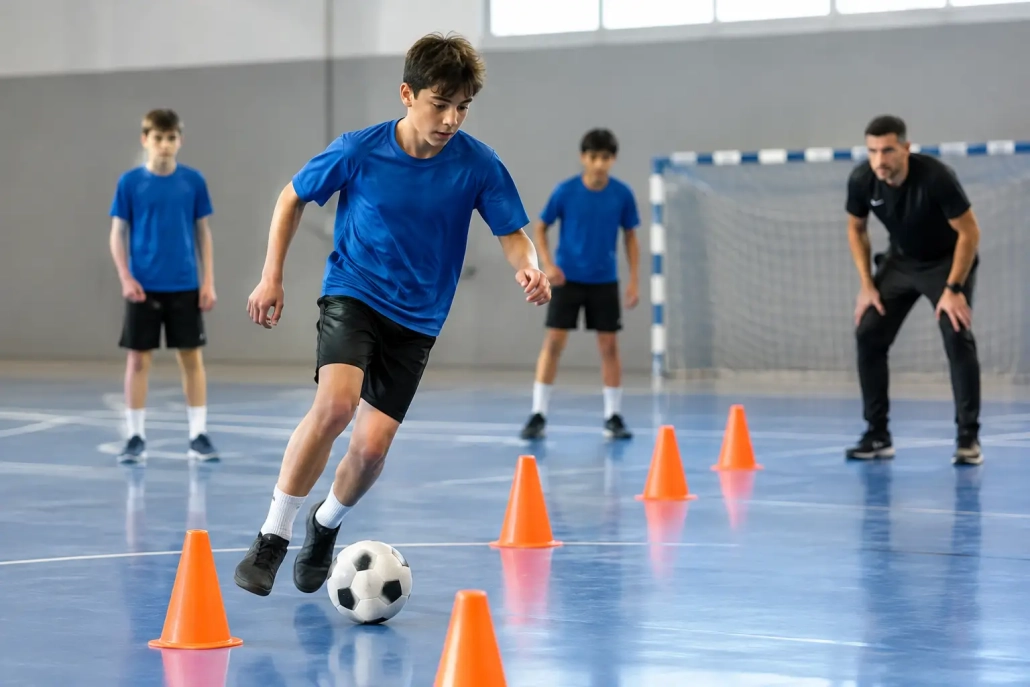
A player can spend an hour indoors getting hundreds of touches and still leave without improving the part of the game that matters most. The difference is drill selection. Knowing how to choose indoor soccer drills means matching the session to the player, the space, and a specific development outcome – not simply filling time with fast-paced activities.
Indoor training creates a major advantage for young players: consistent repetitions in a controlled environment, regardless of the Ohio weather. But smaller spaces also expose weak habits quickly. A drill that is too easy produces empty touches. A drill that is too complex creates frustration and poor technique. The right drill places the player under enough pressure to grow while preserving the quality needed to build confidence.
Start With the Skill Gap, Not the Drill Library
Parents and players often begin with the question, “What are the best indoor drills?” A better question is, “What does this player need to improve next?” Elite development is built on diagnosis before activity.
For a young beginner, the priority may be balance, coordination, comfort with the ball, and learning to use both feet. For a competitive player, it may be receiving on the half-turn, accelerating after a change of direction, scanning before the first touch, or executing under time pressure. Those needs require different drills, different coaching language, and different levels of challenge.
Choose one primary objective for each session. A session designed to improve close control should not become a finishing clinic halfway through. A player can work on supporting skills within the same practice, but the central outcome should remain clear enough that both coach and player can measure it.
A useful test is simple: if you cannot explain in one sentence what the drill is developing, it is probably too broad. “Improve 1v1 moves at game speed” is clear. “Get lots of touches” is not a development plan.
How to Choose Indoor Soccer Drills by Age and Stage
Age matters, but developmental stage matters more. Two players of the same age can have very different needs based on coordination, playing experience, confidence, and competitive environment.
Ages 2 to 6: Build comfort and movement
At this stage, drills should feel active and imaginative while quietly building athletic foundations. Players need to learn how to stop, start, turn, protect personal space, and manipulate a ball without fear of making a mistake. Short activities with simple cues work best because attention spans are limited.
Avoid long lines, complicated rules, and drills that require waiting for a turn. The player should be moving frequently, touching the ball often, and hearing clear encouragement. A dribbling game that asks a young player to change direction around cones is more valuable than a technical pattern they cannot yet understand.
Ages 7 to 11: Build technique under light pressure
This is a critical window for technical development. Players can begin to refine dribbling surfaces, first touch, passing weight, turning, and simple 1v1 actions. Indoor drills should increase repetition, but repetition alone is not enough. Add a defender, a time limit, a target, or a decision to make the technique transferable to matches.
For example, a player may first practice a pull-push turn without pressure. Once the movement is clean, add a defender recovering from behind or a gate the player must attack after the turn. The progression teaches the player not only how to perform the action, but when and why to use it.
Ages 12 to 18: Build speed of play and decision-making
Older and more competitive players need drills that connect technical precision to game intelligence. The indoor environment is especially valuable because limited space forces quicker scanning, sharper first touches, and faster decisions.
Choose activities with realistic constraints. Give the player a directional first touch, a pressing defender, a limited number of touches, or a transition moment after the action. A high-level player should not finish a session saying only, “I worked hard.” They should be able to identify what decision became faster, what technique held up under pressure, and what needs further work.
Match the Drill to the Indoor Environment
An indoor field, turf lane, court, or training room changes what is possible. Good drill selection respects the environment rather than copying an outdoor practice into a smaller area.
Small-sided games, 1v1 battles, tight-space possession, reaction work, and combination passing are often excellent indoors because they reward awareness and ball mastery. Long passing patterns and full-field tactical exercises may be less practical unless the facility has enough space and the session has a clear reason for using them.
Safety also shapes the drill. Confirm there is enough separation between players, equipment, and walls. Keep high-speed movements away from congested areas. Use ball size, cone spacing, and target dimensions that fit the player’s age and the training surface. A drill that works perfectly on a full outdoor field can become unsafe or ineffective when squeezed indoors.
The facility should add value, not just provide a roof. At Soccer Field Academy, indoor work can be paired with tools such as SoccerBot360 and Speed Court training when the player’s goals call for technical repetition, reaction speed, or cognitive challenge. Technology is useful when it produces a measurable training target. It should never replace quality coaching or game-based decision-making.
Use Progressions Instead of Constantly Changing Drills
Players do not need a new drill every five minutes. They need enough repetition to understand the movement, followed by the right progression to test whether they can execute it under pressure.
A strong indoor sequence often moves from controlled to competitive. Start with an unopposed technical pattern to establish body shape and footwork. Then add a directional target, an opponent, and finally a consequence for success or failure. The drill becomes more demanding without changing the core skill.
Consider a player working on receiving the ball. First, they receive and pass through a gate. Next, they must check a shoulder before receiving. Then, a defender applies pressure from one side, forcing the player to choose a safe first touch. The technical action stays the same, but the decision becomes increasingly game-like.
This approach also gives coaches a clearer view of the player’s real level. If technique disappears as soon as pressure is added, the player may need more work at the earlier stage. That is not failure. It is useful information.
Look for Drills That Include Perception and Decision-Making
Soccer is not a cone sport. Cones are helpful for organizing space and teaching movement patterns, but they do not react, press, or create uncertainty. The best indoor soccer drills require players to see, decide, and execute.
Add visual or verbal cues whenever appropriate. A coach can call a color before the player turns, show a number that determines the target, or position a defender to close one route. These details train the player to lift their head, process information, and adjust their action.
This does not mean every drill must be complicated. Young players benefit from simple decisions, such as choosing between two gates. Advanced players can handle layered problems, including receiving with a defender behind them and a limited passing window ahead. The level of complexity should challenge the player without turning the drill into confusion.
Measure What the Drill Produces
A quality drill should give you evidence of progress. That evidence may be a number, a video clip, coach observation, or the player’s ability to explain what changed. Without a feedback loop, it is easy to mistake activity for improvement.
Track outcomes that fit the objective. For ball mastery, count clean repetitions at speed. For passing, track accuracy and the quality of the receiving touch. For reaction training, measure response time or correct decisions. For 1v1 work, record whether the player creates separation and attacks the space after the move.
Numbers should support development, not create anxiety. A player who misses a benchmark is not behind forever. The score simply identifies the next training priority. Consistent assessment helps parents see value in the work and helps players connect discipline with visible growth.
Avoid Drills That Look Busy but Teach Little
Some drills create energy without creating transfer. Be cautious of activities with long lines, repeated shots without a realistic setup, complicated relay races, or technical patterns that never require a decision. They may be entertaining, but entertainment is not the same as player development.
Also avoid pushing intensity before movement quality is ready. Speed amplifies habits. If a player cannot cut, decelerate, or receive the ball with control at a manageable pace, forcing game speed will often reinforce poor mechanics. Build the foundation, then demand faster execution.
The best choice may also depend on the player’s emotional state. A player returning from injury, struggling with confidence, or entering a new competitive level may need a drill that creates early success before higher pressure is introduced. Development is demanding, but the right challenge builds belief rather than breaking it down.
Choose indoor drills with intention, coach them with clear standards, and revisit them often enough to reveal real progress. When every activity has a purpose, players learn that serious work is not random – it is the path to becoming faster, sharper, and more confident when the game speeds up.