
Indoor Soccer Training Versus Outdoor Practice
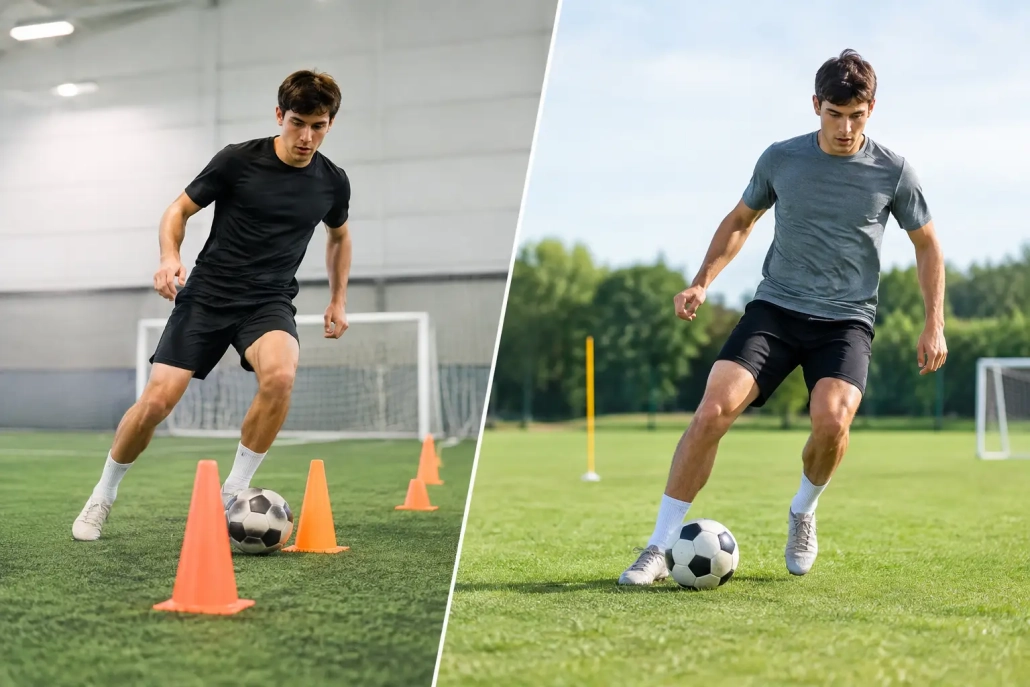
A player receives the ball with a defender closing, takes one poor touch, and loses possession. That moment is not fixed by simply playing more games. It is fixed through purposeful repetitions, better scanning habits, cleaner technique, and the confidence to solve pressure quickly. That is the real conversation behind indoor soccer training versus outdoor practice: not which setting is better in every situation, but which environment develops the skill a player needs next.
For ambitious youth players, indoor and outdoor work should not compete. Each creates a different training demand. The strongest development plans use both with intention, rather than assuming a full outdoor schedule covers every area of a player’s growth.
Indoor Soccer Training Versus Outdoor Practice: The Core Difference
Outdoor practice prepares players for the full game. The larger field, changing weather, natural spacing, and 11v11 tactical demands teach players how to manage territory, recognize team shape, track runners, and execute decisions across realistic distances. It is where players must understand the flow of the match.
Indoor training creates a more controlled, high-repetition environment. The ball stays active, space disappears quickly, and every touch matters. A player cannot hide on the far side of the field. They must receive, turn, pass, defend, and react repeatedly, often at a faster tempo than they would experience outdoors.
Neither setting is automatically superior. An 8-year-old building comfort on the ball may benefit enormously from an indoor environment that provides hundreds of meaningful touches. A 16-year-old winger preparing for showcase season also needs outdoor work to sharpen long passing, recovery runs, crossing, and tactical positioning over a full field. The right answer depends on age, current ability, position, and performance goal.
Why Indoor Training Accelerates Technical Development
Technical quality breaks down when players have too much time between meaningful actions. A typical outdoor session can include long lines, coaching pauses, balls leaving the field, and drills that give each player limited contact. Those elements are sometimes necessary, but they do not always create enough repetitions to change a habit.
A professional indoor setting can reduce wasted time and increase purposeful ball contact. Smaller spaces demand a softer first touch, a quicker release, and stronger body positioning. Players learn to receive on the half-turn because receiving square under pressure is no longer an abstract coaching point – it leads immediately to a turnover.
This is especially valuable for foundational skills: ball mastery, dribbling under pressure, short passing, one-touch combinations, weak-foot development, finishing in traffic, and defending in isolated moments. Indoor training also gives coaches a clearer view of a player’s details. If a player consistently approaches the ball with the wrong angle or fails to scan before receiving, the mistake appears again and again. That creates an opportunity to correct it, measure improvement, and demand a higher standard.
At Soccer Field Academy, technology-driven sessions can add another layer to these repetitions. Tools such as SoccerBot360 and Speed Court are not replacements for coaching or game play. Used correctly, they create measurable training moments around reaction speed, footwork, cognitive processing, and execution under a defined task.
The pressure is different, and that matters
Indoor pressure is often immediate. The field is tighter, opponents arrive faster, and loose touches are punished. This helps players become more composed when the game speeds up.
That does not mean every indoor environment should be frantic. Quality coaching organizes the intensity. Younger players need space to experiment and develop coordination. Advanced players need constraints that force faster decisions without sacrificing technique. The objective is not to make training chaotic. It is to make the player calmer inside chaos.
What Outdoor Practice Develops Better
The outdoor game asks questions indoor training cannot fully replicate. How does a center back manage depth when an opponent can run in behind? When should a midfielder switch the point of attack? How does a wide player time a run to create space without drifting offside? These are field-scale decisions.
Outdoor practice is essential for building tactical awareness within a team model. Players learn the relationship between lines, units, and positions. They experience transition moments over larger distances. They develop the fitness and pacing required to repeatedly cover ground in real match conditions.
Certain technical actions also need outdoor context. Long driven passes, aerial service, goal kicks, crossing, striking from distance, and defending wide spaces require room to read the ball and execute. A player training only indoors may become sharp in tight areas but still lack comfort when the game opens up.
Weather and surface variation provide another useful challenge. A wet ball, uneven bounce, wind, cold conditions, and natural grass or turf all require adjustment. Competitive players will encounter imperfect conditions. Outdoor practice teaches them to adapt rather than wait for ideal circumstances.
The Trade-Off Parents Should Understand
More activity does not always equal more development. A player can attend multiple outdoor practices each week and still plateau if the sessions lack individual feedback, intensity, and repetitions. They can also spend every winter in a small-sided indoor environment and miss the tactical understanding required for the outdoor season.
Parents should look beyond the label of the program. Ask what the player is actually doing during the session. Are they standing in lines? Are coaches correcting the details that influence performance? Is the training matched to the child’s age and current level? Does the program have a progression, or is it simply another hour of play?
For recreational players, the balance may be simple: one structured indoor technical session during the colder months can keep confidence growing while outdoor practice remains the foundation during the season. For a serious travel or high school player, the plan may include team training outdoors, private technical work indoors, speed and agility development, and targeted sessions tied to their position or upcoming season.
The goal is not to fill every night on the calendar. Young athletes still need recovery, school balance, and time away from pressure. Productive training is demanding, but it must be sustainable.
How Age Changes the Indoor-Outdoor Balance
For players ages 2 through 6, development is largely about coordination, confidence, listening skills, movement, and a positive relationship with the ball. Indoor space is often ideal because it is predictable, protected from weather, and easier for coaches to keep young players active. At this stage, the setting matters less than the experience: lots of movement, simple instruction, and encouragement to try.
Players ages 7 through 12 enter a major technical window. This is when indoor training can be especially powerful. Players should build comfort with both feet, develop ball control at speed, learn simple decision-making, and gain confidence in 1v1 situations. Outdoor game play remains valuable, but individual technique needs attention that team practices may not have time to provide.
For players ages 13 through 18, training should become more individualized. An aspiring midfielder may need faster scanning and passing under pressure. A striker may need better movement in the box, first-touch finishing, and explosive separation. A defender may need recovery speed, body orientation, and long-range distribution. Indoor and outdoor work should support the athlete’s role, physical development, and competitive pathway.
Build a Plan Around the Player, Not the Season
The strongest players do not treat winter as an offseason from improvement or spring as a reason to stop technical work. They use each phase of the year to address the demands in front of them.
Indoor sessions are ideal when a player needs high-volume technical repetitions, quicker decision-making, speed of play, or dependable training conditions during a Columbus winter. Outdoor practice remains indispensable for team tactics, match realism, larger-space actions, and the physical demands of the full game.
A player who can dominate tight spaces but cannot recognize the next pass needs outdoor tactical exposure. A player who understands the game but loses the ball under pressure needs more intentional indoor repetition. Honest assessment creates the right training mix.
Serious progress comes from putting players in the environment that exposes their next weakness, then giving them the coaching and repetitions to turn that weakness into a strength. Grind now, shine later.