9 Best Soccer Exercises for Balance and Control
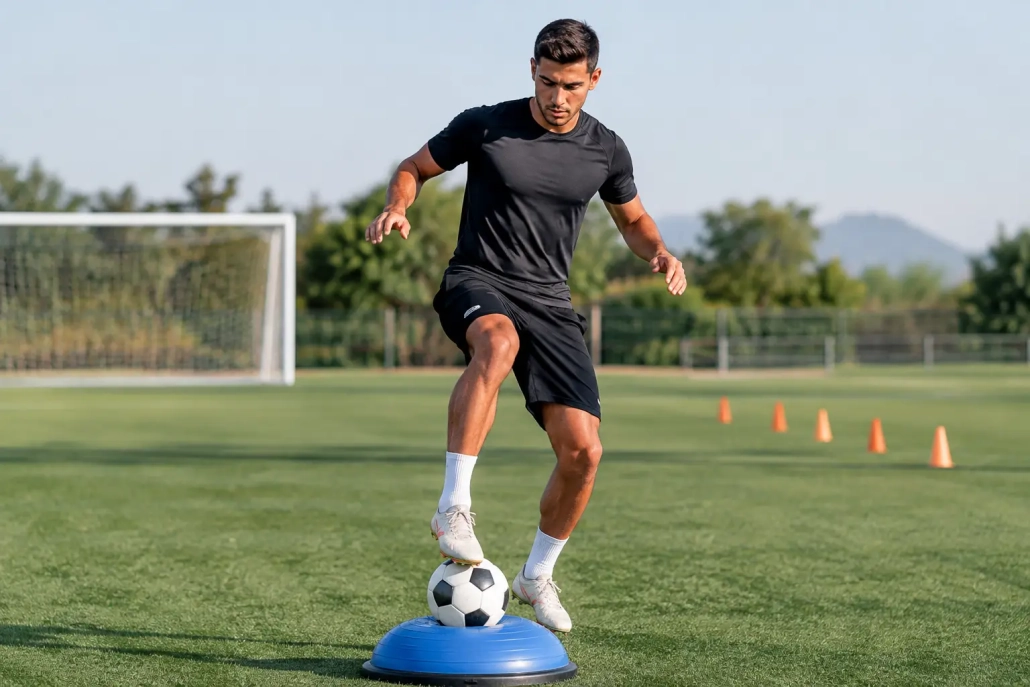
A player who loses balance after a first touch often loses the next action too. The pass arrives late, the defender closes space, and a promising moment disappears. That is why the best soccer exercises for balance should not look like a disconnected fitness routine. They should build the body control players need to receive, turn, cut, protect the ball, and finish under pressure.
For young players, balance is not about standing on one foot for as long as possible. It is the ability to control the body while the game keeps moving. A balanced player can plant before shooting, absorb contact without falling away from the ball, and recover quickly after a change of direction. Those details separate a clean action from a rushed one.
Why Balance Changes a Player’s Game
Soccer balance starts with posture, core stability, ankle strength, and coordination, but it shows up in technical moments. When a player receives on the back foot, their body must stay stable enough to take the ball away from pressure. When they make a sharp cut, the knee and ankle must align before they push into the next stride. When they strike a ball, they need a firm plant foot and controlled upper body to create accuracy.
This is especially valuable during the youth development years. Players grow quickly, and a sudden change in height or strength can make them feel less coordinated for a period of time. Regular balance work helps restore body awareness while building movement habits that carry into higher-speed training.
Parents should also understand the trade-off: balance drills alone do not create an elite player. A player can perform beautifully on a balance pad and still struggle to make decisions in a match. The strongest training blends balance with the ball, visual awareness, reaction, and game-realistic pressure.
9 Best Soccer Exercises for Balance
1. Single-Leg Ball Rolls
Have the player stand on one leg with a slight bend in the support knee. Using the sole of the free foot, they roll a ball forward and backward, then side to side, without letting the upper body sway excessively. Complete 20 to 30 seconds per leg.
This drill teaches players to stabilize through the ankle, hip, and trunk while keeping a relationship with the ball. Younger players should move slowly and focus on posture. Advanced players can keep their head up and respond to a coach calling colors, numbers, or directions.
2. Hop, Stick, and Pass
Set two cones about three to five yards apart. The player performs a small lateral hop over a line or cone, lands on one foot, holds the landing for one second, then receives and passes a ball. Alternate landing legs.
The key word is stick. The player should land quietly with the knee tracking over the toes, not collapsing inward. Once the landing is controlled, add a firmer pass or ask the player to open their body before playing the ball. This connects safe deceleration to a useful soccer skill.
3. Split-Stance Receiving
Place a player in an athletic split stance with one foot slightly ahead of the other. A partner passes the ball into either foot. The player receives, shifts weight efficiently, and returns the pass in two touches.
This may look simple, but it develops a critical habit: controlling the center of mass before the ball arrives. Players who stand tall or lock their knees often take heavy first touches because they are reacting after contact. Rotate the front foot every few repetitions and challenge older players with passes at different speeds.
4. Clock Reach with a Ball
Standing on one leg, the player uses the other foot to tap a ball placed at different points around the body, like positions on a clock. Start at 12, 3, 6, and 9 o’clock, then add diagonal positions. The support foot stays planted while the player reaches with control.
Clock reaches improve ankle stability and hip control, both essential for cutting and changing direction. Keep the range manageable. A player who twists, reaches too far, and loses alignment is practicing compensation rather than control.
5. Mirror Shuffle and Freeze
In pairs, one player leads with light lateral shuffles, forward steps, and backward steps inside a small grid. The second player mirrors the movement. At any moment, the leader calls or signals “freeze,” and both players hold an athletic position for two seconds.
This is one of the best soccer exercises for balance because it requires reactive movement, not a predetermined pattern. Players learn to keep their feet underneath them while reading another athlete. Add a ball only after the movement quality is strong, or use this as a high-energy warm-up before technical work.
6. Three-Cone Turn and Escape
Set three cones in a triangle, each about four yards apart. The player dribbles to the first cone, performs a controlled turn, accelerates to the second, then repeats at the third. Use inside cuts, outside cuts, drag backs, or Cruyff turns across different rounds.
Balance matters most at the moment the player slows down. Encourage them to lower their hips before the turn, take short adjustment steps, and exit with the ball within playing distance. Speed comes after control. If a player repeatedly slips, reaches for the ball, or takes an extra touch on every turn, reduce the pace and rebuild the mechanics.
7. Shoulder Contact Shielding
Two players work in a marked channel with one ball. The attacking player dribbles slowly while the defending player applies light, controlled shoulder pressure. The attacker uses the arm legally for space, keeps a low center of gravity, and protects the ball with the far foot.
This exercise is especially useful for players who are technically clean in unopposed drills but get knocked off the ball in games. The goal is not heavy contact. It is learning how to absorb pressure, reposition the feet, and keep the next touch available. Increase resistance only when players can maintain safe body positions.
8. One-Leg Finishing Setup
A player receives a pass, takes a preparation touch, briefly stabilizes on the plant foot, then strikes the ball toward a target. The pause should be short, just enough to reinforce a strong plant and balanced body shape.
As players improve, remove the pause and increase the pace of service. The lesson remains the same: a rushed plant foot creates rushed finishing. For younger players, use larger goals or target gates so they can train clean technique before chasing power.
9. Reactive Speed Court or Color Call Cuts
Use a coach’s color call, numbered cone, or reaction system to direct the player’s next cut. The player begins in an athletic stance, reacts to the cue, accelerates to the target, decelerates under control, and returns to the center.
Reaction-based work adds the cognitive demand that static drills cannot provide. In a match, players do not know the next movement in advance. They read the ball, a teammate, an opponent, and available space. Training balance under an unpredictable cue helps turn physical control into game-ready movement.
How to Build Balance Work Into a Weekly Plan
For most youth players, two or three short balance blocks per week are more effective than one exhausting session. Ten to fifteen focused minutes before ball mastery, speed work, or finishing can produce meaningful gains when the quality stays high.
A younger player may need simple single-leg activities, hopping patterns, and playful reaction games. A competitive player ages 11 and up can handle more demanding deceleration, shielding, and reactive cutting work, especially when it is paired with technical execution. The right level depends on movement quality, not just age.
Avoid turning every drill into fatigue training. If form breaks down, players start rehearsing poor landings and unstable positions. A high-performance environment should demand intensity, but it should also demand precision. The standard is not simply completing the rep. The standard is completing it with posture, control, and purpose.
What Coaches and Parents Should Watch For
Look for progress that transfers. Is the player more composed after receiving a difficult pass? Can they turn without taking three recovery steps? Do they stay on their feet through light contact? Are they planting with confidence before shooting?
Also watch for warning signs. Persistent pain, repeated ankle rolling, or major differences between the right and left side deserve attention from a qualified medical professional. Training can improve movement, but it should never push a player through pain.
At Soccer Field Academy, balance training fits within a larger development process that includes technical repetition, speed mechanics, decision-making, and confidence under pressure. The objective is never to collect drills. It is to help players build reliable actions they can trust when the game speeds up.
Give balance the same attention as passing, dribbling, and shooting. The player who can control their body has more time to control the ball, and that extra moment can change the next play.