
What Is Speed Court Training for Soccer?
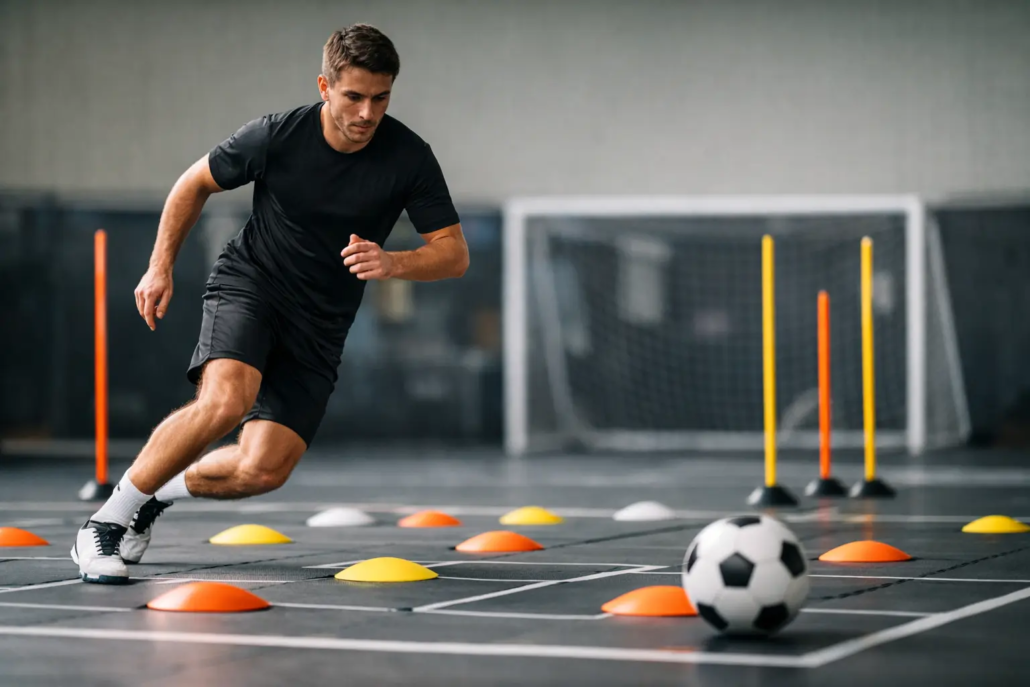
A player receives the ball under pressure, sees one lane close, and has a fraction of a second to adjust. That moment is why parents and players ask, what is speed court training? It is not simply a workout for faster feet. Speed Court training uses interactive visual and audio cues to challenge how quickly an athlete sees information, processes it, moves, and resets for the next action.
For soccer players, that combination matters. Game speed is rarely just about straight-line sprinting. It is about reading a defender, changing direction without losing balance, reacting after a bad touch, and making the next decision before the opportunity disappears. A Speed Court creates a measurable, high-energy environment to train those demands with purpose.
What Is Speed Court Training?
Speed Court training is a reactive movement system performed on a court with numbered zones, sensors, lights, and programmed commands. The athlete receives a cue, moves to the correct target, and is measured on factors such as reaction time, movement efficiency, accuracy, and total completion time.
The system can be used for a range of movement patterns: forward acceleration, lateral shuffling, backpedaling, diagonal cuts, pivots, and rapid stops. A coach can also adjust the sequence, work-to-rest periods, difficulty, and movement standards to match the player’s age, training history, and goals.
That is the key difference between random quick-feet drills and quality reactive training. Random movement may elevate a player’s heart rate, but it does not always require perception and decision-making. On the Speed Court, the next movement is not fully known in advance. Players must respond to information, just as they must respond to the constantly changing picture of a soccer match.
Why Reactive Speed Matters in Soccer
A soccer player almost never gets to run a pre-planned pattern for 10 seconds. They react to the ball, teammates, opponents, space, and game context. A winger may need to cut inside when a fullback overcommits. A midfielder may have to reposition immediately after a pass. A defender may need to recover after an attacker changes pace.
Speed Court work targets the physical and cognitive connection behind those moments. The player learns to recognize a cue, organize their body, and move with control. That can support sharper first steps, cleaner changes of direction, and better body awareness when training is coached correctly.
For young players, this is especially valuable because coordination is still developing. Players do not need to be elite sprinters to benefit. A beginner may need to learn how to stop under control, turn both directions, and keep their knees aligned. A high-level player may need more demanding sequences that challenge their reactions while fatigue builds.
The goal is not to make every athlete move the same way. The goal is to give each player a more efficient foundation for the movements soccer requires.
Speed Is More Than Fast Feet
Fast feet look impressive, but they are only one piece of athletic performance. A player can tap their feet quickly in place and still struggle to explode into space, brake safely, or react to a late cue. Effective Speed Court training addresses the transition between those actions.
A quality session emphasizes posture, balance, force control, and deceleration. Players should learn to lower their center of gravity before a cut, push into the ground with intent, and control their landing before attacking the next target. Those details separate hurried movement from athletic movement.
For soccer, the ability to slow down is as valuable as the ability to speed up. If a player cannot brake under control, they lose time on the next cut. They may also arrive late to the ball, overrun a pressing action, or need extra steps to recover defensively.
How a Speed Court Session Works
A Speed Court session usually begins with movement preparation. Players should be warm, attentive, and ready to move well before they are asked to move fast. Coaches use this time to reinforce athletic positions, foot placement, posture, and the day’s objective.
The reactive work then begins with a sequence appropriate for the athlete. A younger player may start with simple targets and clear directional commands. The focus is confidence, coordination, and learning to move with intent. As the player improves, the court can introduce faster cues, more complex patterns, decision-making demands, and competitive timed rounds.
The equipment provides immediate feedback through the result on the screen or timing system. That feedback can be motivating, but the score is not the entire story. A coach should watch how the player earns the score. Did they stay balanced? Did they plant effectively? Did they turn efficiently in both directions? Did their form collapse when the sequence became difficult?
Data gives the training session a benchmark. Coaching gives it meaning.
At Soccer Field Academy, the Speed Court fits into a broader development plan rather than standing alone as a novelty station. Technical development, strength and movement quality, soccer-specific decision-making, and confidence all need attention. The court is one tool that helps make progress visible and gives players a clear standard to chase.
What Players Can Improve With Speed Court Training
The exact outcome depends on the program and the athlete’s effort, but consistent reactive training can develop several areas that transfer well to soccer:
- First-step quickness and the ability to initiate movement from an athletic position.
- Lateral movement, pivots, and directional changes used in defending and creating separation.
- Reaction speed when visual or audio information changes unexpectedly.
- Body control during acceleration, deceleration, and recovery steps.
- Focus under pressure, especially when the player must perform accurately against the clock.
The final point is often underestimated. Young athletes can have the physical ability to move well but hesitate when a task becomes unfamiliar or fast. Repeated exposure to manageable pressure can build confidence. Players learn that they can make a mistake, reset, and attack the next rep instead of shutting down.
That mindset carries value beyond the court. Soccer rewards players who recover quickly after an error.
What Speed Court Training Does Not Replace
Speed Court training is powerful, but it is not a substitute for soccer training. It will not replace ball mastery, passing technique, finishing, tactical understanding, strength work, or live game experience. A player still needs to learn how to scan before receiving, manage the ball at speed, communicate, and solve problems against real opponents.
It also should not be treated as a one-size-fits-all test of athletic potential. A player’s score can be influenced by familiarity with the system, confidence, movement maturity, fatigue, and the specific drill setup. Comparing a 9-year-old beginner directly with a 16-year-old competitive athlete has limited value.
The best use of the court is individualized. Coaches can establish a baseline, observe patterns, and build a progression. If a player consistently struggles to cut left, loses balance during deceleration, or reacts slowly after a turn, that gives the coach a specific development target.
Who Benefits Most From This Training?
Speed Court training can help players across the development pathway, from young athletes building coordination to serious competitors preparing for higher-speed environments. The format simply needs to match the player.
For ages 2 through 6, training should feel playful, brief, and heavily coached. The priorities are listening, movement confidence, balance, and basic directional awareness. Complex timed competition is usually less useful than simple success-based activities.
For players in the foundational and competitive years, the court can reinforce stronger mechanics and introduce meaningful performance benchmarks. This is where athletes often begin to understand that quickness is trainable. Discipline in small details – how they plant, stop, and react – creates measurable change over time.
Advanced players can use reactive sequences as part of a more demanding performance plan. However, the court should be paired with soccer-specific work. A college-bound player does not need more generic drills. They need training that connects athletic tools to their position, movement profile, and competitive demands.
Getting Better Results From Every Rep
Players get more from Speed Court training when they approach it with intent instead of chasing a score alone. The fastest rep is not always the best rep if it is filled with sloppy plants, poor posture, or guessing. Control comes first. Then the athlete earns greater speed.
Parents can support that process by looking beyond one impressive number. Ask whether the player is becoming more coordinated, more confident, and more consistent across sessions. Progress may show up as cleaner movement before it shows up as a dramatic time reduction.
The player who stays coachable, attacks each repetition, and commits to the details will carry the greatest advantage. The court provides the challenge. Consistent work is what turns that challenge into game-ready movement.
