
Soccer Training for Defenders That Wins Duels
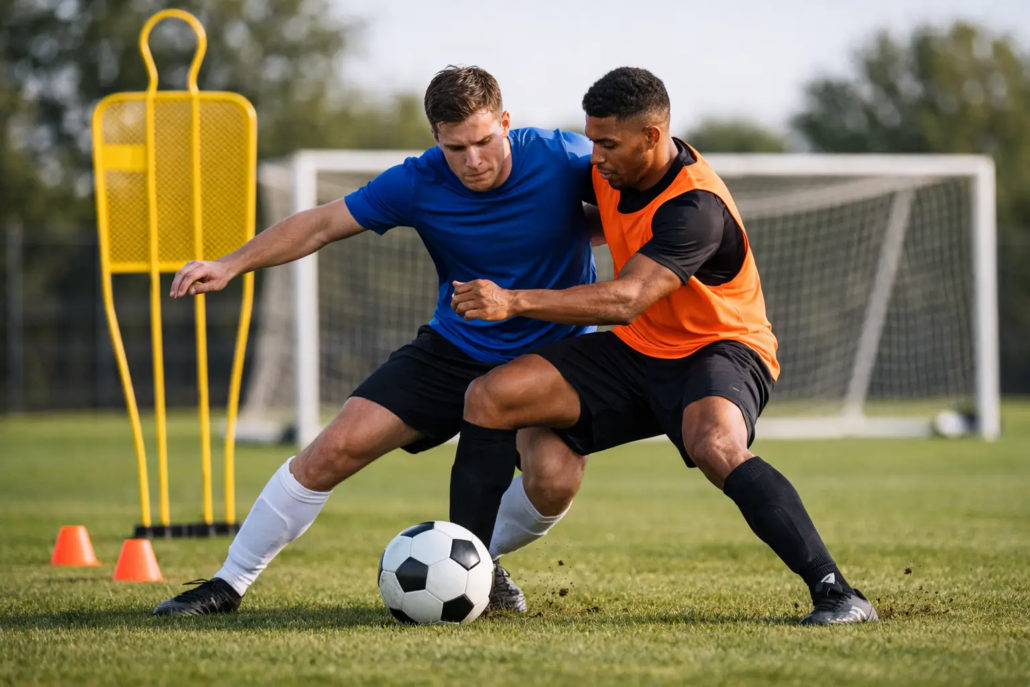
A defender can make 20 clean passes, win every sprint, and still lose the moment that changes the match if their starting position is wrong. That is why soccer training for defenders cannot be reduced to tackling drills. Great defenders read danger early, control space, communicate clearly, and stay composed when the game speeds up.
For young players, defensive development is often overlooked because the ball naturally attracts attention. Yet defenders who can win duels, build out under pressure, and organize the line become indispensable to their teams. The work requires discipline, repetition, and coaching that measures more than effort.
What Elite Defenders Learn to See
The first job of a defender is not to tackle. It is to prevent the attacker from receiving, turning, or driving into a dangerous area. That starts with scanning before the ball arrives. A player who checks both shoulders can identify the runner, the supporting midfielder, the nearest threat to goal, and the space their teammate has left behind.
Positioning is a constant decision. When the ball is wide, a center back must judge how far to shift, whether to protect the near-post channel, and how much space to leave for a switch. When the ball is central, they need to recognize whether pressure is arriving on the ball or whether they must delay the attack themselves. Those decisions happen in seconds.
Young defenders should learn a simple priority order: protect the goal, protect the space behind, pressure the ball when the moment is right, then win possession. The sequence matters. Chasing a ball carrier 30 yards from goal may feel aggressive, but it can open the exact lane the opponent wants. Controlled defending is often more valuable than dramatic defending.
Soccer Training for Defenders Starts With Body Shape
A defender’s stance tells you whether they are prepared. Flat feet, squared hips, and crossed legs make it easy for an attacker to change direction. A balanced, side-on stance gives the defender a chance to react, accelerate, and guide the opponent away from danger.
Defend the space, not the highlight
In one-on-one situations, the goal is usually to slow the attacker and force them toward a less dangerous area. That might mean showing them to the sideline, onto their weaker foot, or toward a teammate providing cover. A defender who lunges too early turns a manageable duel into a recovery sprint.
Training should include repeated approaches to the ball: close distance quickly, decelerate under control, get low, and arrive at a distance where the attacker cannot easily burst past. Players need practice using small adjustment steps rather than taking one large step that commits their weight.
Tackling still matters, but timing matters more. A clean tackle often comes after the attacker takes a heavy touch, looks down at the ball, runs into a crowded channel, or loses balance while changing direction. Coaches should reward those cues, not simply reward the player who throws themselves into every challenge.
Build recovery speed and change of direction
Even excellent defenders get beaten occasionally. The difference is how they recover. A strong defensive athlete can turn, accelerate, track a runner, and regain goal-side position without panicking.
That is why speed development for defenders should go beyond straight-line sprints. Players need reaction work, lateral movement, opening their hips, crossover steps, deceleration, and reacceleration. A center back may sprint backward before turning to chase. An outside back may need to recover 40 yards after joining an attack. A defensive midfielder may have to change direction twice in a five-second transition.
Tools such as a Speed Court can add objective feedback to this work by challenging reaction time, foot placement, and change-of-direction efficiency. Technology does not replace coaching, but it can reveal whether a player is becoming faster at the movements the position actually demands.
Train Defending as a Unit
Defending is not an individual job. The strongest back lines move together, communicate early, and understand who pressures, who covers, and who balances the far side. A player may make the correct individual decision and still create a problem if they do not coordinate with the teammate next to them.
Small-sided games are especially valuable when they include clear defensive constraints. For example, a three-versus-three plus goalkeeper game can teach players how to protect the middle, cover a teammate who steps to the ball, and recover after a pass breaks the first line. A wide-channel exercise can teach outside backs when to engage and when to wait for help.
Communication should be specific. “Step,” “drop,” “turn,” “hold,” and “man on” are useful because they direct an immediate action. Vague shouting creates noise. Young players also need the confidence to communicate before the emergency, not after it. The best defenders provide information while their teammates still have time to use it.
There is a trade-off in every defensive line. A high line can compress the field, support possession, and put pressure on the opponent. It also demands pace, synchronized movement, and a goalkeeper prepared to manage space behind. A deeper line can protect against direct balls, but it may invite pressure and make it harder to regain possession. Players should understand the reason behind the team’s tactic, not memorize a fixed distance from goal.
Make the First Pass After the Win
A defender’s work is not finished when possession is won. At higher levels, the next pass determines whether the team launches an attack or gives the ball away again.
Defenders need technical repetition with both feet: receiving across the body, playing firm passes through lines, changing the point of attack, and carrying the ball into open space when no immediate pass is available. They also need composure when the first option disappears. Clearing the ball is sometimes the right decision, particularly under severe pressure near goal. It should not become the automatic decision every time a defender feels rushed.
Ball-mastery work can sharpen the first touch and awareness needed in these moments. SoccerBot360-style training is particularly useful when players are challenged to receive, scan, react, and execute under time pressure. The value is not just more touches. It is learning to process information before the ball reaches their feet.
A Weekly Development Plan for Young Defenders
Defensive progress comes from consistent, focused sessions rather than one hard workout before a tournament. A competitive player might organize a week around team training, a technical session, strength and speed work, and game review. The exact volume depends on age, current workload, recovery, and the demands of their club schedule.
For younger players, the priority is movement literacy, balance, confidence in one-on-one situations, and comfort with the ball. They should not be locked into one position too early. Playing across the back line, midfield, and even forward helps them understand the problems each position creates.
For older competitive players, training can become more position-specific. Center backs may emphasize aerial timing, line leadership, longer passing, and defending central spaces. Outside backs need repeated work on wide defending, recovery runs, overlapping decisions, and crossing. Defensive midfielders need scanning, interception angles, receiving under pressure, and protecting the space in front of the back line.
At Soccer Field Academy, a structured development plan can combine high-level coaching, indoor consistency, technical technology, and performance training so players can build these qualities year-round. The best program is not necessarily the one with the most hours. It is the one that identifies the player’s gaps, provides purposeful repetition, and tracks whether those gaps are actually closing.
How Parents Can Measure Real Defensive Progress
Goals and assists are easy to spot. Defensive growth requires a closer look. Parents should watch for earlier scanning, calmer body language in pressure moments, better recovery runs, stronger communication, and more intelligent positioning before the ball arrives.
Game film can be useful when reviewed with a clear purpose. Rather than asking, “Why did you lose that ball?” ask, “What did you see before the pass?” or “Where was your cover?” That turns a mistake into a decision-making lesson. Players should also notice what went well: an attacker forced backward, a passing lane closed, or a smart delay that allowed teammates to recover.
A developing defender does not need to win every tackle to have a strong game. If they consistently protect the dangerous space, make the attacker predictable, and help the team regain its shape, they are doing work that wins matches. Keep training the details, because the next decisive play is usually won long before the tackle happens.

