College Prep Soccer Training for High School Players
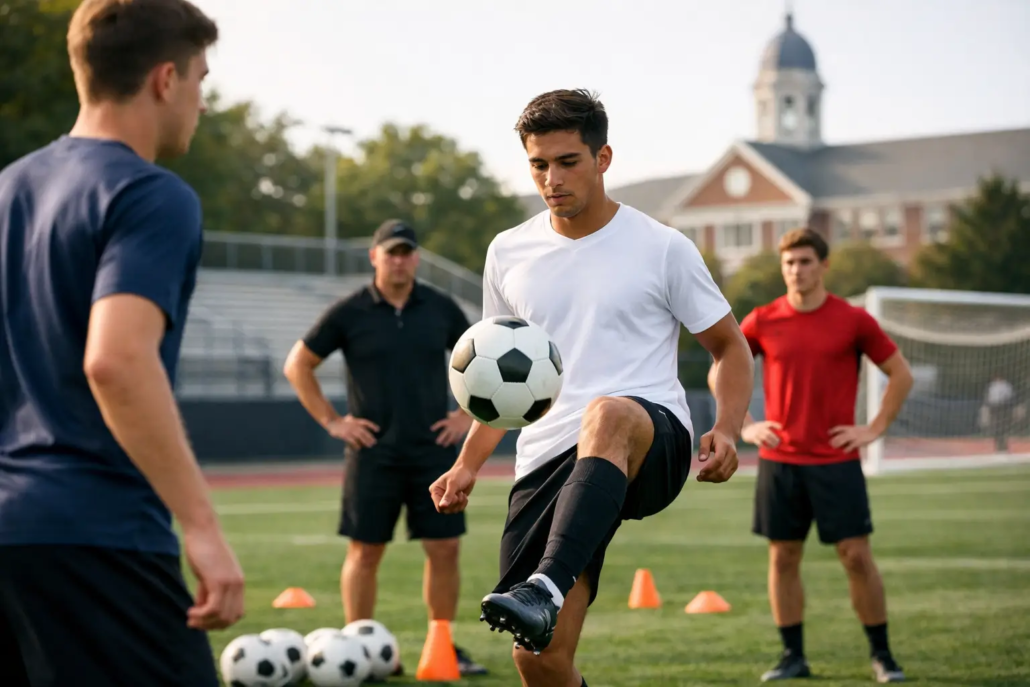
The gap between a strong high school player and a true college prospect is usually smaller than families think – and more demanding. College prep soccer training for high school players is not just about working harder. It is about training with structure, measurable standards, and a clear understanding of what college coaches actually evaluate.
A lot of players spend their teenage years doing more of the same. More team training, more games, more showcases, more mileage. Sometimes that helps. Sometimes it hides the real issue, which is that the player has not separated from the pack in the areas that matter most: technical efficiency under pressure, repeat speed, tactical decision-making, physical readiness, and consistency over time.
What college prep soccer training for high school players should actually do
If a program is serious, it should prepare a player for two things at once. First, it should help them perform better now for their high school and club teams. Second, it should build the profile and habits needed for the college game, where the speed of play, physical demands, and accountability level rise fast.
That means training cannot be generic. A center back, an outside back, a holding midfielder, and a striker do not need the exact same developmental emphasis. They all need technical quality, but the details shift. One player may need to improve body shape and first-pass decisions. Another may need better change of direction and timing in 1v1 finishing. Another may already be technically clean but lack the acceleration and repeat sprint capacity to survive at the next level.
The best college prep work starts by identifying where the player is right now, not where they hope to be. That honesty matters. Players improve faster when the training plan is built around specific deficiencies instead of vague goals like getting more exposure.
Technical quality still separates players
Parents often assume recruiting starts with exposure. In reality, exposure only helps when the player is ready to be seen. College coaches are not looking for highlight-reel tricks. They are looking for actions that translate – clean first touch, ability to play under pressure, reliable passing range, efficiency in tight spaces, and composure at game speed.
This is where many high school players fall behind. Team sessions often prioritize shape, game prep, and match rhythm. Those matter, but they do not always provide enough high-repetition technical work to fix details. A player who takes an extra touch every time they receive or struggles to open up on the half-turn will not solve that by simply playing more games.
College prep training should create repetition with a purpose. That can include receiving across the body, one-touch and two-touch passing patterns, finishing from multiple service angles, scanning before the ball arrives, and tighter execution windows. Technology can help here if it is used correctly. Measurable reaction work, passing targets, and foot-speed metrics can show whether the player is actually improving or just getting tired.
Speed matters, but soccer speed is more than a 40 time
Raw pace gets attention, but college soccer speed is broader than straight-line sprinting. It includes reaction speed, first-step quickness, braking mechanics, lateral movement, recovery runs, and the ability to execute technically while moving fast.
A high school player can look fast in open grass and still struggle in college environments because their movement efficiency breaks down under pressure. This is why smart college prep training blends speed development with ball work and decision-making. If the feet are quick but the mind is slow, the player still loses the moment. If the player reads the game well but cannot physically close space, they still get exposed.
There is also a trade-off here. More is not always better. Players who stack too many extra speed sessions on top of club and school workloads often train themselves into fatigue. Development requires intensity, but it also requires recovery and timing. The training calendar has to respect the season, the player’s age, and their current match load.
Game IQ is trainable when coaches are specific
One of the biggest mistakes in youth development is treating tactical awareness like a personality trait. It is not. Some players naturally see pictures earlier, but game intelligence can absolutely be coached if the environment is demanding enough.
For high school players aiming at college, that means learning to solve problems faster. Where is the next pass before the ball arrives? When should you play forward versus secure possession? How do you shift your starting position based on the opponent’s shape? What pressing cues actually trigger your run?
Generic feedback like be quicker or make better decisions does not help much. Good coaching breaks the game down into repeatable situations. It teaches players to recognize patterns, not just react emotionally to the last play. The result is not only better performance. It is confidence, because the player starts to understand why a decision works.
That matters in recruiting too. College coaches notice players who understand space, tempo, and role discipline. Athleticism opens the door, but soccer intelligence keeps players in the room.
Strength, durability, and body control cannot be optional
A lot of talented players lose momentum in the recruiting years because they are constantly managing small injuries, recurring soreness, or physical inconsistency. College prep soccer training for high school players has to address this. Skill alone is not enough if the body cannot support the workload.
Performance training should focus on movement quality first, then power, force production, and durability. Core strength, landing mechanics, single-leg stability, hamstring strength, and hip control all influence how a player accelerates, decelerates, and handles contact. This is not bodybuilding. It is athletic preparation.
The right approach depends on the player. A freshman may need foundational movement work and coordination. A junior with college ambitions may need a more advanced program built around sprint output, force application, and recovery. Position matters as well. So does growth and maturation. Two players of the same age may need very different plans.
Recruiting is part performance, part positioning
Families sometimes assume that if the player becomes good enough, recruiting will sort itself out. Sometimes it does. Often it does not. There are too many strong players competing for limited spots, and fit matters as much as talent.
That is why college prep should include realistic recruiting education. Not every player is a Division I prospect, and that is fine. The right goal is the level where the player can contribute, develop, and enjoy the experience. A strong Division III, NAIA, or junior college fit may be better than chasing a logo that does not match the athlete.
Players also need to understand timeline. Sophomores do not need panic. Seniors do not need fantasy. Video, communication, academic readiness, and event selection should support the process, not replace development. If the training is not producing a better player, no amount of outreach solves that.
What families should look for in a serious training environment
The strongest environments are not built around hype. They are built around progression. Families should look for coaches who can assess the player clearly, explain what needs work, and connect training to outcomes. The setting should feel demanding, organized, and developmental, not random.
That often includes smaller training ratios, position-aware coaching, performance tracking, and year-round consistency. Indoor training can be especially valuable in a market like Columbus, where weather can interrupt rhythm for months at a time. Consistent reps matter when a player is trying to close the gap before the next season or showcase window.
At Soccer Field Academy, that kind of structure matters because serious players do not need more noise. They need a development system that combines coaching standards, performance tools, and a pathway that matches their ambition.
The right time to start is earlier than most families think
Many players wait until junior year to get serious about college prep. By then, improvement is still possible, but the margin for error is smaller. The strongest approach starts earlier, when there is still enough runway to build technique, speed, confidence, and tactical maturity layer by layer.
That does not mean every ninth grader needs a recruiting plan. It means they need a development plan. Sophomore and junior years can then build on that base with more individualized work and clearer college targeting.
The players who make real jumps are usually not the ones searching for shortcuts. They are the ones training with discipline, accepting honest feedback, and stacking measurable progress month after month. That is what college coaches trust, and it is what gives players a real chance to step into the next level ready for it.