
A Parent’s Guide to Private Soccer Lessons
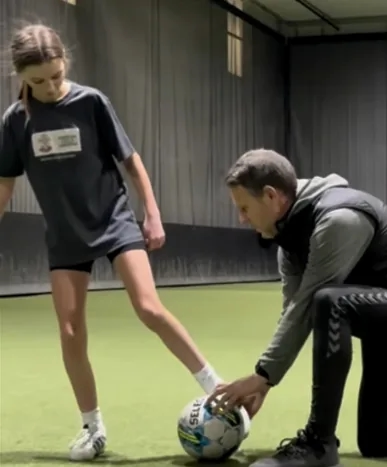
Most players do not need more random reps. They need better reps.
That is the real value of a guide to private soccer lessons. For parents, private training can feel like a major commitment in both time and cost. For players, it can be the difference between staying stuck in the same habits and making visible progress in confidence, technique, decision-making, and game speed.
Private lessons are not magic. They are a tool. Used well, they can accelerate development in ways team training often cannot. Used poorly, they become expensive extra touches with no clear transfer to the field.
What a guide to private soccer lessons should answer
The first question is not whether private lessons are good. It is whether they are right for your player right now.
In a team setting, a coach has to manage the whole group. That means limited individual correction, fewer position-specific details, and less time to isolate a player’s technical gaps. A private session changes that equation. The coach can slow down a movement pattern, rebuild body mechanics, increase repetition quality, and adjust the session in real time based on how the player learns.
That matters for different reasons at different ages. A younger player may need confidence on the ball, cleaner coordination, and better movement habits. A middle-school player may need stronger first touch, passing detail, and the ability to play under pressure. A high-level player may need refinement – scanning habits, receiving angles, finishing technique, speed of play, or position-specific execution.
Private training works best when the goal is specific. “Get better” is too broad. “Improve weak-foot passing under pressure” is useful. “Clean up shooting mechanics and composure in the box” is useful. “Build acceleration and first-step explosiveness for a winger” is useful.
Who benefits most from private soccer lessons
Not every player needs the same amount of individual work, but several groups tend to benefit quickly.
Players who are new to the game often improve fast because they are building the base. A private coach can teach clean fundamentals before bad habits settle in. That early stage is not about flashy drills. It is about balance, coordination, ball mastery, striking technique, and confidence.
Players in the competitive middle years often see the biggest jump because they are old enough to absorb detail but still young enough to make technical changes stick. This is where private coaching can sharpen first touch, passing weight, receiving shape, and 1v1 execution.
Advanced players also benefit, but for a different reason. They are rarely looking for basic instruction. They need precision. That might mean refining movement before receiving, improving speed of execution, or training with technology and measurable feedback to expose what standard sessions miss.
There is also a less obvious group: players who train hard but are not translating it into games. Often the issue is not effort. It is the absence of targeted correction.
What private soccer lessons should actually include
A strong private session is structured, demanding, and connected to match performance.
The best coaches do not just run players through cones for an hour. They identify a problem, coach the details, and build progressions that move from technique to pressure to decision-making. A session on finishing, for example, should not stop at striking the ball cleanly. It should also address first touch setup, body position, timing, visual cues, and how to finish under fatigue or defensive pressure.
That same standard applies to ball mastery, passing, defending, and speed work. Repetition matters, but repetition without correction builds average habits faster.
This is where environment matters too. A professional indoor setting allows for consistency, especially during weather shifts and winter months. A serious training space also tends to support better focus, cleaner session flow, and better use of performance tools. In Columbus, Ohio, that consistency can be a real advantage for families trying to maintain development year-round instead of losing months to the calendar.
How to choose the right coach
This part matters as much as the session itself.
A good private coach is not just energetic or encouraging. The coach should be able to assess the player quickly, explain what needs to change, and teach it in a way the player can apply. Credentials matter, but so does the ability to connect coaching to measurable improvement.
Parents should look for a coach who can answer simple but important questions. What is the player’s current level? What are the top one or two priorities? How will progress be tracked? What should transfer into games over the next eight to twelve weeks?
If a coach cannot define outcomes, the training may feel active without being productive.
It also helps to understand the coach’s methodology. Some coaches focus heavily on technical repetition. Some are stronger in tactical teaching. Others integrate sports performance, reaction training, or cognitive tools. None of those are automatically right or wrong. The right fit depends on the player’s age, position, training history, and goals.
For serious families, this is where elite environments separate themselves. Licensed coaches, clear developmental standards, and data-backed tools tend to create more accountability than informal side training. Soccer Field Academy, for example, builds private development inside a larger pathway, which gives families more than a one-off lesson. It gives them context for what comes next.
What parents should expect after the first few sessions
Progress is rarely linear.
Sometimes a player looks sharper immediately because the session cleaned up a visible technical issue. Other times performance gets messier before it gets better. That is normal. When a coach changes footwork, body shape, or timing, the player is replacing an old habit. That transition period can look uncomfortable.
What parents should watch for is not perfection. Watch for cleaner execution, better body control, more confidence in repetition, and stronger decision-making under pressure. In games, that may show up as fewer rushed touches, more composed passing, better 1v1 moments, or improved physical readiness.
It is also fair to expect communication. A serious private training process should include honest feedback. If the player is progressing, the coach should be able to explain how. If the player is not progressing, the coach should be able to explain why.
How often should a player do private lessons?
It depends on the player’s level, schedule, and objective.
For many players, one private session per week paired with team training is enough to create momentum. That schedule gives the player time to absorb correction and apply it in regular sessions and matches.
For players in a technical rebuild or a high-performance phase, two sessions per week can make sense. That is especially true during the offseason, before tryouts, or during a period when the player is chasing a clear performance jump. The trade-off is load. More is not always better if the player is mentally fried or physically overtrained.
For younger players, consistency usually matters more than volume. A steady pattern of high-quality lessons is more valuable than short bursts of intense training followed by long gaps.
Common mistakes families make with private soccer lessons
The biggest mistake is using private training as a shortcut. It is not a replacement for team play, match experience, or long-term development. It is an accelerator when the fundamentals of training and competition are already in place.
Another mistake is chasing variety over progression. A player does not need a new drill every session. They need focused work that builds from week to week. If every lesson feels completely different, it may be entertaining, but it can slow mastery.
Parents also sometimes expect immediate game domination after a few sessions. Real development is more disciplined than that. The goal is not a highlight reel by next weekend. The goal is a player who becomes more technically sound, tactically aware, and confident over time.
Finally, there is the issue of fit. A high-level player may outgrow a general trainer. A beginner may struggle with a coach who teaches too far above the player’s current level. The best private training feels demanding but clear.
Is private training worth it?
When the coaching is strong, the goals are defined, and the player is ready to work, yes.
Private lessons offer something team environments cannot always provide: concentrated attention, immediate correction, and a development plan built around the individual. That can raise confidence for a young beginner, sharpen execution for a competitive player, or prepare an advanced athlete for the next level.
The key is to think beyond the session itself. Ask what the lesson is building toward. Ask how progress will be measured. Ask whether the environment supports consistent, serious work.
Private training is not about doing more soccer. It is about doing the right work, with the right coach, at the right time. When that happens, improvement stops feeling random and starts looking earned.
