
8 1 on 1 Soccer Drills That Build Winners
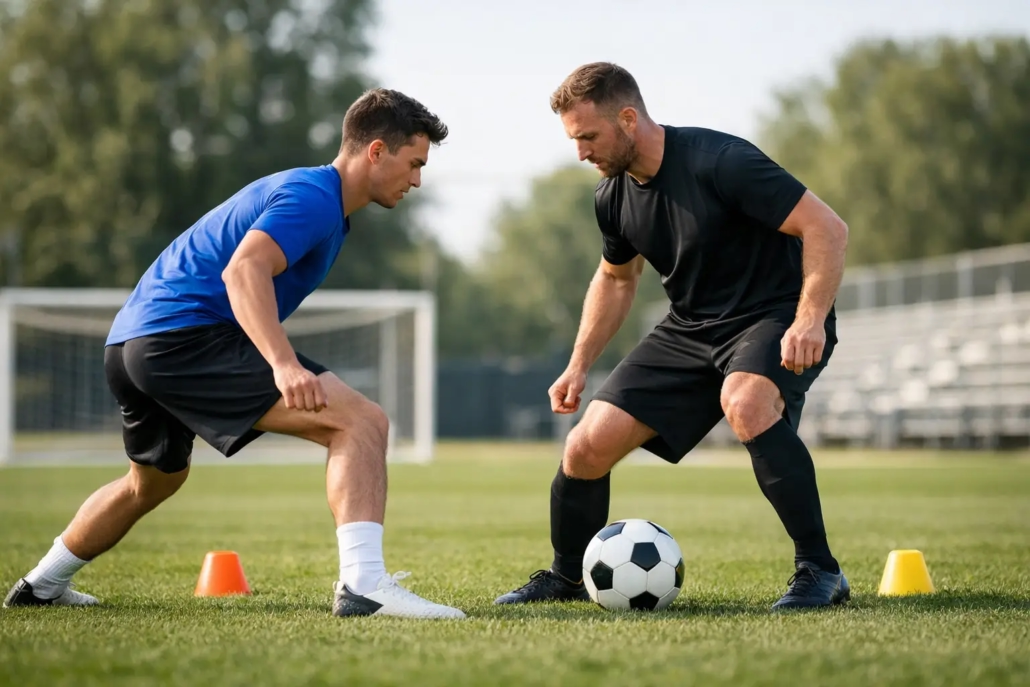
The moment a player squares up against one defender, the game gets honest fast. Technique matters, but so do timing, deception, balance, and courage. That is why 1 on 1 soccer drills are some of the most valuable exercises in youth development. They expose decision-making under pressure and force players to solve the exact duels that decide goals, stops, and momentum shifts.
For parents, this is where training starts to look measurable. You can see whether a player creates separation, protects the ball, closes space, or gets beaten too easily. For players, 1v1 work builds more than moves. It builds the confidence to attack with intent and defend with discipline.
Why 1 on 1 soccer drills matter
A lot of team sessions move quickly from pattern play into larger-sided games. That has value, but it can also let weaker individual habits hide inside the group. In a 1v1 duel, there is nowhere to hide. The attacker has to commit. The defender has to read, react, and recover.
That is what makes this training so effective across age levels. Younger players learn how to control their body and the ball at the same time. More advanced players sharpen details such as changing speed after a move, baiting a defender onto one foot, or delaying instead of diving in defensively.
The biggest mistake is treating every 1v1 drill as a freestyle contest. Real development comes from structure. The best sessions isolate one problem, repeat it enough to create learning, then add a game-like trigger so players can transfer the skill into matches.
8 1 on 1 soccer drills that actually transfer to games
1. Gate attack duel
Set two small gates five to eight yards apart and place the attacker in the middle with a defender in front. The attacker scores by dribbling through either gate under control. The defender scores by winning the ball or forcing the attacker out of bounds.
This drill teaches the first job of an attacker in a duel – make the defender commit. It also teaches defenders to stay balanced and not chase the first fake. If the attacker is young, keep the space tighter so touches stay manageable. If the player is advanced, give more room and require a finishing burst through the gate.
2. End-line beat
Create a narrow channel to the end line. The attacker starts with the ball facing one defender and must beat the defender to dribble across the line. This looks simple, but it trains a skill that shows up constantly in wide areas.
The coaching point is not just the move. It is the change of speed after the move. Many players can perform a scissors or body feint in isolation, then fail to accelerate out of it. If there is no explosive exit touch, the move is just decoration.
3. Defender delay and win
Now flip the lens. Put the attacker in a channel with a target line to reach, and ask the defender to slow the attack before making a clean challenge. Young defenders often lunge because they are eager to win the ball immediately. Strong defenders understand that delaying can be the win.
This is where body shape matters. Show the attacker one direction, stay side-on, and keep feet active. A defender who stays patient usually creates the attacker’s mistake.
4. Back-to-goal turn duel
Start the attacker with their back to the defender and a ball played into their feet. The attacker must protect, turn, and attack a small goal. The defender pressures from behind and tries to disrupt the first touch or block the turn.
This drill is excellent for midfielders and forwards because many game actions begin while receiving under pressure. It teaches players to feel contact, use their arms legally, and turn only when the defender’s weight shifts. It also teaches defenders how to pressure without fouling and how to anticipate the direction of the turn.
5. Recovery race 1v1
Place the attacker slightly ahead with the ball and the defender chasing from behind and to one side. On the signal, both race toward goal, and the attacker tries to finish before the defender recovers.
This is a more athletic version of 1v1 training and it matters because not every duel starts from a static square-up. Games create uneven starts, broken lines, and recovery moments. Attackers learn to protect the final touch before shooting. Defenders learn angles, urgency, and how to recover without diving into a foul.
6. Touch-limit showdown
Play a 1v1 game to small goals, but cap the attacker at three touches before they must shoot or score. This changes the problem. Instead of endless dribbling, the player has to attack space quickly and make a decision.
For technical players who love the ball, this is healthy pressure. It teaches efficiency. For defenders, it encourages a faster read because they know the attacker must act. If the quality drops too much, raise the touch limit. Good training should stretch players, not turn into chaos.
7. Number call reaction duel
Two players stand side by side while a coach or parent serves a ball and calls a number or color tied to a direction. One player becomes the attacker, the other the defender, and they react instantly into a live 1v1.
This adds perception and cognitive speed, which is often the missing piece in standard technical sessions. The first step in a duel is usually mental. Who sees the cue first, organizes their feet first, and claims the advantage first? Reaction-based drills build that edge.
8. Finish under pressure
Set a small goal or regular goal 10 to 15 yards away. The attacker starts in a 1v1 duel and must create enough space to finish within a short time window. The defender presses to block, tackle, or force a rushed shot.
This is one of the best ways to connect dribbling skill to end product. Plenty of players can beat a defender in midfield. Fewer can beat one and still stay composed enough to finish. That final action is where technical work becomes match value.
How to coach 1v1 work the right way
Good 1 on 1 soccer drills are not about collecting fancy moves. They are about solving a defender. That distinction matters. A move is only useful if it creates a clear advantage – a shooting lane, a passing angle, or a route past pressure.
For attackers, coach three layers. First, the setup touch must be controlled and purposeful. Second, the deception must sell the wrong picture. Third, the exit touch has to be explosive enough to separate. If one of those layers is missing, the duel usually stalls.
For defenders, the priority is different. First, close space under control. Second, angle the attacker away from danger. Third, tackle when the ball becomes exposed, not when the attacker is still fully balanced. Defending is often treated as reactive, but elite defenders dictate the duel with positioning and timing.
What changes by age and level
Not every player should train 1v1s the same way. A seven-year-old benefits from more repetitions, simpler rules, and smaller spaces. The goal is ball mastery, bravery, and basic body control. A fifteen-year-old competitive player needs more layered problems such as directional pressure, transition moments, and finishing under fatigue.
This is also where parents should be realistic. More advanced is not always better. If the drill is too complex, players stop learning and start surviving. The right level creates challenge without stripping away quality. Serious development comes from progression, not random intensity.
How often players should train 1v1s
One or two focused blocks per week can make a real difference if the reps are sharp. That could be built into team training, private sessions, or small-group work. The key is intention. Ten high-quality repetitions with coaching and feedback often produce more than thirty rushed ones.
Players in growth phases also need variety. If every 1v1 session is pure attacking, the player becomes predictable and incomplete. Train both sides of the duel. The attacker learns how defenders think. The defender learns what actually threatens them.
In a high-performance environment, this is where structured coaching changes outcomes. A quality trainer can adjust spacing, timing, and constraints so the drill matches the player instead of forcing every player through the same template. That is one reason serious families in Columbus look for environments like Soccer Field Academy, where development is built around progression, not just activity.
The standard that gets results
The best 1v1 players are not always the flashiest. They are the ones who recognize the moment, stay composed, and execute the right action at speed. Training should reflect that standard. Fewer wasted touches. Better body control. Cleaner decisions. Stronger defensive habits.
If a player wants to become more dangerous on the ball or more reliable without it, this is one of the clearest places to start. Build the duel, coach it with purpose, and make every rep honest. That is where confidence stops being talk and starts showing up on the field.
