
What Makes a Great Indoor Soccer Training Facility
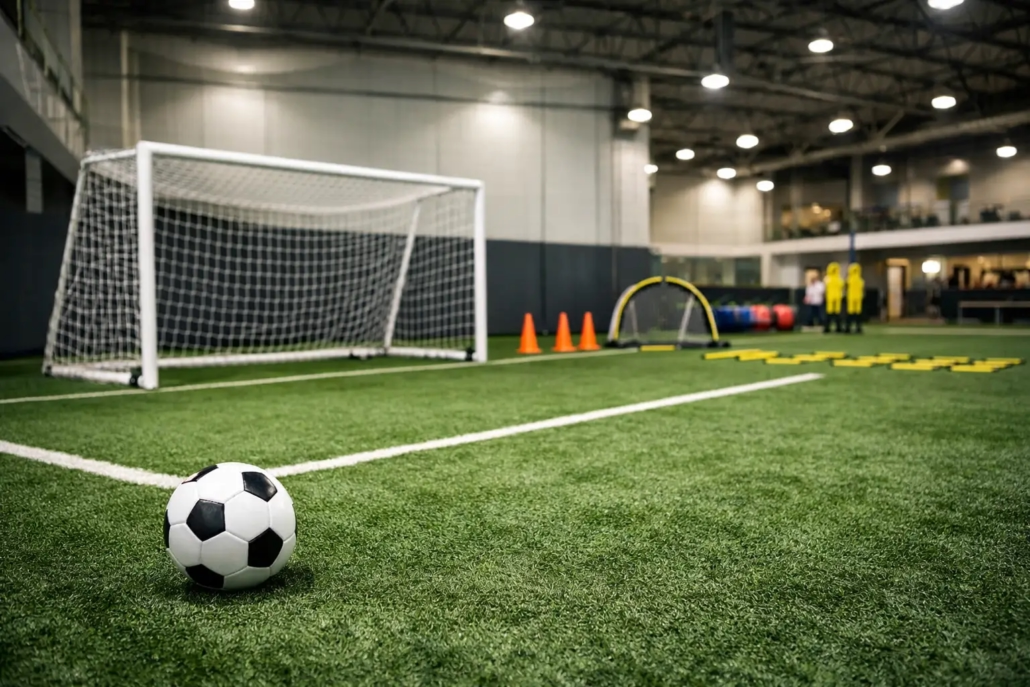
Bad weather should never be the reason a player falls behind. A serious indoor soccer training facility is not just a backup plan for winter or rainouts. It is a controlled performance environment where players can build technique, speed, decision-making, and confidence without losing weeks of development to the calendar.
That distinction matters more than most families realize. Plenty of indoor spaces offer turf, goals, and enough room to run a session. Very few are designed to develop players over time. If your goal is real progress, the standard cannot be whether a player gets touches. The standard has to be whether those touches are coached, measured, and connected to a larger development plan.
What an indoor soccer training facility should actually do
At the youth level, environment shapes habits. If the facility is organized around convenience alone, players get activity. If it is organized around development, players get better. Those are not the same thing.
A true indoor soccer training facility should create repeatable conditions for improvement. The field quality matters. The layout matters. The ability to train year-round matters. But the biggest separator is whether the space supports intentional work. Technical repetition, cognitive reaction, movement efficiency, and position-specific habits all improve faster when training is structured and distractions are reduced.
For younger players, that structure builds comfort with the ball and confidence in movement. For older and more competitive players, it creates a place to sharpen details that often get missed in team sessions – first touch under pressure, speed of play, finishing mechanics, scanning, acceleration, and recovery patterns. Indoor training is valuable because it compresses learning when it is done correctly.
Coaching matters more than the turf
Parents often start by comparing facilities based on size, location, or appearance. Those things matter, but they are not the main driver of results. Coaching quality is.
An impressive space with low-level instruction becomes expensive field time. A disciplined coaching staff with a clear methodology can turn a training block into measurable growth. That is why families should look closely at who is leading sessions, how groups are organized, and whether there is an actual progression model behind the program.
The best facilities do not run the same session for every age and level. A 6-year-old learning coordination and comfort on the ball needs a very different coaching approach than a 15-year-old winger trying to improve change of direction, finishing consistency, and speed of decision-making in tight spaces. Good coaching recognizes those differences and trains accordingly.
There is also a difference between energy and instruction. Players may enjoy a loud, fast session, but enjoyment alone does not equal advancement. Serious coaching includes correction, repetition, standards, and accountability. It gives players a reason for each exercise and a target to hit within it.
Technology should support development, not distract from it
The strongest modern indoor facilities use technology well, but not for show. Tools only matter when they create feedback a coach can apply.
That is where development becomes more precise. Ball-striking systems, reaction-based training stations, and speed platforms can reveal details the eye misses or confirm what a coach is seeing. A player may feel sharper, but measured data can show whether passing speed improved, reaction time dropped, or movement efficiency changed over a training cycle.
This is especially valuable for ambitious players who want proof of progress and for parents who want to understand what their investment is producing. It also helps keep development honest. Sometimes a player looks busy in training but is not actually improving in the areas that matter most to game performance.
There is a trade-off, though. Technology should never replace coaching judgment. A screen cannot teach timing, courage, composure, or game understanding on its own. The best indoor environments combine data-backed tools with experienced coaches who know how to turn feedback into training decisions.
Why year-round indoor training changes the development curve
Consistency is one of the biggest advantages an indoor setting provides. Development in soccer is rarely limited by effort alone. More often, it is limited by interruptions. Weather cancellations, frozen fields, inconsistent field access, and uneven practice environments all slow momentum.
A year-round indoor soccer training facility removes those interruptions. Players can train on schedule, maintain rhythm, and stack quality sessions over time. That matters because skill development is cumulative. First touch improves through thousands of quality repetitions. Speed of play improves when players repeatedly solve the right problems under the right pressure.
For young athletes, consistency also builds trust. They know where they are training, what is expected, and what progress looks like. For older players balancing school, team schedules, and seasonal shifts, reliable indoor training becomes a way to stay sharp when outdoor environments become less dependable.
In a market like Columbus, Ohio, where weather can interfere with outdoor plans for long stretches, indoor consistency is not a luxury. For families serious about development, it is often the difference between maintaining progress and restarting it every few months.
The best facilities create a pathway, not just sessions
One of the clearest signs of quality is whether the facility offers a progression from entry-level training to advanced performance work. Families should be able to answer a simple question: if my player improves, what comes next?
That pathway matters because players do not stay in the same developmental stage for long. A beginner may need basic coordination, confidence, and ball mastery. A more advanced player may need small-group technical work, private correction, cognitive training, and sports performance support. If the facility cannot meet players at different stages, families eventually outgrow it.
A strong training environment creates that progression intentionally. Younger players are introduced to the game in a way that builds enjoyment and movement quality. Developing players learn technical discipline and tactical habits. Advanced athletes get more specialized work tied to performance demands, competitive goals, and even college preparation.
This is where serious academies separate from general-use indoor centers. They are not renting out space and hoping development happens inside it. They are building an ecosystem where each stage prepares players for the next one.
What parents should evaluate before committing
The right fit depends on the player, but a few standards should be non-negotiable. Parents should look for coach credentials, clear age and level groupings, and evidence that the training is designed rather than improvised. They should also ask how progress is tracked. If a facility cannot explain how it develops players over time, that is a warning sign.
It is also worth paying attention to session structure. Are players standing in lines for long stretches, or are they engaged with purposeful repetitions? Is there individual feedback, or are coaches simply managing activity? Does the environment feel disciplined and focused, or casual and unfocused?
For competitive players, another key question is whether the facility can address specific needs beyond general technical work. That might include speed development, 1-on-1 finishing, cognitive reaction training, or individualized support during recruiting years. Not every player needs every service, but serious athletes usually need more than one lane of development.
Parents should also be realistic about goals. Not every child needs elite-level volume at every age. Sometimes the right environment is the one that builds confidence and foundation first. Other times, especially for players with competitive ambitions, a higher-performance setting is exactly what accelerates growth. It depends on readiness, commitment, and the quality of the coaching relationship.
Why the environment changes confidence
Confidence in soccer is often treated like personality. In reality, it is usually built through preparation. Players become more confident when they know what to do, have practiced it under pressure, and can repeat it consistently.
That is why a serious indoor facility can have such a strong impact. It gives players controlled exposure to the skills and decisions that show up in games. As technique becomes cleaner and reactions become faster, confidence starts to look less like emotion and more like evidence.
At Soccer Field Academy, that performance mindset is central to the training environment. Players are not asked to hope they improve. They are expected to work, be coached, and build progress that can be seen.
The right indoor soccer training facility should make that process clearer, not more confusing. It should help families understand where a player is, what needs work, and what the next stage of development requires. When a facility can do that consistently, it becomes far more than an indoor field. It becomes a place where serious players build the habits that carry forward long after the session ends.

