
Youth Soccer Development Pathway: A Parent’s Guide (Columbus, OH)
The mistake most families make is not starting too late. It is treating every year of training like it should look the same. A real youth soccer development pathway guide helps parents and players understand what should be trained, when it should be trained, and how to tell whether development is actually happening.
That matters because youth soccer is full of noise. One program promises fun. Another promises elite results. A team environment may improve game experience but leave technical gaps untouched. A private trainer may sharpen skills but miss the tactical side. The right pathway is not about chasing the label with the most prestige. It is about matching the player’s age, readiness, ambition, and training load to the next step that makes sense.
What a youth soccer development pathway guide should actually do
A useful pathway is not a marketing chart with arrows pointing upward. It should give families a progression model. Early stages should build coordination, confidence, and comfort on the ball. Middle stages should organize technical repetition, decision-making, and speed of play. Later stages should raise standards around position-specific detail, athletic development, competitive habits, and college or high-level team preparation.
The key is that each phase has a different job. If a 6-year-old trains like a 16-year-old, the process gets forced. If a 15-year-old is still only doing general beginner activities, development stalls. Good coaching recognizes that long-term player growth is sequential. The next layer works best when the previous one is stable.
Stage 1: Early exposure and movement literacy
For very young players, the first objective is not tactical sophistication. It is body control, balance, coordination, rhythm, and a positive relationship with the ball. At this age, the best training environments are structured but simple. Players should dribble often, change direction, strike the ball in different ways, and learn to move with confidence.
Parents sometimes underestimate this phase because it does not always look advanced. But this is where athletic habits begin. A player who learns to decelerate, turn, react, and stay balanced has a stronger foundation for every future skill. Confidence matters here too. When young players enjoy the process and feel capable, they engage more fully and learn faster.
The trade-off is that too much pressure too early can backfire. A serious environment is valuable, but seriousness at this age should mean quality coaching and clean structure, not constant correction or outcome obsession.
Stage 2: Building technical habits that hold up in games
Once players have basic comfort with movement and the ball, technical development has to become more deliberate. This is the stage where first touch, passing quality, ball striking, dribbling under pressure, and receiving across the body begin to separate players.
This is also where many families discover that games alone are not enough. Match play teaches application, but it does not produce the high-volume repetition required to clean up technique. A player may touch the ball only a limited number of times in a game. In a focused training session, that player can repeat a movement pattern dozens or hundreds of times with correction.
That does not mean every player needs private training immediately. It does mean players need a structured technical environment somewhere in their week. For some, academy training is enough. For others, especially players with competitive goals or visible weaknesses, a mix of group training and 1-on-1 work is often more effective.
Stage 3: Decision-making, speed of play, and tactical growth
As players move into later elementary and middle school years, technical ability must start functioning at game speed. This is where soccer intelligence becomes more visible. Can the player scan before receiving? Can they play quickly under pressure? Can they recognize space, solve problems, and execute without extra touches?
A lot of players plateau here because they trained technique in isolation but never learned to process information fast enough. Strong development environments address both. Technical repetition still matters, but now it should be tied to perception, timing, angles, and choices.
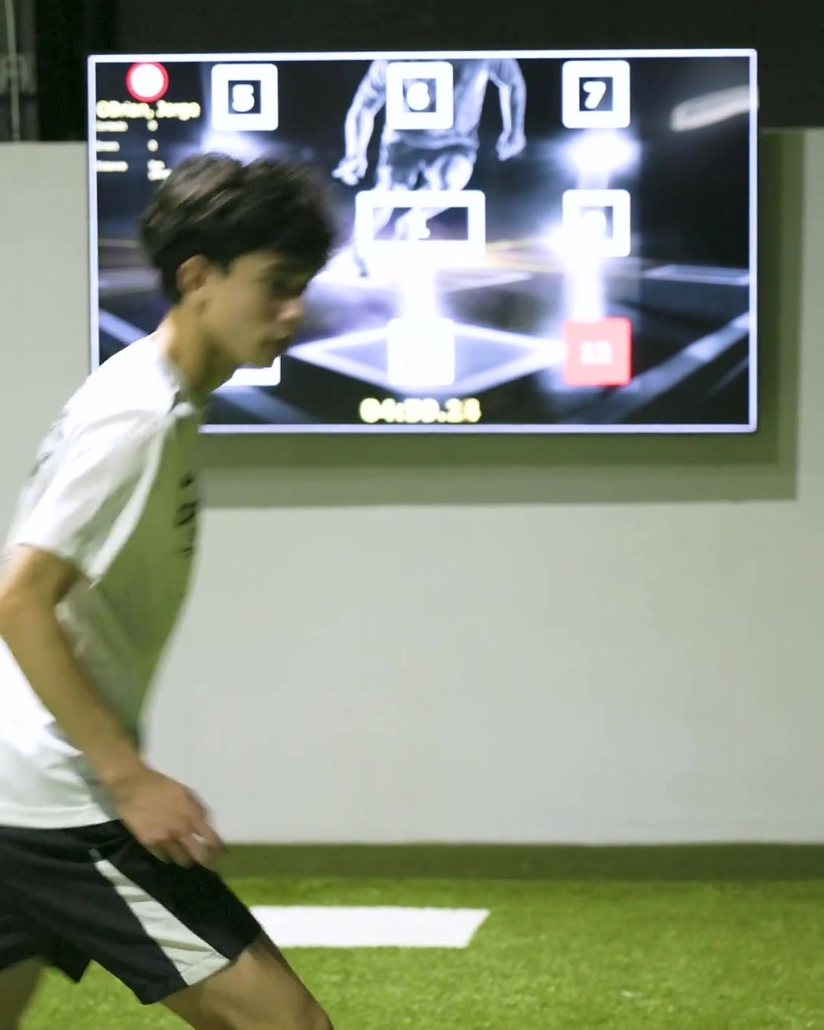
Technology can help in this phase when it is used with purpose. Tools that measure reaction time, speed, footwork, and passing accuracy can expose gaps that casual observation misses. The value is not the machine itself. The value is objective feedback. When players can see measurable progress, standards get clearer and motivation gets more mature.
Stage 4: Performance training and competitive separation
By the teenage years, the pathway becomes more individualized. Not every player is aiming for the same level, and not every player should train the same way. Some need technical rebuilding. Some need speed and power work. Some need tactical refinement tied to their position. Some need higher-level training groups that raise the daily standard.
This is the point where discipline becomes a separator. Serious players usually need more than team training. They need intentional supplemental work that addresses what their club sessions do not. That could include private technical sessions, small-group positional work, sports performance training, or cognitive-speed training.
There is an important balance here. More training is not always better if quality drops or fatigue climbs. Parents should look at the full weekly load. A player doing four team sessions, one game, and two private sessions may improve quickly if recovery, nutrition, and school-life balance are managed well. The same schedule can also become counterproductive if the player is constantly tired or mentally flat.
How parents can evaluate the right next step
The best pathway decisions are usually made by asking better questions. Is the player confident on the ball, or just active? Are they improving because the environment is challenging, or just because they are bigger and faster than peers right now? Are weaknesses being identified and addressed, or ignored because the player is surviving in games?
Parents should also distinguish between participation and development. Participation has value. It builds enjoyment, friendships, and game exposure. But development requires progression. That means the training should become more demanding as the player grows. It should also become more specific.
One useful benchmark is whether progress can be seen in concrete ways. Is the first touch cleaner than three months ago? Is weak-foot use increasing? Is the player scanning more often? Is change-of-direction speed improving? Vague praise is easy to give. Real development leaves evidence.
A practical youth soccer development pathway guide for training choices
For younger beginners, one or two well-run sessions per week may be enough if they are active, engaged, and learning core movement patterns. For developing players in the skill-building years, a combination of team play and structured academy training often creates the best balance. For advanced players, the strongest pathway usually includes layered support: team training for competition context, specialized technical work for precision, and performance training for speed, power, and durability.
It also depends on the player’s goals. A recreational player does not need the same pathway as a player targeting top club placement or college soccer. Neither goal is wrong. What matters is honesty. Families waste time when they say they want elite outcomes but train with a recreational standard, or when they overload a player who simply wants to enjoy the game and improve steadily.
In Columbus, Ohio, that clarity matters because families have options. The strongest programs stand out by offering progression rather than random sessions – from introductory stages for young players to higher-accountability environments that use licensed coaching, indoor consistency, and measurable tools to move serious athletes forward.
What the best pathway looks like over time
A strong pathway does not rush kids past fundamentals, but it also does not let them stay comfortable for too long. It introduces the right pressure at the right time. It builds confidence first, then competence, then consistency, then competitive sharpness.
That progression is rarely perfectly linear. Players hit growth spurts, confidence dips, team changes, and plateaus. Some need extra technical work after making an elite team. Others need to step back, rebuild habits, and then push forward again. That is normal. Development is not a straight climb. It is a managed process.
The families who handle it best tend to focus less on short-term labels and more on long-term standards. They want coaches who can explain why a player is in a certain stage, what must improve next, and how training will produce that change. That is where real trust comes from.
If you want a player to grow year after year, choose environments that make progress visible, expectations clear, and hard work non-negotiable. The right pathway should not just keep a player busy. It should move them forward with purpose.
Summer Camps · Columbus, OH · Filling Now
Put the pathway into action this summer.
A week of real development — technical work, SoccerBot360, Speed Court, and licensed coaching — in the only facility of its kind in Columbus. Small rosters, structured progression, every age and level.
See Camp Dates & Register →Questions? Call or text (614) 300-0016

