
How to Improve Ball Control in Soccer
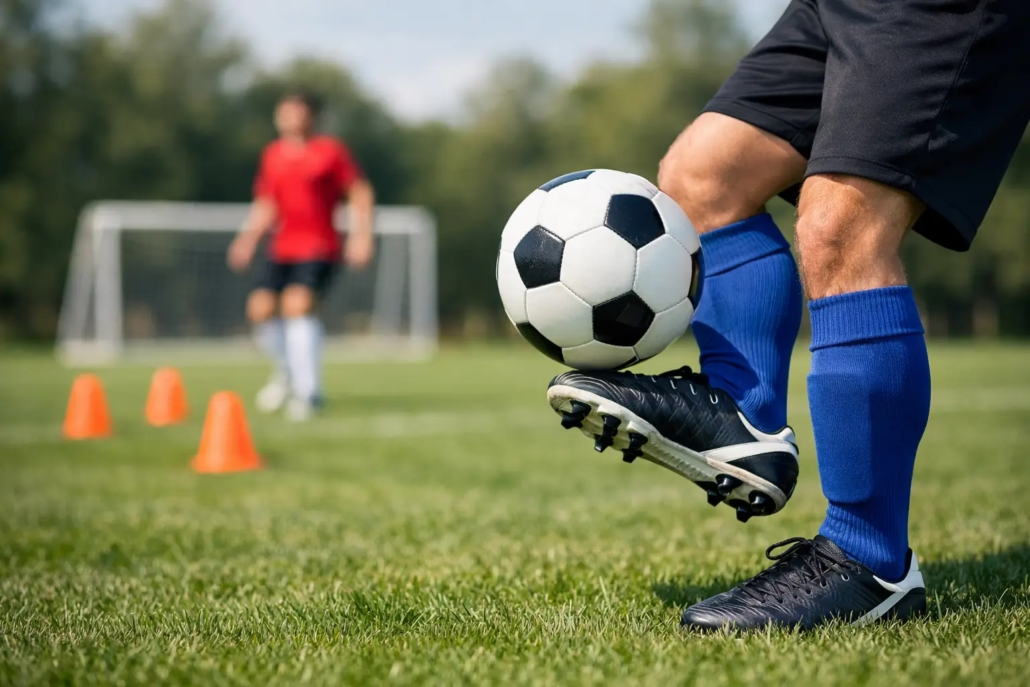
The first touch tells the truth. It does not care how fast a player is, how strong they look, or how many games they have played. If the ball gets away on the first contact, the next action is already harder. That is why players and parents constantly ask how to improve ball control – because better control changes everything from confidence under pressure to speed of play in real matches.
Ball control is not just “soft feet.” It is the ability to receive, settle, move, and protect the ball with purpose. The best young players do this early, quickly, and repeatedly. They do not need extra touches to solve simple moments. They create time because their touch is clean.
What ball control actually means
A lot of players think ball control is just juggling or dribbling through cones. Those tools can help, but true control is broader than that. It includes receiving with different surfaces, adjusting the ball into space, keeping it close at speed, and handling pressure without panic.
For younger players, ball control starts with coordination and comfort. Can they stop the ball cleanly? Can they move it without staring down every touch? For older and more competitive players, the standard rises. Can they receive on the half-turn, take the ball away from pressure, and prepare the next pass or shot in one or two touches?
This is where development gets more serious. A player can look sharp in isolated drills and still struggle in games if their control breaks down under speed, fatigue, or decision-making pressure. Good training has to challenge all three.
How to improve ball control with the right training focus
If you want to know how to improve ball control, start by changing the goal. Do not train just to complete drills. Train to make each touch intentional.
That means every repetition should answer a question. Was the touch too heavy? Did the player use the right surface? Did the ball move into useful space, or just away from the body? Did the eyes come up after contact? Players improve faster when training is measured by quality, not just volume.
The other key is consistency. Ball control responds to frequent, focused work better than occasional long sessions. Fifteen to twenty minutes of sharp technical repetition done four or five times a week will usually beat one casual marathon session on the weekend.
There is also an age and stage component. A 7-year-old needs different corrections than a 16-year-old. Younger players often need rhythm, balance, and basic foot-eye coordination. Advanced players need tighter margins, faster processing, and more pressure-based reps. The mistake many families make is using advanced drills before the foundation is stable.
First touch comes before fancy moves
The fastest way to raise a player’s level is usually to improve the first touch. Every second touch depends on it.
Start with clean receiving mechanics. The ankle should be firm but not rigid. The receiving surface should be slightly relaxed to cushion the ball. The body should get behind the line of the pass when possible. Most importantly, the touch should have a direction. Dead stopping the ball has its place, but in match play, the first touch should often help the next action.
A simple wall can be an excellent teacher here. Pass with one foot, receive with the other, then switch surfaces. Inside, outside, laces, sole. The point is not to mindlessly hit the ball against the wall 200 times. The point is to receive with control and shape the body as if pressure is coming.
Players who want elite-level progress should practice receiving across the body, opening up to play forward, and taking the ball into space with the first touch. That is where the game speeds up.
Close control is about balance, not just fast feet
Many players hear “ball control” and immediately think of quick touches. Fast feet matter, but only when they are connected to posture, balance, and coordination.
When the upper body is out of control, the touches usually are too. Players need a low athletic stance, bent knees, and the ability to shift weight efficiently. If they are upright and stiff, the ball will bounce away under pressure.
This is why quality footwork training matters. Quick coordination patterns can improve rhythm and body control, but they should connect back to the ball. Add a ball to movement patterns. Change direction after every few touches. Use both feet. Work the inside and outside of the foot in tight spaces. Keep the ball close enough to change plans quickly.
There is a trade-off here. Some players train only tiny touches and become neat but slow. Others push the ball too far in the name of speed and lose possession. Real progress comes from learning when to keep the ball glued to the foot and when to let it travel slightly into space.
How to improve ball control under pressure
This is where many players separate themselves. Ball control in an empty space is one level. Ball control with a defender closing, limited time, and the wrong bounce is another.
To improve this part of the game, training needs pressure. That can mean a live defender, a tight grid, a time limit, or a requirement to scan before receiving. The player has to feel that the touch matters.
One strong progression is to go from unopposed to passive pressure to live pressure. First, train the technique. Then add a defender who shades one side. Then make it fully competitive. This builds confidence without skipping steps.
Cognitive demand is just as important. Players should be checking shoulders before the ball arrives. They should know where the next pass or dribble lane is before the first touch. Advanced training tools can accelerate this because they force reaction, timing, and precision at game speed. When a player combines technical repetition with decision-making, the transfer to match play gets much stronger.
The best drills are the ones players can repeat correctly
Players do not need 25 drills. They need a handful of excellent ones done with discipline.
A strong weekly plan should include receiving and passing off a wall, tight-space dribbling with both feet, directional first-touch work, turns under pressure, and ball mastery patterns that challenge rhythm and coordination. Add finishing or passing only after the touch quality stays sharp.
Juggling can help, but it should not be overrated. It improves feel and concentration, especially for younger players, yet it does not replace receiving driven balls, controlling on the move, or solving pressure in realistic spaces. It is one tool, not the full answer.
Parents should also know that more reps are not always better if technique is sloppy. Once players get tired, quality can drop fast. Shorter, more focused blocks usually produce cleaner learning than long sessions filled with bad touches.
Why environment matters more than most families realize
A player’s training environment has a direct effect on ball control. Surface quality, coaching detail, repetition volume, and feedback all matter.
If the training space is inconsistent, touches become survival-based. If the coaching is vague, players repeat errors. If the session lacks structure, the player may work hard without actually improving the specific skill.
That is why serious technical development benefits from a professional environment where players can get a high number of quality touches and immediate correction. At Soccer Field Academy, that process is strengthened by licensed coaching, a clear progression model, and technology-based training that helps players sharpen touch, reaction, and execution with measurable intent.
For families in Columbus, Ohio, indoor consistency can be a major advantage. Players improve faster when weather does not interrupt their technical work for weeks at a time.
What parents should watch for
Parents do not need to analyze every detail, but they can spot progress if they know what to look for. Watch whether the player’s first touch stays within playing distance. Watch whether they need fewer recovery touches. Watch whether they can use both feet, especially when receiving under pressure.
Confidence is another clue. Players with stronger ball control ask for the ball more often. They are calmer in tight spaces. They make cleaner decisions because their touch gives them options.
Improvement is rarely linear. A player may look great in training, struggle in games for a few weeks, and then suddenly settle into a higher level. That is normal. Development is built through repetition, correction, and patience.
The standard, though, should stay high. Ball control is not a cosmetic skill. It is one of the clearest indicators of a player’s technical ceiling. Train it seriously, and the rest of the game becomes more available.
Keep the goal simple: one better touch at a time, done with discipline, until control becomes a habit instead of a hope.
