
Indoor Soccer Training for Winter That Works
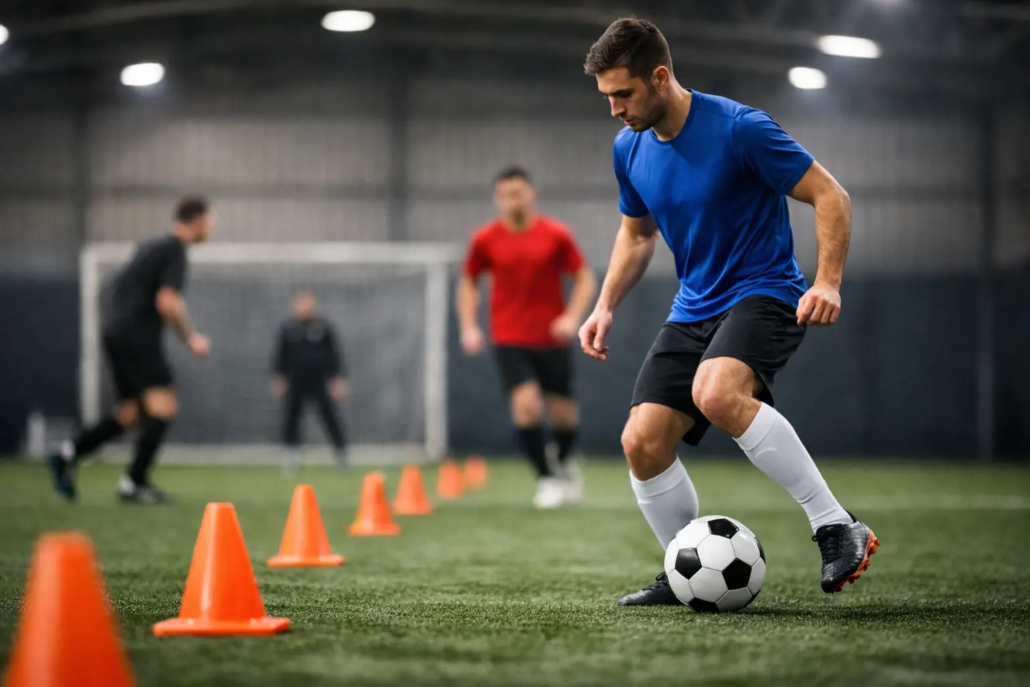
Winter exposes every gap in a player’s development. When field space disappears, team sessions get canceled, and touches drop off, progress slows fast. That is exactly why indoor soccer training for winter matters – not as a backup plan, but as a serious phase of player development where technique, speed, and decision-making can improve with more consistency than they often do outdoors.
For families, the question is not whether players should train in winter. It is whether that training is structured enough to produce visible results. The best winter work is not random futsal-style scrimmaging every week and it is not conditioning for the sake of conditioning. It is targeted training in a controlled environment where repetition, coaching, and measurable standards all work together.
Why indoor soccer training for winter matters
Outdoor seasons reward athleticism and game energy. Winter should reward precision. When weather removes distractions, strong indoor training can isolate the details that separate average players from confident, reliable ones under pressure.
That starts with ball mastery. In smaller indoor spaces, players get more touches in less time. They are forced to clean up first touch, tighten dribbling mechanics, and play faster in compact areas. For younger players, that creates comfort on the ball. For advanced players, it sharpens execution at game speed.
It also improves cognitive speed. Good indoor sessions create more decisions per minute than many outdoor practices. The ball moves quickly, pressure arrives early, and players must scan, receive, adjust, and release with intent. That is not just technical growth. It is game intelligence training.
Then there is consistency. Winter often becomes the season where players either build momentum or lose it. A structured indoor environment removes the unpredictability of frozen fields, canceled practices, and long breaks between meaningful touches. Development responds to repetition. Repetition requires access and discipline.
What effective indoor soccer training for winter should include
Not all indoor training produces the same outcome. The difference is in the session design.
A strong winter program should prioritize technical repetition first. Players need large volumes of quality touches under coaching, not just free play. That means work on receiving across the body, turning out of pressure, finishing in tight windows, passing on proper weight, and striking through the ball cleanly. If those details are not being coached, players may stay active without actually improving.
The second layer is speed and movement. This is where many programs miss the mark. Winter training should not turn into distance running indoors. Soccer speed is about reaction, acceleration, body control, and repeatable movement patterns. Short explosive actions matter more than generic fatigue.
The third piece is decision-making. Players need training environments that force choices. One-touch and two-touch restrictions, directional possession, transition moments, and small-sided pressure all create better habits. A player who can execute in a smaller, faster environment usually carries that confidence into the spring.
Finally, there has to be progression. A six-year-old beginner does not need the same winter workload as a sixteen-year-old preparing for high-level competition or college exposure. Training has to match age, stage, and ambition. That sounds obvious, but many families end up in generic sessions that treat all players the same. Serious development does not work that way.
The biggest mistake parents make in winter
The most common mistake is choosing activity over development. A player can be busy all winter and still enter spring unchanged.
Games alone are not enough. Indoor leagues can be helpful for rhythm, confidence, and competitiveness, especially for younger players. But league play does not replace coached repetition. If a player struggles with first touch, weak-foot passing, speed of play, or finishing mechanics, those issues usually do not fix themselves in games. They get exposed in games.
The second mistake is overloading the calendar. More sessions are not always better if intensity and quality are poorly managed. Younger players need engagement and fundamentals. Competitive middle-school and high-school players may need a more demanding mix of technical work, speed development, and position-specific repetition. It depends on the player’s age, training history, and in-season demands.
Parents should also pay attention to environment. Indoor space can be excellent for development, but only if the coaching is organized and the standards are high. If sessions are chaotic, lines are long, or players spend more time waiting than working, winter becomes expensive maintenance instead of meaningful growth.
How to choose the right winter training environment
Start with coaching. Strong coaches do more than keep sessions moving. They correct body shape, passing angles, receiving detail, timing, and decision speed. They know when to demand more and when to simplify. Credentials matter, but so does the ability to teach in a way that produces visible progress over time.
Next, evaluate the structure. Good winter training has a clear objective. One session may emphasize first-touch quality under pressure. Another may center on finishing from quick combinations. Another may focus on acceleration and reaction speed. Players should not leave guessing what they worked on.
Technology can also add value when it supports coaching rather than replacing it. Tools that track reaction time, foot speed, passing accuracy, or cognitive response can make development more measurable. For serious players and invested parents, that matters. It gives context to improvement and helps identify where the next gains should come from.
Facility quality matters too. A professional indoor environment creates better repetition, safer footing, and more reliable scheduling. That reliability is one of the biggest advantages of winter indoor work. Families can build routines around it, and players can train without losing weeks to weather.
For players in Columbus, Ohio, that consistency becomes even more valuable once winter weather starts disrupting outdoor sessions regularly.
Building a winter plan by age and level
Younger players need confidence first. Ages 2 to 7 benefit most from movement quality, coordination, balance, basic ball familiarity, and a positive rhythm with the game. Winter should help them enjoy the ball and build habits, not feel like a pressure-filled performance test.
For developing players in the 8 to 12 range, winter is often the best time to tighten technical weaknesses. This age group can make major gains in dribbling control, passing cleanly with both feet, first touch, and body mechanics. Because they are still highly coachable, consistent indoor repetition can create visible improvement by spring.
For serious players from 13 to 18, the standard should rise. This is where winter training should become more individualized and more demanding. Position-specific work, quicker decision-making, explosiveness, finishing repetition, and high-speed technical execution all matter. Older players do not just need more work. They need better work.
That is also why a progression model matters. A player should be able to move from foundational training into more advanced technical and performance-based sessions as goals change. Soccer Field Academy is built around that kind of long-term pathway, with age-specific programming, private coaching options, and measurable tools that support both developing and elite players.
What results should families expect by spring
The right winter training should show up quickly, but not always in flashy ways at first.
A player may look calmer receiving under pressure. Their weak foot may become usable instead of avoided. Their touches may be cleaner, their movement sharper, and their confidence more stable. Those are real gains. By spring, those details often become the difference between chasing the game and influencing it.
Physical changes can show up too, especially with speed and reaction training. Players who spend winter improving acceleration, coordination, and body control often look more explosive when outdoor play returns. But the biggest payoff is usually trust in their own game. When players have trained with discipline all winter, they enter the next season prepared rather than hoping to play themselves into form.
That matters for every level. Recreational players enjoy the game more when they feel capable. Competitive players earn more consistent minutes when execution improves. High-level players separate themselves when winter becomes a development phase instead of downtime.
Winter does not have to be a holding pattern. For players who train with purpose, it can be the most productive stretch of the year. The cold months are where confidence gets built quietly, one corrected touch and one sharper decision at a time.