Player Development Training for Soccer That Works
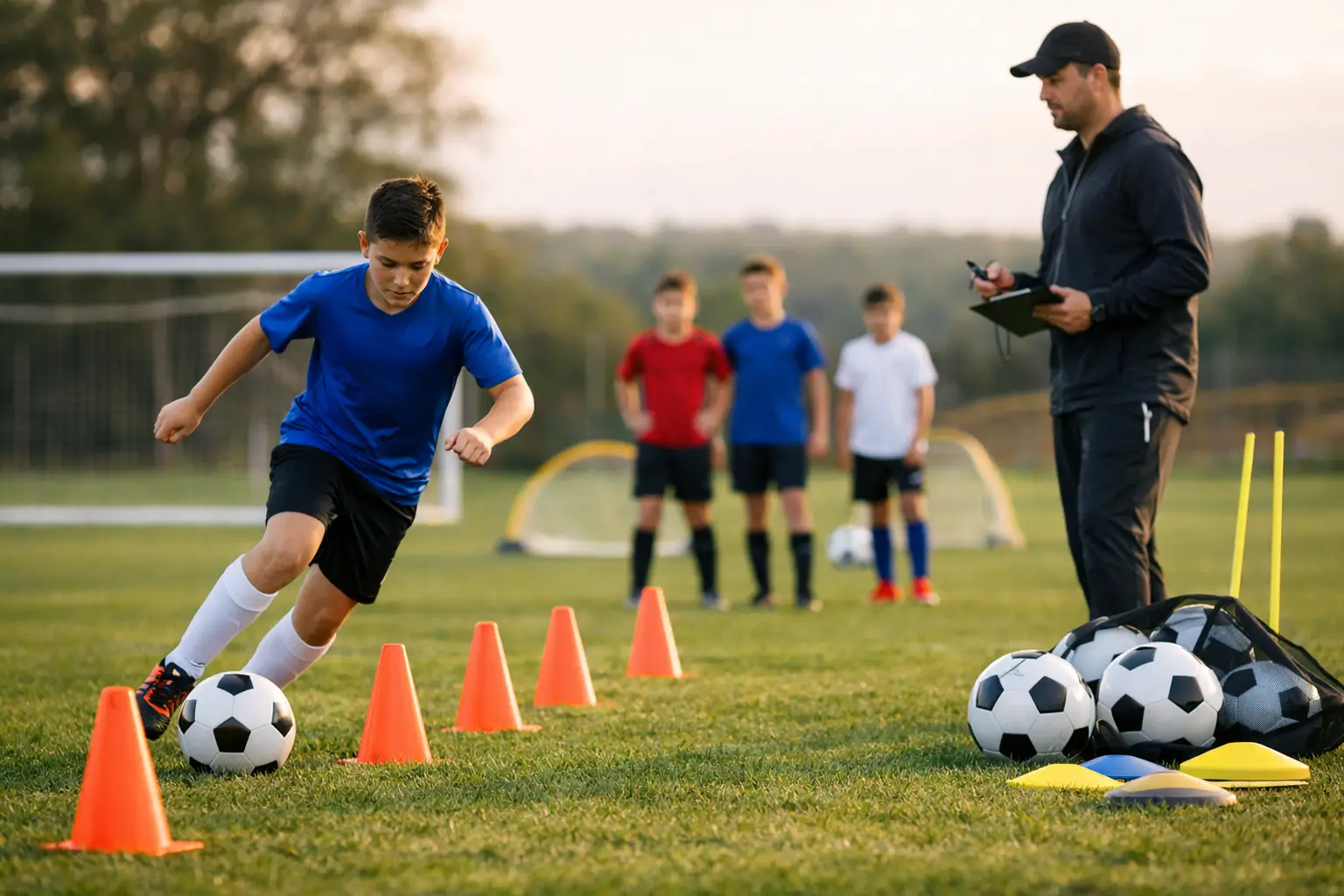
A talented player can still stall out fast when training lacks structure. That is the gap player development training for soccer is supposed to close. Not by piling on random drills, but by building technical quality, game intelligence, physical capacity, and confidence in the right order.
Parents usually see the surface first. A player looks busy in training, gets plenty of touches, maybe even sweats hard for an hour. But activity is not the same as development. Serious growth comes from a system that identifies what the player needs now, what comes next, and how progress will be measured over time.
What player development training for soccer should actually do
Good training does more than tire players out. It should improve execution under pressure, sharpen decision-making, and raise the standard of repeatable actions. That means the player is not just learning how to pass, receive, turn, or finish in isolation. They are learning when to use each action, how quickly to recognize the moment, and how to perform it cleanly at game speed.
That is where many players get stuck. They may look sharp in open technical sessions but break down once the tempo rises. Their first touch gets loose. Their scanning drops. Their body shape closes off options. Their speed shows up in straight lines but not in changes of direction or reaction moments. Real development addresses those weak links instead of hiding them.
For younger players, that process starts with balance, coordination, rhythm, and comfort on the ball. For older and more ambitious players, the standard gets tighter. Technical precision has to hold up under pressure. Tactical understanding has to become faster. Physical training has to support soccer movement, not just general fitness. It depends on the age and level, but the principle stays the same: build the athlete and the soccer player together.
The difference between repetition and progression
A lot of youth training is built on repetition alone. There is value in repetition, especially with foundational technique. But repetition without progression creates players who can perform familiar patterns and struggle in unfamiliar moments.
Progression means the session evolves with the player. A simple receiving pattern becomes receiving on the half-turn. Then it becomes receiving with a defender closing space. Then it becomes receiving while scanning a second option and playing the correct next action. The skill stays connected to the game.
The same applies to speed and athletic work. Running hard is not enough. Soccer-specific speed development includes acceleration mechanics, deceleration control, reaction timing, and multidirectional movement. A player who can stop, re-accelerate, and change direction efficiently is often more effective than a player who only tests well in a straight sprint.
This is also why measurable tools matter when used correctly. Technology should not replace coaching, but it can expose details the eye misses and give players objective feedback. Passing speed, reaction time, footwork efficiency, and decision speed become easier to track when training includes data-backed systems rather than guesswork.
The core pillars of effective soccer development
Technical quality
Every level of player needs technical work. The difference is the standard. Young players need clean fundamentals and confidence on the ball. Competitive players need tighter touches, cleaner striking, faster release, and two-footed competence. Elite players need those same skills under stress, fatigue, and pressure.
Technical quality should show up in first touch, passing range, ball striking, finishing, dribbling control, and receiving angles. It also has to be coached with detail. Where is the standing foot? Is the player receiving across the body? Are they scanning before the ball arrives? Are they using the correct surface at the correct moment? Vague praise does not build elite habits. Specific coaching does.
Decision-making and cognitive speed
Soccer is a problem-solving game. Two players can have similar technique, but the one who reads the game faster usually looks better. That is why serious player development training for soccer has to include the cognitive side of performance.
This means teaching players to scan early, recognize pressure, understand spacing, and choose the right action quickly. It also means exposing them to game-like problems instead of over-relying on static lines and scripted patterns. Players improve when they are forced to read cues, adapt, and execute.
Physical development for soccer
Strength, speed, coordination, and movement efficiency all matter. But they have to match the player’s stage of development. A 7-year-old does not need the same physical emphasis as a 16-year-old preparing for a high-level season or college pathway.
For younger athletes, the focus should be on movement literacy, balance, coordination, and body control. For older players, training can become more targeted: acceleration, change of direction, explosive power, injury resilience, and repeat-effort capacity. The goal is not bodybuilding. The goal is to build a more explosive, durable, and efficient soccer athlete.
Confidence built through competence
Confidence is often talked about as if it can be handed to players with encouragement alone. It cannot. Real confidence comes from preparation and proof. When players know they have trained the details, repeated the right habits, and seen measurable gains, confidence shows up naturally.
That matters in big moments. The player who has trained receiving under pressure is calmer when the game speeds up. The player who has built striking consistency is more decisive in front of goal. The player who has developed reaction speed and movement control is less likely to panic defensively. Confidence grows when performance becomes more reliable.
Why age-specific pathways matter
One of the biggest mistakes in youth development is treating all players the same. A preschool beginner, a motivated 10-year-old, and a serious high school athlete do not need the same environment. Their training should reflect different developmental priorities, different attention spans, and different performance demands.
For the youngest age groups, the focus should be enjoyment, body coordination, ball familiarity, and simple listening habits. This stage is about creating a base and making players comfortable in the environment. Too much tactical overload too early can do more harm than good.
As players move into elementary and middle school years, technical repetition becomes more intentional. This is the stage where clean habits can either be formed or missed. Players should be learning to strike properly, receive with purpose, dribble under control, and make basic decisions at speed.
For advanced teenagers, training has to become more demanding and individualized. Generic sessions often stop being enough. These players need precise feedback, position-relevant work, exposure to faster decision-making demands, and physical training that supports competitive performance. If college soccer is part of the goal, the margin for error narrows even more.
What parents should look for in a training environment
Not every soccer program is built for development. Some are built for convenience. Some are built to entertain. Some are built to keep players moving without ever identifying what actually needs to improve.
Parents should look for coaching credentials, training structure, and whether the environment has a real progression model. Does the program group players appropriately by age and level? Is there a clear difference between introductory training, academy-level repetition, private coaching, and elite pathways? Are players receiving correction with detail, not just encouragement? Is progress visible over time?
The training setting matters too. A professional indoor environment creates consistency, especially during weather disruptions and off-season months. That consistency is often the difference between players who maintain momentum and players who lose months of development. For families in Columbus who want year-round structure, that matters more than most people realize.
At Soccer Field Academy, that standard is built around licensed coaching, measurable training tools, and a progression model that serves players from first touches to high-performance preparation. That kind of structure is what turns ambition into actual improvement.
The role of private training within player development training for soccer
Private training is not necessary for every player, but it can be a powerful accelerator when used well. The key is purpose. Private sessions should target specific needs that group sessions cannot fully address, whether that is first-touch cleanup, finishing mechanics, position-specific movement, speed work, or confidence in tight spaces.
For some players, one-on-one training fills technical gaps that have been ignored in team settings. For others, it creates accountability and intensity. The trade-off is that private work should support the broader development plan, not replace game exposure or quality group training. Players still need to apply improvements in realistic environments.
The best results usually come from combining both. Group training develops rhythm, competition, and game-relevant decision-making. Private training sharpens the details. When those two pieces work together, development tends to move faster and hold up better in matches.
The best player development training is not flashy. It is disciplined, progressive, and demanding in the right ways. When players train in an environment that values detail, measures growth, and pushes each stage at the right time, improvement stops being a hope and starts becoming the standard.